By Staff Reporter
ISLAMABAD: Pakistan has branded India’s decision to suspend the Indus Waters Treaty “outlaw behaviour”, telling the United Nations that the move breaks international law, threatens the water supply of more than 240 million people and risks pushing the two nuclear-armed neighbours towards conflict.
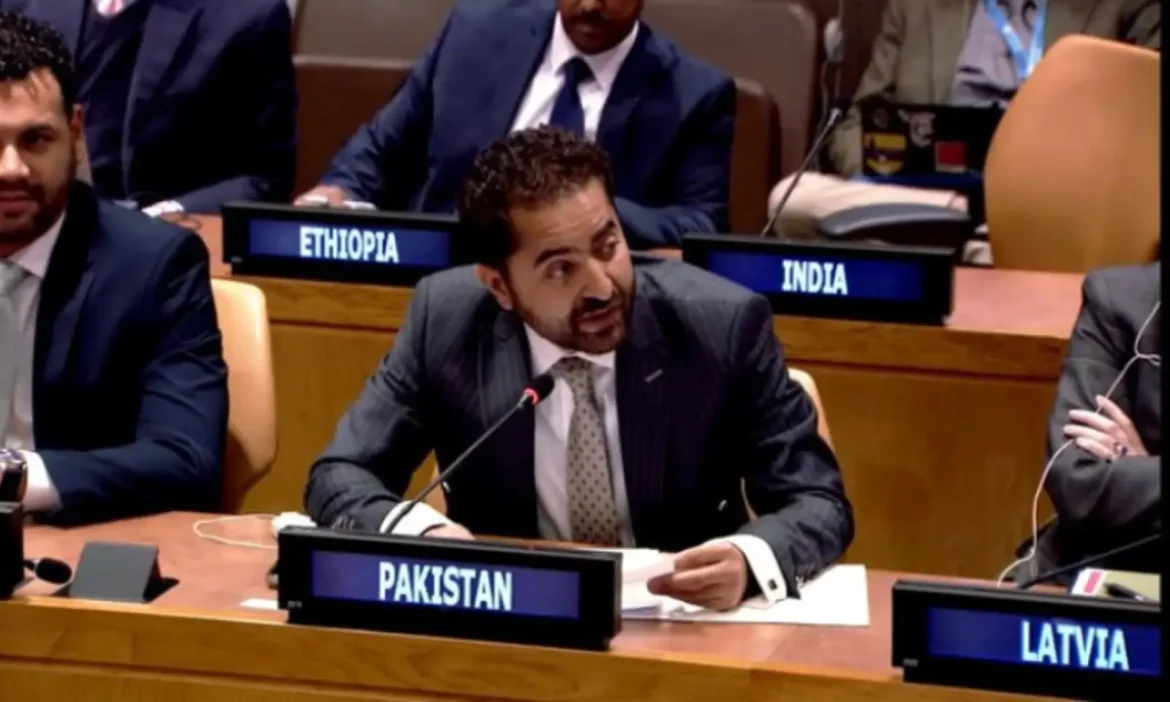
Ansar Shah, a first secretary at Pakistan’s mission, said on Wednesday that New Delhi was claiming the right to decide for itself when the 1960 agreement applied and on what terms it should operate.
“That is not treaty law; it is outlaw behaviour,” he said, replying to remarks by India’s representative.
Using the waters on which more than 240 million Pakistanis depend as a weapon, he said, was not a “reassessment” of the treaty but an act of coercion that created conditions conducive to conflict.
The exchange followed an informal Arria-formula meeting of Security Council members convened by Liberia on natural resources and conflict. India’s Permanent Representative, Harish Parvathaneni, defended the use of existing international mechanisms to manage resource disputes. He cited the Kimberley Process, which has helped curb the trade in conflict diamonds while protecting legitimate commerce.
Shah said India had met the treaty dispute with deflection and denial. The agreement, he said, contains no provision allowing either side to place it in abeyance. To India’s argument that the world has changed since 1960, he replied that the UN Charter is older still.
“Does India consider that outdated as well?” he asked, accusing New Delhi of ignoring Security Council resolutions on Jammu and Kashmir.
He alleged that Indian forces had killed more than 100,000 Kashmiris since 1989 and continued to suppress their fundamental rights and deny them self-determination.
Shah also dismissed what he called frivolous and inappropriate remarks by the Indian envoy on Pakistan’s domestic affairs, describing his country as a constitutional democracy where citizens are free to choose their leaders. He accused India’s ruling Hindutva establishment of promoting discrimination against minorities, suppressing free speech and inciting religious hatred, and urged New Delhi to abandon its “hubris” and honour its obligations under international law, treaties and Security Council resolutions.
Pakistan’s case had earlier been set out by Usman Jadoon, its deputy permanent representative, who accused India of seeking to weaponise water by putting the treaty in abeyance and threatening to stop river flows into Pakistan.
He pointed to the 31 August award of the Court of Arbitration, which found that the treaty remained fully in force and that India was still bound by its obligations. India rejected the ruling the same day, saying the tribunal was illegally constituted and had no jurisdiction over its sovereign decisions, and that the suspension would continue. The court had also dismissed the grounds India advanced to justify suspending or terminating the agreement.
No state, Jadoon said, should be allowed to use shared natural resources as an instrument of coercion or political pressure in breach of international law and binding treaty obligations. Citing Security Council Resolution 2788, he stressed the peaceful settlement of disputes under Article 33 of the UN Charter, and said respect for international law and mutually agreed arrangements was indispensable for transboundary waters.
India’s position has not shifted. It announced in April 2025, after the Pahalgam terror attack, that the treaty would be held in abeyance until Pakistan “credibly and irrevocably” abjures support for cross-border terrorism. It has since dismissed each ruling of the Court of Arbitration as illegitimate, calling the court’s May award on maximum pondage “null and void”. Pakistan had asked the court in March this year to determine the treaty’s present status.
The dispute has been brought to the UN repeatedly. In May, Pakistan’s ambassador handed the Security Council president a letter from Foreign Minister Ishaq Dar, urging the council to take up the suspension. In July, India told a Council debate that the treaty would remain in abeyance until Pakistan ended cross-border terrorism.
At Wednesday’s meeting, Jadoon also spoke more broadly about resource-related conflict. Natural resources, he said, should serve development, shared prosperity and peace rather than fuel exploitation. He warned that external interference, commercial interests, historical grievances, ethnic tensions, political exclusion and weak institutions could together turn resource wealth into a source of instability, and cited the Democratic Republic of Congo, where mineral riches have sustained conflict rather than prosperity.
He set out three priorities: tackling underlying political and governance failures; disrupting illicit financial flows through international cooperation; and ensuring that resource-rich developing countries benefit from investment, technology transfer, local processing and skills development. Developing nations, he argued, should be equal partners in global supply chains, not merely suppliers of raw materials. Transit and consuming states, multinational companies and financial institutions must also share responsibility through stronger traceability, responsible supply chains and information-sharing, he said.
Under the 1960 treaty, the eastern rivers, the Ravi, Beas and Sutlej, were allocated primarily to India. Pakistan received rights over the western rivers, the Indus, Jhelum and Chenab, subject to specified uses by India.
Copyright © 2021 Independent Pakistan | All rights reserved