By Staff Reporter
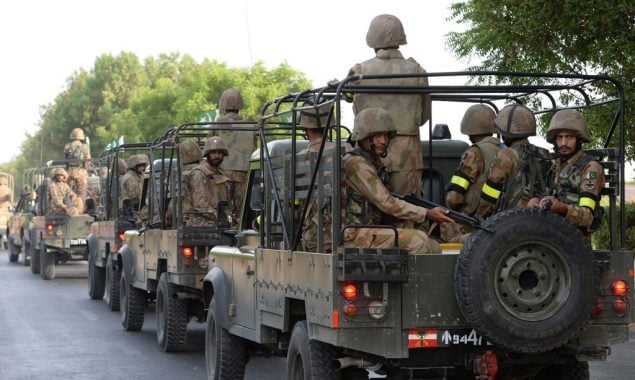
ISLAMABAD: Pakistan’s military said its forces killed 22 militants in three districts of northwestern Khyber Pakhtunkhwa over two days, the latest in a succession of operations in a province where violence has risen sharply for four years.
The Inter-Services Public Relations (ISPR), the army’s media wing, said the fighting took place on 16 and 17 November. Fifteen of the dead were killed in an intelligence-based operation in South Waziristan, six in two separate encounters in Bannu, and one in Tank.
“During the conduct of the operation, own troops effectively engaged khawarij location and, after intense exchange of fire, 15 khawarij belonging to Indian-sponsored Fitna-al-Khawarij were sent to hell,” the ISPR said in a statement on Thursday.
Fitna al-Khawarij is the label the Pakistani state applies to the banned Tehreek-e-Taliban Pakistan (TTP). Islamabad has long accused India of backing the group.
The ISPR said weapons and ammunition were recovered from the dead, who it said “remained actively involved in numerous terrorist activities in the area”.
“Sanitisation operations” were continuing, the military said, and its campaign under the “Azm e Istehkam” initiative, approved by the Federal Apex Committee on the National Action Plan, would go on “at full pace to wipe out the menace of foreign-sponsored and supported terrorism from the country”.
The announcement follows a run of similar operations. Last week the military said two soldiers and 16 militants, including two Afghan nationals, were killed in North Waziristan during operations lasting 12 hours. On 13 November, it said 74 militants had been killed in Balochistan and Khyber Pakhtunkhwa, among them 35 in Mir Ali and eight in Orakzai.
The figures sit against a worsening picture. The Armed Conflict Location & Event Data project (ACLED), a global monitoring group, recorded 2,425 attacks in Pakistan in 2025, almost four times the 658 logged in 2022.
The trend has continued this year. Two security reports presented to the federal cabinet in October found that militant incidents in Khyber Pakhtunkhwa had risen by 195 percent between March 2024 and September 2026. They also found that 73 percent of attacks recorded in the province in 2026 had targeted police and security personnel, and that drones and improvised explosive devices were an increasing threat.
The Centre for Research and Security Studies (CRSS) found that Khyber Pakhtunkhwa and Balochistan together accounted for nearly 96 percent of violence-related deaths in the second quarter of 2026. Khyber Pakhtunkhwa was worst affected, with 475 deaths, more than 61 percent of the national total, against 265 in Balochistan. It also recorded the most incidents, 151, or 57 percent of the total, ahead of Balochistan’s 94.
Pakistan has dated the surge to 2021, when the Taliban returned to power in Kabul, and accuses the Afghan authorities of letting the TTP operate from Afghan soil and stage attacks across the border. A United Nations Security Council monitoring report published in February backed Islamabad’s concerns. It said TTP attacks originating in Afghanistan had increased and that the group was being given greater freedom and support by the de facto authorities.
The dispute has also turned violent. Cross-border fighting this year ended a ceasefire brokered by Qatar and Turkey in October, after talks in Istanbul failed to produce a lasting agreement. The TTP announced a new campaign for 2026, which it named “Operation Khyber”.
Copyright © 2021 Independent Pakistan | All rights reserved