By Staff Reporter
KARACHI: Pakistan’s education minister has postponed a planned Karachi rally in support of new provinces after law enforcement agencies asked his party to reconsider, deepening a bitter row with a coalition partner over the possible division of Sindh.
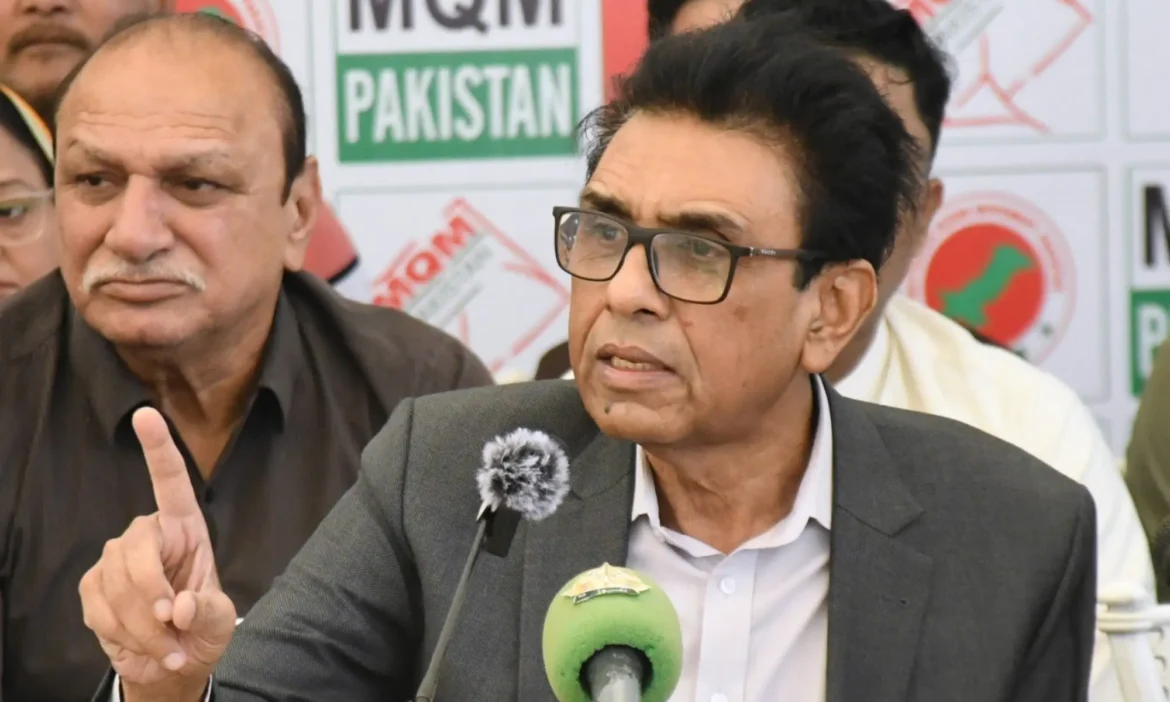
Khalid Maqbool Siddiqui, who chairs the Muttahida Qaumi Movement-Pakistan (MQM-P), said on Thursday that a new date for the demonstration would be announced after consultations within the party. It had been due to take place on Sharea Faisal on 29 November, the same day as a rival gathering against new provinces announced by the Sindh Taraqqi-pasand Party (STP). Siddiqui said law enforcement agencies had contacted the party and asked it to rethink the date in view of the prevailing law and order situation. Earlier this month, Karachi’s mayor, Murtaza Wahab, had urged the MQM-P to hold its event in a park rather than on Sharea Faisal.
The retreat from the street came after the most inflammatory exchange yet in the argument over whether Sindh should be carved up. Bilawal Bhutto Zardari, chairman of the Pakistan Peoples Party (PPP), which governs Sindh and shares the federal coalition with the MQM-P, said in a speech this week: “We talk about the garbage on Karachi’s streets, but if Sindh is divided, we will see blood flow through its streets.” He has said the PPP opposes division by force or without the consent of the people, and that any new province must follow constitutional and legal procedure. Asked a day later, he insisted he was not issuing a threat but warning of the likely reaction.
Siddiqui, speaking at the MQM-P’s Bahadurabad headquarters, treated it as a threat and called on the judiciary to take suo motu notice.
“Is this a threat?” he asked, urging the authorities to act against what he called provocation. Addressing Bhutto Zardari directly, he said: “If the demand was for the creation of provinces in all of Pakistan, why would there be bloodshed in just Karachi, Hyderabad, Mirpurkhas or Nawabshah? Are you threatening us?”
He then asked who would carry out any violence, naming Uzair Baloch, a figure from Karachi’s Lyari gang wars, as well as Janu Arain and Qadir Magsi, the STP chairman. “Will you get Uzair Baloch to do it?” he said.
“Threats do not work on us,” Siddiqui said. “If there is a logical argument, we will accept it and understand it.” He added that “the people of Sindh’s urban areas are not bonded peasants who can be threatened”, and that the demand for new provinces “cannot be equated with treason”.
The Sindh government’s answer came later in the day. Sindh Senior Minister Sharjeel Inam Memon said the PPP wanted no tension and that Bhutto Zardari had “very clearly said” his party did not incite violence or take up arms. He said the PPP chairman had spoken with the history of Sindh in mind, which saw communal clashes in the 1970s, and had referred to cities where different communities live side by side.
Memon then accused the MQM-P of preparing a conspiracy to trigger riots, saying the government had indications of it, and declared: “We are not afraid of MQM-P, nor have we ever been.” He said the provincial government had decided not to grant permission to any party to hold a rally on 29 November, and that a committee had been formed to approach the MQM-P and the nationalist party and urge them to cancel their events.
“You know what happens if people with two differing opinions gather in one place on the same date,” he said. The Sindh Assembly, he added, was the most powerful forum of public representatives in the province, and such decisions belonged there, not on the streets.
Siddiqui insisted the argument be settled in parliament. He said provinces, like districts and divisions, were administrative units and should not be treated as anyone’s personal property. “Just as districts and divisions are administrative units, provinces are administrative units too. We will not allow anyone to treat provinces as their personal estate,” he said.
His party, he said, was not seeking provinces on linguistic grounds but on the basis of population, and the number of districts and divisions had grown over the past 50 to 60 years. “The demand for new provinces, which once emerged from the urban areas of Sindh, is now a demand across the country.”
He also challenged the way new provinces could be created, arguing that provincial assemblies had a conflict of interest in deciding the division of their own provinces and that the federal government should initiate the process.
Much of his press conference was an attack on the PPP’s record. He questioned its claim to be a national party, saying it had lacked representation in 55 percent of the country at the 1970 general elections, and alleged it had only linguistic roots. He said the PPP opposed new units because it feared losing control of urban areas that generate the overwhelming bulk of Sindh’s revenue, which he claimed was not being spent in proportion in those areas.
Citing the provincial Planning and Development Department, he said poverty had fallen in every province except Sindh. “Sindh also has the highest number of schools and yet the worst literacy rate,” he said. He further claimed that corruption, crime and land grabbing brought in more than twice the province’s declared revenue.
Without naming the Bhutto family, he criticised what he described as the concentration of wealth within a single political family, putting its assets at more than Rs50,000-60,000 billion. He called this an existential threat to the country and regretted that it had not brought development even to Larkana, the PPP’s stronghold.
On the 2023 census, he accused the provincial government of undercounting Karachi, saying high-rise buildings had not been properly counted. He said the political will of 65 percent of Sindh’s urban population was being ignored, and that Karachi and other urban centres had enough resources to fund new administrative units. “We will even give it to those who fall short [in the budget],” he said.
He described the country’s politics as “feudalistic democracy”, in which leaders emerged from dynastic backgrounds rather than rising through party ranks. “And when the leadership emerges from dynastic and feudal backgrounds, their temperament is also feudalistic,” he said.
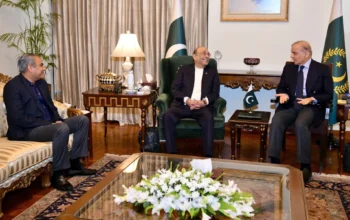
The dispute cuts across the governing alliance. President Asif Ali Zardari and Prime Minister Shehbaz Sharif met today to adhere strictly to constitutional provisions on creating new provinces or administrative units. The prime minister’s adviser has said a 28th constitutional amendment is expected before the new year and could be the last chance to open the way for new provinces.
Bhutto Zardari had already angered ministers on Tuesday by calling for a “political reset”, urging the government to revive dialogue with the opposition, including Pakistan Tehreek-e-Insaf, and end political victimisation. Defence Minister Khawaja Asif, Minister of State for Interior Talal Chaudhry and Health Minister Mustafa Kamal, an MQM-P leader, all hit back. On Wednesday the PPP chairman told them to calm down.
“We should calm down, and you started a debate, and now you should have the courage to continue it,” he said. “This debate has not happened in parliament yet, and you decided to hold this debate in front of businessmen. Pakistan is not so weak as a society that unilateral debates take place which everyone else has to accept.”
Siddiqui said his party would keep to the law. “We respect you and we honour your mandate, but you’re using this kind of language because we had decided that we won’t fight,” he said, addressing Bhutto Zardari. “But we will still fight the constitutional and legal battle. We will still talk in the assemblies.”
Copyright © 2021 Independent Pakistan | All rights reserved