By Staff Reporter
ISLAMABAD: President Asif Ali Zardari and Prime Minister Shehbaz Sharif have agreed to settle all differences through dialogue, two days after the president’s son warned that any forced division of Sindh would end in bloodshed.
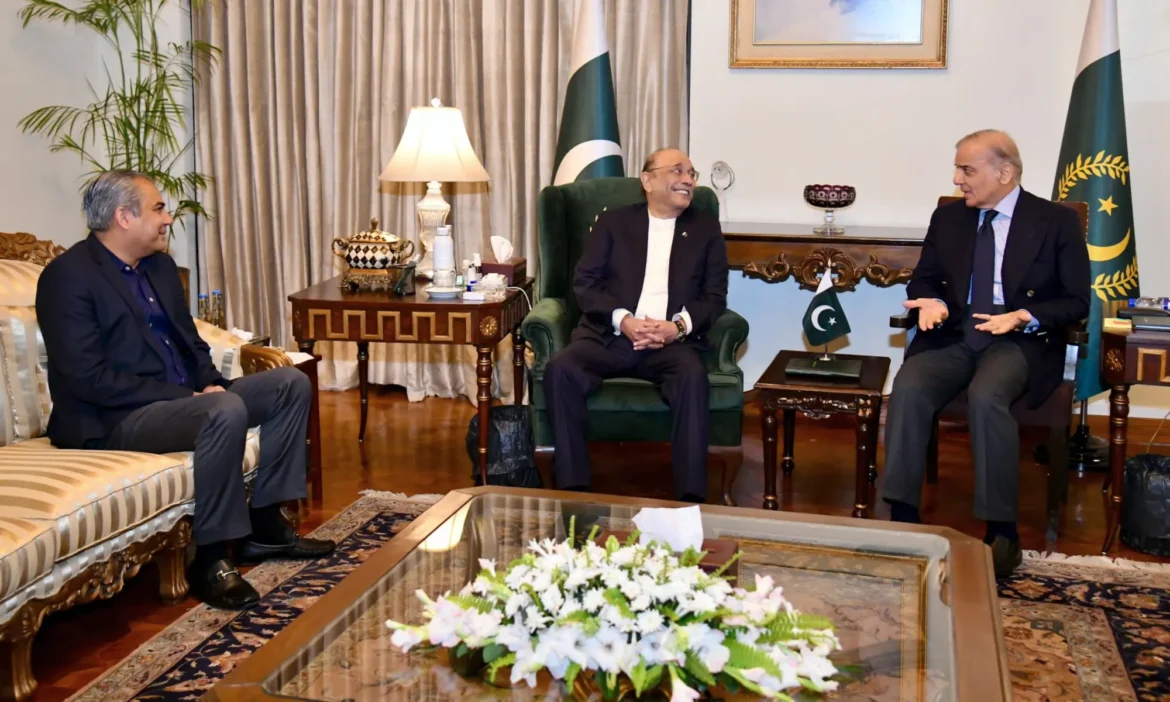
The two leaders met at the presidential palace in Islamabad on Thursday. Interior Minister Mohsin Naqvi, a military face in the current coalition set-up and who ignited the debate on new provinces and was a target of much of Bilawal Bhutto-Zardari’s criticism, was also present.
The Presidency said the leadership would “sit down together on all matters and resolve them through consultation”. It said the “current political situation was reviewed in detail” and that the Middle East conflict was also discussed. Its published account did not mention provinces by name.
The statement did contain a pointed line on constitutional change: “The previous constitutional amendments were passed through mutual consultation among all allied parties.” Bhutto-Zardari, who chairs the Pakistan Peoples Party (PPP), had said on Tuesday that the 27th Amendment was passed with a “brute majority” rather than consensus.
Speaking at a Karachi Press Club event, Bhutto-Zardari said no one in government had raised the question of new provinces with him or with his father, even though some federal ministers have openly backed the idea.
“If the province is divided by force, society will be divided; it will lead to enmity, ordinary people will take up arms, and the bloodshed will not be limited to a single death,” he said.
Bhutto-Zardari rejected Naqvi’s proposal for a referendum, arguing that the Constitution already lays down a procedure for creating provinces and that a plebiscite was an unconstitutional alternative. He also hinted that the government was considering a 28th Amendment for the purpose. He questioned whether the judiciary enjoyed public confidence after the 27th Amendment, which he had himself strongly advocated when it was passed a year ago.
The reaction from the PML-N, the senior partner in the coalition, was swift and sharp. Rana Sanaullah, adviser to the prime minister on political affairs, accused the PPP of rewriting its own role.
“They were fully involved in the 26th Amendment. For the 27th Amendment, they ensured that every single vote was accounted for, and now they are calling it brute force,” he said.
Defence Minister Khawaja Asif questioned Bhutto-Zardari’s moral standing to lecture others, pointing to the PPP’s 18 years in power in Sindh. The Muttahida Qaumi Movement-Pakistan (MQM-P), another coalition member, also hit back. It has long campaigned for new provinces carved out of Sindh and said on Thursday that its resolve was final.
Bhutto-Zardari did not retreat. In a string of televised interviews he told ministers to “calm down” and listen to one of the country’s largest political stakeholders. He called for a “political and democratic reset” to meet the economic challenges, while insisting he was not “disowning” the 27th Amendment but seeking more consensus on such legislation. He also said his party still stood with the government, wanted Sharif to succeed, and had spoken so that the prime minister’s hands would be strengthened.
The dispute and debate stated in July, when Naqvi told an economic summit in Islamabad that the country’s governance system had “collapsed” and called for additional provinces or administrative units.
The PPP, which governs Sindh, has opposed the idea throughout. On September 4 the Sindh Assembly passed a resolution rejecting any division of the province, and Chief Minister Syed Murad Ali Shah said there would be no compromise on its geographical unity. President Zardari has not commented publicly on the matter.
The referendum idea gathered pace this week. Information Minister Attaullah Tarar backed it in a video statement after Bhutto-Zardari’s speech. “Small administrative units should be seen in a constructive manner instead of making them a cause for controversy,” he said. “And this decision should be based on the opinion of the people. And the best way to know the opinion of the people can be through a referendum.”
However, a senior official in the prime minister’s office said no date had been set. “The prime minister has not instructed to prepare for referendum yet,” a local media reported. Asked whether the president supported a referendum, his spokesman Murtaza Solangi said: “The President has not spoken on that matter yet. When he does, we will let you know.”
The two leaders also met on Saturday at Sharif’s Model Town residence in Lahore. The prime minister’s office said they discussed cooperation among coalition partners, continuity of consultations and progress on public welfare projects. Official sources said they had agreed to stick to the constitutional process for any new provinces. The statement did not mention a referendum.
Pakistan, home to more than 240 million people, has four provinces of very different size and weight. Creating new ones would require constitutional amendments and agreement on political representation and the division of federal revenues. Critics also ask whether a cash-strapped state can afford the extra bureaucracy.
The next move may come from within the Zardari family. Local media, citing sources, reported that Bhutto-Zardari was due to travel from Karachi to Islamabad to meet his father to discuss new provinces, a possible referendum, proposed constitutional amendments and political realignments, and that a decision on convening the PPP’s Central Executive Committee was also expected.
They also reported that ruling PML-N is to open talks with every parliamentary party on creating new provinces days after a public row with its main coalition partner intensified tensions inside the governing alliance.
The Pakistan Muslim League-Nawaz would form a political coordination committee of senior leaders to approach parties including the PPP and MQM-P. The aim is a joint strategy on key national issues.
The leadership is weighing the constitutional and legal implications of new administrative units, including whether to put the question to a public referendum, and is considering another constitutional amendment. The federal government may convene a national political conference. If consensus emerged, proposals could go to parliament, where a committee might be formed to work out the constitutional detail.
The talks would also cover a joint approach to terrorism, the economy and an effective local government system. Further decisions on the scope and direction of the initiative would depend on how the political situation evolves.
Copyright © 2021 Independent Pakistan | All rights reserved