By Staff Reporter
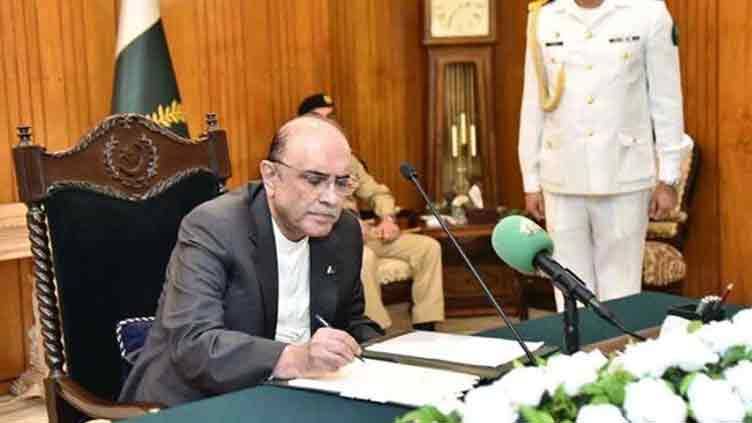
ISLAMABAD: President Asif Ali Zardari has scrapped the legal protection that shielded Khyber Pakhtunkhwa lawmakers from preventive detention, six weeks after the province’s chief minister and Assembly speaker were taken into custody under emergency rule.
Zardari promulgated five ordinances for the north-western province, his office confirmed on Saturday. Together, they remove most of the “privileges” enjoyed by members of the provincial Assembly and set up a new legal framework for development spending in the province, with the military named as a possible implementing agency.
Twenty-one of the 40 sections of the Khyber Pakhtunkhwa Provincial Assembly (Powers, Immunities and Privileges) Act 2026 have been omitted. Among them are the clauses protecting members from “preventive detention”, requiring the Speaker’s permission before a lawmaker can be arrested, and shielding members from civil or criminal action. The schedule of offences covering “breach” of the privileges of the Assembly, its members and its committees has also gone, leaving members with few significant safeguards.
The timing is hard to separate from events since 11 October, when the federal government imposed a state of emergency on the advice of Prime Minister Shehbaz Sharif and declared that the provincial government could no longer function under the constitution. Sohail Afridi, whose role as chief minister was rendered non-functional by governor’s rule, and Afridi, Speaker Babar Saleem Swati and other lawmakers have been in “preventive detention” since then. Governor Faisal Karim Kundi said last month that they had been placed under house arrest.
The Assembly law is itself barely seven months old. Passed on 30 April under the PTI-led provincial government and signed by the governor on 6 May, it was gazetted the next day but not posted on the Assembly’s website, and drew criticism when its contents circulated in July. Section 10 gave members blanket immunity from preventive detention, a marked widening of the 1988 law it replaced, according to a Dawn review of the statute as reported by BOL News. The chief minister’s spokesperson rejected reports that it also granted blue passports to members and their spouses, saying passports were a federal matter; the Express Tribune, as reported by BOL, said the provision appears in the enacted text. Section 10 is among the provisions now removed, as are sections 5 (attendance of detained or arrested members), 6 (members not liable to civil or criminal action), 11 (speaker’s permission before arrest or detention), 15 (power to summon), 22 (power to arrest), 31 (breach of privilege), 32 (breach of privilege as an offence) and 34 (cognisance of offence).
The provincial Assembly is suspended, with its legislative powers resting with parliament.
Two of the other ordinances, both titled the Khyber Pakhtunkhwa Special Initiative Ordinance 2026, concern spending and projects. One covers the 12 districts designated as facing the most acute security challenges, including the merged districts, which were brought under a new Area Representative and Development Council after the emergency was declared. The other covers the rest of the province.
Each creates an executive committee with a chairman, a vice-chairman and other members. For the 12 districts they are nominated by the prime minister, and for the remaining districts by the governor. The Area Development Secretariat will serve the first committee and the planning and development department the second.
The definition of a “special initiative” is broad. It covers any work, development scheme, rehabilitation or reconstruction project, procurement of goods and human resources, consulting or non-consulting service, or any other activity involving public money that the committee so determines.
The committees can declare an initiative urgent, scrutinise and approve proposals, concept papers and PC-Is, and grant anticipatory approval. They can also identify and recommend the body that carries out the work, “including military organisations and formations”. They must provide for monitoring and evaluation, including by third parties, and review progress. They can set up sub-committees or designate individuals for specific tasks.
Committees must meet at least monthly. Decisions are taken by majority vote, with the chairman holding a casting vote in a tie and the power to co-opt further members or technical experts.
Both ordinances override other laws, among them the Khyber Pakhtunkhwa Public Procurement Regulatory Authority Act 2012 and the Public Private Partnership Act 2020. No civil court will have jurisdiction over any act done, order passed or proceedings taken under them.
A fourth ordinance amends the Khyber Pakhtunkhwa Societies (Registration) Act. Madressahs registered with the Directorate General of Religious Education under the federal education ministry will no longer need to register under the Societies Act as well. The fifth sets the salaries, allowances and privileges of the Speaker and Deputy Speaker.
The Presidency said four of the ordinances were published in the Official Gazette on 19 November.
The emergency, imposed under articles 232 and 234 of the constitution, followed the federal cabinet’s criticism of the provincial government’s “deliberate disengagement” from the fight against terrorism. The Pakistan Tehreek-e-Insaf (PTI), the party of the jailed former prime minister Imran Khan, rejected the move, saying “peace cannot be established by weakening provincial autonomy”. The Law Minister said governor’s rule would initially last six months. The Human Rights Commission of Pakistan warned at the time that it risked deepening political tensions and undermining democratic processes.
Copyright © 2021 Independent Pakistan | All rights reserved