By Staff Reporter
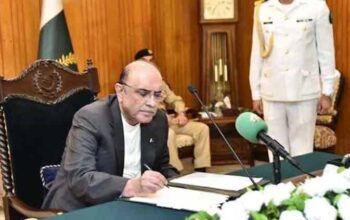
ISLAMABAD: President Asif Ali Zardari met two of the government’s most senior figures in the presidency on Saturday in an effort to halt a public quarrel between Pakistan’s two biggest ruling parties over proposals to carve new provinces out of the existing four.
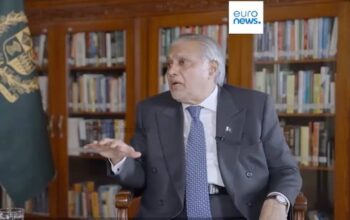
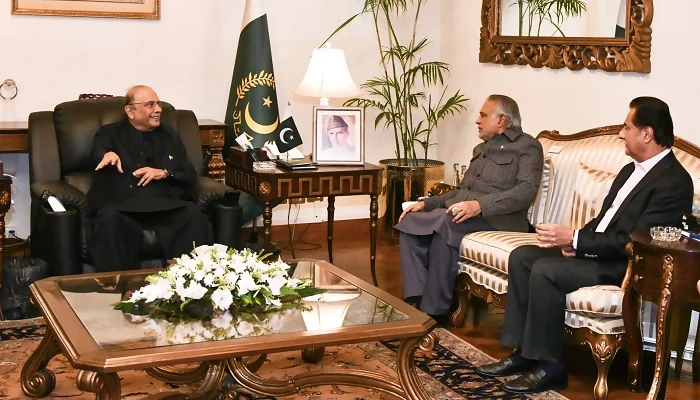
Deputy Prime Minister Ishaq Dar and National Assembly Speaker Sardar Ayaz Sadiq called on Zardari at the Aiwan-e-Sadr in Islamabad. A statement from the president’s media wing said that the men had exchanged views on the “overall political situation”. Former prime minister Raja Pervez Ashraf and the Pakistan Peoples Party’s (PPP) vice president, Senator Sherry Rehman, were also present.
Sources told local media the talks centred on confidence-building measures between the PPP and the Pakistan Muslim League-Nawaz (PML-N) to stop tensions escalating and to end the exchange of public statements between the coalition partners.
The president, who co-founded the PPP, has been the party’s main channel to Prime Minister Shehbaz Sharif. He met Sharif on 19 November, agreed to settle all differences through dialogue, two days after the president’s son and PPP chairman Bilawal Bhutto Zardari warned that any forced division of Sindh would end in bloodshed.
Interior Minister Mohsin Naqvi, a military face in the current coalition set-up and who ignited the debate on new provinces and a referendum, was also present. Local media reported that Zardari and his son Bhutto-Zardari had agreed to hold their position on new administrative units and a referendum, and had discussed calling the party’s Central Executive Committee
The dispute began in July, when Naqvi, regarded as close to those who hold real power in Pakistan, said the political system needed a reset through the creation of new provinces. The Sindh Assembly, where the PPP dominates, passed a resolution against any division of the province. Naqvi repeated his position several times regardless.
Bhutto-Zardari urged an end to the debate in October. On 17 November, he went further at a meet-the-press event in Karachi, rejecting the idea of a referendum and warning that forcing a division of Sindh could trigger a bloodbath. He also criticised the coalition over the treatment of Maulana Fazlur Rehman, the jailing of Imran Khan and the 27th Amendment. He later said he was raising an alarm rather than issuing a threat, and complained that the PPP was not being consulted.
The remarks drew angry responses from the defence minister, Khawaja Asif, and the minister of state for interior, Tallal Chaudhry. Khalid Maqbool Siddiqui, who leads the Muttahida Qaumi Movement-Pakistan (MQM-P), urged the courts to take notice. The MQM-P, which has long wanted new provinces carved out of Sindh, said again on Thursday that its resolve was final.
On Saturday, Rehman tried to lower the temperature. “Chairman Bilawal Bhutto-Zardari is looking to prevent bloodshed, not shed it,” she said, urging ministers to avoid provocative statements and warning of a hard winter of gas and resource shortages in which politicians should not add to people’s troubles. “They [the ministers] should know that the Constitution will still refer the matter to parliament. There is no walking away from the votes of the assemblies. A referendum does not override the Constitution, nor does it change any ground reality where any given province has spoken with its majority.”
The PPP’s secretary general, Nayyer Hussain Bukhari, said the party had no principled objection to new provinces but would not accept any move outside the constitutional framework. “The authority to decide on creation of new provinces, including holding a referendum on the matter, rests with parliament rather than commercial groups or non-parliamentary forums,” he said. He asked Sharif to clarify the government’s position, citing contradictory statements from the interior, planning and defence ministers.
Hopes of a quieter weekend did not last, and Defence Minister Asif, who has been attacking Bhutto-Zardari since the Karachi speech, took to X to make another off-topic and provocative statement about Bilawal House in Lahore. “Can someone disclose the ownership of this property? Who owns it, and who lives there? If this palace-like fortress is being used by anyone, who are they?” he wrote, instead of strictly debating constitutional reforms or provincial boundaries. He asked whether people occupying properties without legal title could “morally claim any privileged position”.
The PPP’s Nadeem Afzal Chan replied with a video of party workers gathering at the house, calling it the home of every PPP worker. “Show us people entering any other big house in the same way. Uncle… answer the questions, whether you like it or not,” he said. The party said the defence minister was trying to provoke it into personal attacks on the Sharifs, and that Bhutto-Zardari had told his colleagues to ignore him and stick to issue-based politics. But it added that it knew the controversies around the PML-N leadership, citing the Panama Papers, Avenfield properties and Al-Azizia Steel Mills cases.
Another senior PML-N figure, Saad Rafique, argued that smaller provinces alone would not fix the country’s structural problems. He urged the government to prioritise reform of the civil service, electoral system, local government and judiciary, and to move quickly on a proposed parliamentary committee on electoral reform.
The PML-N has decided to reach out to all parliamentary parties, including the PPP and MQM-P, and is expected to form a political coordination committee of senior leaders. The government may also convene an all-parties conference.
The opposition Pakistan Tehreek-e-Insaf (PTI) used the row to attack the assemblies themselves. Its information secretary, Sheikh Waqas Akram, called the referendum proposal absurd and futile, and said it could not replace a majority vote or a constitutional bill. He claimed the sitting assemblies had been built on a “stolen mandate and usurped seats” through Form-47 results.
“Because the current lawmakers are not true public representatives, any referendum held under the present setup would be as fraudulent as the assembly itself,” he said.
Akram said the PTI would set its policy on new provinces only after party leaders were given direct access to Imran Khan, the jailed founder, who has the final say. He challenged Bhutto-Zardari to prove his sincerity by returning the reserved seats to the PTI and removing Kundi as governor or expelling him from the PPP. He also condemned the disappearance from a police station of Taimur Saleem Jhagra, a former provincial finance minister, after his arrest, and demanded that all detained party leaders be produced in court and released.
Maulana Fazlur Rehman, who leads the Jamiat Ulema-e-Islam-Fazl, told the Peshawar High Court Bar Association that the answer to Pakistan’s political, economic and constitutional troubles lay in free and transparent elections and a government of genuine representatives. Assemblies without real public backing, he said, served the powerful rather than the people, and he accused those in positions of influence of engineering governments and running politics through “dummy assemblies”.
Politicians took the blame for every failure, he said, while the real decision makers stayed out of view. He questioned the governor’s rule and emergency in Khyber Pakhtunkhwa, asking why similar steps had not been taken in Balochistan if terrorism was the justification. He asked where Pakistan stood on exports, the rupee and inflation compared with its regional neighbours, nearly eight decades after independence.
He also said none of the Council of Islamic Ideology’s recommendations had been debated in parliament, despite a commitment made under the 26th Amendment three years ago. He welcomed investment but said using political differences as a pretext to reopen cases against opponents was unacceptable.
Copyright © 2021 Independent Pakistan | All rights reserved