By Staff Reporter
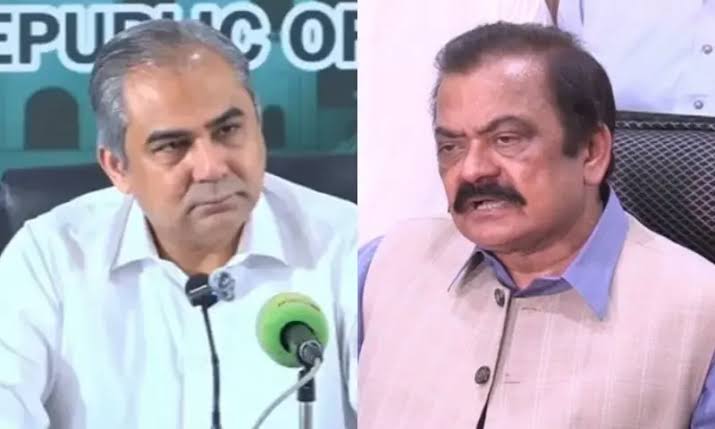
ISLAMABAD: A public feud between interior minister Mohsin Naqvi and the prime minister’s political adviser Rana Sanaullah has laid bare the strain inside the governing coalition over plans to carve up the country’s provinces.
Sanaullah, who advises Shehbaz Sharif on political affairs, told a private news channel on Monday that Naqvi should have gone to the PPP’s leadership before taking the idea public, since both its chairman, Bilawal Bhutto-Zardari, and his father, President Asif Ali Zardari, have said nobody spoke to them. “If the PPP is not on board and Bilawal Bhutto-Zardari is saying, four months later, that nobody even spoke to him, while President Zardari is also saying that the matter was never discussed with him, then what have you been doing for four months?” he asked “You are present where they are, and they consider you close to them. If you could not even take them into confidence, then this is your total failure.”
It was the third personal row over the past three days between the two men. On Saturday, in an interview, Sanaullah said the provinces question had been spoiled by being raised at a business forum where, in his words, “objectionable businessmen” were in the audience. He also said Naqvi, an independent senator elected with PML-N and PPP votes, was under the discipline of President Asif Ali Zardari, who he said called him his son.
On Sunday, Naqvi answered in Lahore without using Sanaullah’s name. He described the businessmen as respectable citizens and among the country’s biggest taxpayers, and asked why, if they were so objectionable, parties took billions of rupees from them in funds at every election. He accused the minister of commenting on him on television almost every day to gain attention. He said he had listened patiently for two and a half years. “The day I comment on this minister, he will not be able to show his face,” he said.
Sanaullah, who held the interior portfolio before Naqvi, confirmed on Monday that he was the target and said he was happy to be criticised. “Mohsin Naqvi can comment on me as much as he likes; I will welcome it,” he said. “Is he Quaid-i-Azam that for two and a half to three years, I have supposedly been commenting on his personality and thoughts, and it just doesn’t seem to end?” The title belongs to Muhammad Ali Jinnah, Pakistan’s founder. “If he has a counterargument to what I have said, he should present it. Threatening me in this manner is not going to silence someone like me. Why is there a need to be so short-tempered?”
He said he had always kept the minister’s dignity in mind, calling him nothing less than the “worthy interior minister” and never the chairman of the Pakistan Cricket Board, a post Naqvi also holds. When the host asked whether he really meant “worthy”, after the phrase drew comment on social media, he replied: “Definitely, worthy as in English.”
On the funding remark, Sanaullah challenged the interior minister to name his source. “Other parties may be receiving such funds, and other politicians may be doing so,” he said. “I challenge anyone to prove that my party, the PML-N, or I have received billions, millions or even a hundred rupees from any businessman. Let them bring forward the person who gave the party such funds.”
He also stood by what he said on Saturday about Zardari and Naqvi. “I have heard Zardari sahib himself say more than once that Mohsin is my son,” he said. “He should deny that this is incorrect and that we have made it up ourselves.” Naqvi is an independent senator who was elected with PML-N and PPP votes. Mr Sanaullah has said in recent days that Zardari had a 60 percent role in his appointments as Punjab caretaker chief minister and interior minister.On the provinces themselves, Sanaullah’s complaint is one of process. Mr Naqvi chose “the wrong method, the wrong procedure, the wrong forum”, he said, and made a speech right at the start “that the whole system collapsed”, which pushed the substance of the proposal out of the debate. “I believe he complicated the matter by making irrelevant statements at an irrelevant forum,” he said. “The issue has now become extremely controversial. If it comes to Parliament in this situation, it will arrive there as a controversial matter. However, we will make every effort to build consensus on it.”
The speech in question was Naqvi’s address to the Pakistan Economic Summit in Islamabad on 30 July, when he called for additional administrative units or provinces to overhaul what he described as an outdated system of governance. Naqvi is considered a close confidant of the army chief, Field Marshal Asim Munir, and Sanaullah said the speech also strayed into territory he objected to. Naqvi had made “completely irrelevant remarks regarding the prime minister”, he said, and later indirect ones about the field marshal. “Field Marshal is a national asset and a national hero; [but] attributing this kind of talk to him indirectly, that he is a red line and that he does not want to cross it, so I objected to these things.”
Asked about the system Naqvi said had collapsed, Sanaullah said he did not accept that it had failed on its own. “It has been made to fail,” he said. “In making it fail, politicians, political parties, the establishment, our worthy judges and the judiciary, [and] bureaucratic circles have played a part. All of us together have made it fail.” That is close to Mr Bilawal’s own position. He called it his “version” and said anyone with another was free to hold it.
He said ministers who back the idea, among them Khawaja Asif, Tariq Fazal Chaudhry and Tallal Chaudhry, were entitled to their views, as he was to his, and that seminars and forums had done nothing but make the question more toxic.
Behind the personal row, the government is edging towards a referendum. Naqvi proposed one on 12 November, and Chaudhry, the parliamentary affairs minister, later said it would take place. M Asif said on Monday that the debate should take “definitive shape” by the year’s end. The PPP is opposed. Bilawal said in a speech last Tuesday that any “forced” attempt to divide provinces, Sindh in particular, could lead to bloodshed.
Sanaullah said a referendum might offer a way through, but only if parliament approved it after debate in both the Senate and the National Assembly. He suggested the PPP’s one real concern was that the vote could be used to win the approval of a constitutional court. “If the PPP is assured that the Constitution will be followed and guidance will also be sought from the people, I believe a consensus could emerge on that point.”
The constitution allows a referendum on a matter of national importance once a joint sitting of parliament approves it, but a referendum would not itself create a province, and any change to provincial boundaries would still have to follow the formal process. Almost four months after Naqvi’s speech, no draft constitutional amendment, agreed number of provinces or timetable has been made public.
Copyright © 2021 Independent Pakistan | All rights reserved