
By Staff Reporter
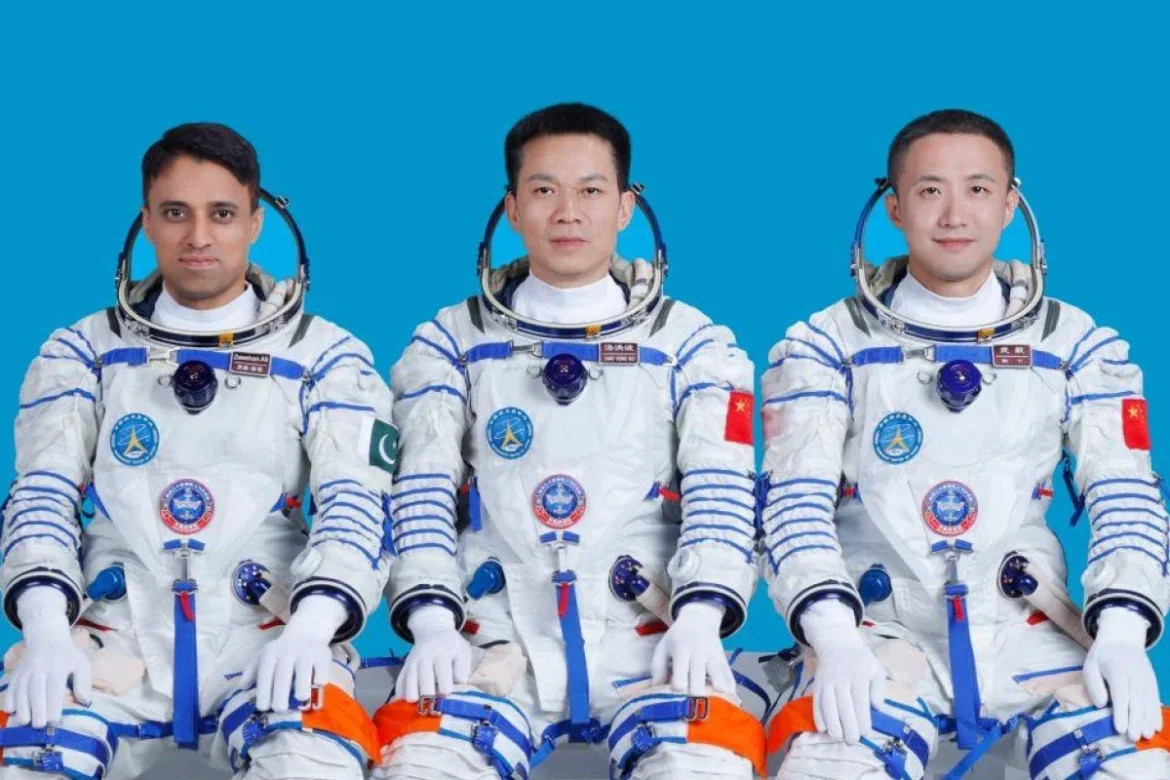
ISLAMABAD: Pakistan’s first astronaut, Muhammad Zeeshan Ali, is due to become the first foreign national to board China’s Tiangong space station when the Shenzhou-24 mission lifts off on Wednesday morning.
Ali was named on Tuesday by the China Manned Space Agency (CMSA) as a payload specialist on the three-person crew. The spacecraft is due to launch from the Jiuquan Satellite Launch Center in north-west China at 8.18am Beijing time, which is 5.18am in Pakistan.
It will be the first joint spaceflight by Chinese and foreign astronauts in the history of China’s crewed space programme. Ali will also become the first Pakistani national to travel to space.
He will fly alongside Tang Hongbo, who will command the mission, and flight engineer Wu Yi. Tang, who has flown on Shenzhou-12 and Shenzhou-17, is set to become the first astronaut to visit Tiangong three times. Ali and Wu will both be making their first spaceflight.
Ali is expected to spend around a week aboard the station, working on experiments with the Chinese crew. The CMSA said about 90 experiments would be carried out during the mission.
He will return to Earth on the Shenzhou-23 spacecraft, which docked with Tiangong in May. His fellow passengers will be Zhang Zhiyuan and Lai Ka-ying, the first Hong Kong astronaut, who are completing a six-month rotation.
Zhu Yangzhu, the third member of the Shenzhou-23 crew, will stay on board for another six months with the two Chinese Shenzhou-24 astronauts. He is on track to complete China’s first year-long stay in orbit, a posting intended to test how the human body adapts to long-term deep-space conditions and to gather data for future lunar landings and even Mars exploration.
The CMSA said the mission would also carry out an orbital rotation with the Shenzhou-23 crew, routine operations and maintenance of the station, and continued space science research, including experiments involving space payloads. Reuters reported that it is the 41st flight of China’s crewed space programme.
Zhang Jingbo, spokesman for the CMSA and director of its general plan bureau, said having a Pakistani astronaut on a Chinese mission was a landmark achievement as the two countries mark 75 years of diplomatic ties.
“Our lunar programme is steadily advancing too,” he said. “We look forward to working with more countries and regions to explore the vast universe… and advance together for the common good of all humanity.”
In Islamabad, the announcement drew immediate congratulations. Planning Minister Ahsan Iqbal said the joint mission marked “the trust and iron brotherhood between Pakistan and China”. Information Minister Attaullah Tarar wrote on X that a Pakistani astronaut going into space was a source of joy and pride for the whole nation.
Prime Minister Shehbaz Sharif met Ali and fellow candidate Khurram Daud in April, when the pair were chosen to begin training in China. He called the mission a “matter of pride for the entire nation” and commended their “round-the-clock efforts”. He said he hoped it would “add new dimensions to the brotherly relationship between Pakistan and China”.
The flight follows a cooperation agreement signed in February 2025 between Pakistan’s space agency, Suparco, and the CMSA. Under the pact, two Pakistanis were to train in China, with one joining a mission to Tiangong. Reuters described the participation as part of bilateral cooperation under Beijing’s Belt and Road Initiative.
The partnership also reflects China’s position in space. It has been barred from the International Space Station since 2011, when the United States prohibited Nasa from collaborating with Chinese space agencies, and has since sought partners for its own programme. Pakistan, whose “all-weather” friendship with Beijing spans decades, is a natural candidate. China is its largest trading partner and a major foreign investor.
Beijing has invested heavily in its space programme in recent years, narrowing the gap with its main rival, the United States. In October, Wang Xiang, deputy chief designer of the crewed space programme, said China planned to land astronauts on the Moon before 2030, with a crew of three, two of whom would walk on the lunar surface.
Zhang told reporters that launch-site rehearsals would soon be held for the Long March-10A rocket and the Mengzhou crewed spacecraft to verify procedures and system interfaces. A technology verification flight for the Long March-10 will follow. He said the maiden flight of the Lanyue lunar lander was on track.
Zhang also praised Lai, a payload specialist on Shenzhou-23, who he said “did a great job” and completed all her tasks in space science research, technological tests and popular science lectures. During spacewalks she operated the robotic arm from inside the cabin, supporting her two teammates as they repaired solar wings and installed space debris protection devices.
“Lai Ka-ying approached every task with a rigorous, conscientious scientific attitude and a pragmatic, truth-seeking work style,” he said. “Her experience has enabled the younger generation – especially youth in Hong Kong and Macau – to personally feel the strength of the motherland’s scientific and technological prowess.”
Copyright © 2021 Independent Pakistan | All rights reserved