By Staff Reporter
ISLAMABAD: Prime Minister Shehbaz Sharif has ordered his cabinet to stop attacking one another in public after a bitter row between two senior colleagues over plans to carve new provinces out of the country.
“On this occasion, I direct all federal cabinet ministers to refrain from making political statements against one another,” Sharif said in a statement issued by his office on Tuesday.
“Statements against one another must cease completely. It is our collective responsibility to play an effective role in ensuring political stability.”
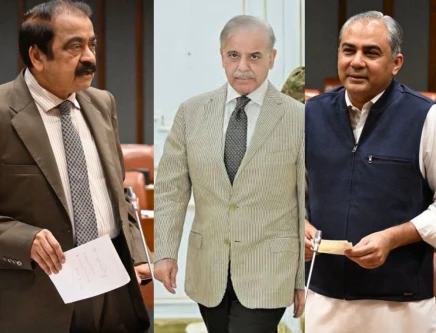
The statement was addressed to the cabinet as a whole. But it followed days of open hostility between the interior minister, Mohsin Naqvi, and Rana Sanaullah, the prime minister’s adviser on political affairs. Sharif said such exchanges created a negative impression and distracted from the government’s work. “The government is continuing its journey from economic stability towards sustainable economic growth.” He also urged representatives of provincial governments to hold back.
The dispute started in July, when Naqvi told an economic forum in Islamabad that the governance system had effectively collapsed and called for administrative restructuring. He argued for new administrative units to “reset” the “system”. On 12 November he floated a referendum to gauge public opinion, saying it could settle the debate “once and for all”.
Sanaullah has criticised Naqvi throughout and on Sunday, Naqvi, without naming his colleague, warned that a cabinet member who had been criticising him for two and a half years would not be able to show his face if he responded. In Naqvi’s words: “The day I comment on this minister, he will not be able to show his face.”
On Monday, Sanaullah said the interior minister had “complicated” the matter by making an “irrelevant speech at an irrelevant forum”. He told a local television channel that the issue had become “extremely controversial” as a result. “Now, if it comes to parliament, it will arrive in a controversial state.” He also accused Naqvi of failing to bring the Pakistan Peoples Party (PPP) leadership on board despite having four months to do so. He insisted it was his right, as a colleague and political worker, to comment on Naqvi’s work, and said his party would make every effort to build consensus.
The row matters because the PPP, a coalition partner, is fiercely opposed to any division of Sindh. On 17 November, its chairman, Bilawal Bhutto-Zardari, rejected the referendum idea in a speech at the Karachi Press Club and warned that any “forced” attempt to divide Sindh could lead to bloodshed. He argued that the constitution already provides a procedure for creating provinces and that a referendum amounted to an unconstitutional alternative. The Sindh Assembly passed a resolution on 4 September rejecting any attempt to divide the province.
The government has not been speaking with one voice. President Asif Ali Zardari and Sharif agreed at a meeting in Lahore on 14 November to adhere strictly to the constitutional provisions on creating new provinces. Sanaullah has said any referendum would need parliamentary approval and could not be called by the government alone. Yet the government maintains that a referendum is a legal and constitutional way of gauging opinion, and the parliamentary affairs minister, Tariq Fazal Chaudhry, insisted last week that it “will happen”.
Hours after the prime minister’s statement, the defence minister, Khawaja Asif, publicly backed Sanaullah on social media, calling him a “credible and respected” political worker. The intervention was not straightforward support for either side of the policy dispute. Asif has himself supported creating as many as 12 provinces.
Demands for new provinces are long-standing, with campaigns for South Punjab, Bahawalpur and Hazara. The Punjab Assembly passed resolutions in 2012 backing South Punjab and the restoration of Bahawalpur province, but they never became constitutional change.
Copyright © 2021 Independent Pakistan | All rights reserved