By Staff Reporter
ISLAMABAD: A Pakistani fighter pilot became the first of his countrymen to reach orbit on Wednesday, riding a Chinese rocket towards a space station no foreign astronaut has entered before.
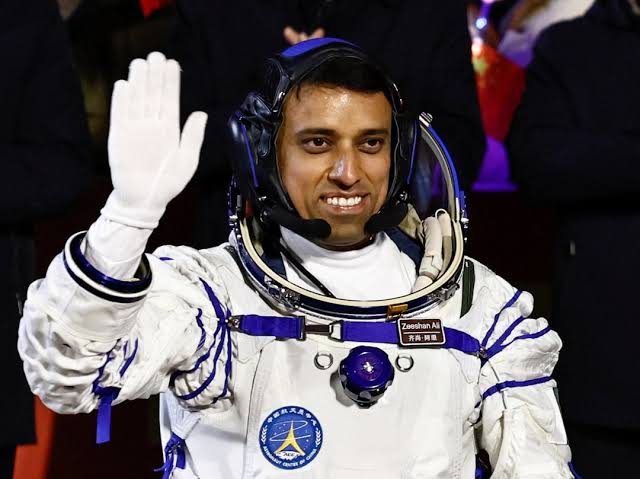
Zeeshan Ali, 40, lifted off aboard the Shenzhou-24 spacecraft at 8.18am Beijing time (5.18am in Pakistan) from the Jiuquan Satellite Launch Centre in north-western China. A Long March-2F rocket carried the capsule into its preset orbit within minutes.
“The spacecraft is functioning well. I declare the Shenzhou-24 launch mission a complete success,” a launch centre official announced.
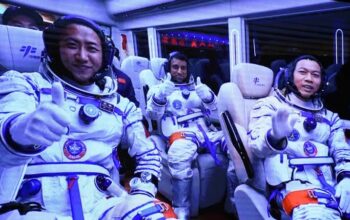
Ali flies as payload specialist beside the mission commander, Tang Hongbo, and the flight engineer, Wu Yi. When the capsule docks with the Tiangong station, he will become the first foreign national to board it. The flight is also the first in China’s human spaceflight programme to carry Chinese and foreign astronauts together.
The mission was declared a success within minutes, but the docking is still ahead. Earlier Chinese crews have taken about three and a half hours to link up with the station.
Planning Minister Ahsan Iqbal, who was in China and watched the send-off and launch, called the flight the start of something larger. “This is just the beginning, not the end,” he told reporters afterwards. On X, he wrote that “the Pakistani flag rises into orbit, lifting the hopes and aspirations of 260 million Pakistanis”, adding: “This is Pakistan’s URAAN (flight) into space, and it is only the beginning of a brighter and more glorious future.”
Ali had struck a similar note at a press briefing in Jiayuguan on Tuesday. He said he was “deeply grateful” to the Chinese government for helping “us realise our dream of going into space”, and that he believed “what comes after this flight matters more than the flight itself”.
“This mission is not a finish line; it is a launch pad,” he said. “And I hope the next chapter of China-Pakistan space cooperation will grow from one astronaut, one flight to multiple joint flights, to the Moon, Mars and beyond.”
He said he felt “the true weight” of the words of Prime Minister Shehbaz Sharif, who had told him Pakistan was about to write a new chapter in its history. “I want to assure you that I am not flying for myself,” he said. “I carry the name of Pakistan on my shoulders, the hopes of 250 million Pakistanis.”
He had a message for children too. “To every child who is watching while I am in orbit, just look up at the sky and remember that I am up there with your dreams.”
To his family he promised that when he first looked back at Earth, he would search for the light of home before looking at anything else. “No matter how far I fly, we will still share the same Moon, and I will still be looking back at the same Earth.”
Ali is expected to spend between five and ten days on the station, a far shorter stay than his Chinese crewmates, who are starting a six-month tour. He prepared for it with seven months in Beijing. As well as technical training, he took intensive Chinese-language classes, learned Chinese songs, read Chinese poetry, practised calligraphy and played table tennis. He also had to master the commands and technical vocabulary his crew would use in flight.
His journey began with a cooperation agreement between Suparco, Pakistan’s space agency, and the China Manned Space Agency (CMSA) in February 2025. It provided for two Pakistanis to train in China, with one flying to Tiangong. Ali and Khurram Daud, also a pilot, emerged from three rounds of screening of medical fitness, psychological resilience and tolerance of launch forces. Ali won the seat and Daud was named his backup.
On the station, Ali will install samples and equipment and carry out scheduled experiments. They include four China-Pakistan projects in biotechnology and materials, among them a study of photosynthetic cyanobacteria. The four biotechnology experiments were chosen by Chinese institutions from more than 300 proposals that Pakistani universities submitted to Suparco. Suparco officials have told Reuters the research is relevant to food security and climate change.
The full crew will run about 90 experiments across space life sciences, materials science, fluid physics and combustion, fundamental physics, space medicine and propulsion technology. In life sciences, researchers will build vascular chips and multi-organ chips to study how the space environment drives vascular ageing.
Zhang Jingbo, a CMSA spokesperson, pointed to work already done on the station as evidence of what long-running experiments can achieve. Chinese scientists used laser cooling to bring a cloud of rubidium atoms down to 9.7 picokelvins, which he described as the coldest known man-made matter, and kept it observable for seven seconds. “China will continue to use the space station as a national space laboratory to steadily advance space science, space applications and space technology,” he said.
The crew handover will be unusual. Tiangong, fully operational since late 2022, can host up to six astronauts while an arriving crew overlaps with the departing one. This time Zhu Yangzhu, who commanded the Shenzhou-23 mission, will stay on for a year to support Chinese research into how the human body copes in space, a step towards a planned crewed lunar mission and a possible journey to Mars. He will hold the record for the longest single stay in orbit by a Chinese astronaut when he leaves. The rest of the Shenzhou-23 crew will return to Earth with Ali.
President Asif Ali Zardari called the flight a “landmark achievement” and said it should inspire the young to pursue knowledge and innovation, quoting the national poet Allama Iqbal: “Sitaron se aagay jahan aur bhi hain”.
Sharif said the country was looking to the skies with “anticipation, pride and deep gratitude”. He thanked the Chinese president, Xi Jinping, and called the mission a testament to the “exceptional trust, mutual respect and enduring brotherhood” between the two countries. “Pakistan-China friendship is surpassing the heights of the Himalayas, in its journey to outer space,” he wrote.
Space cooperation between the two countries goes back to the early 1990s, when Beijing began launching Pakistani satellites. It is expected to reach the moon too, with a Pakistani-built rover due to travel aboard a Chinese lunar mission around 2028.
Copyright © 2021 Independent Pakistan | All rights reserved