By Staff Reporter
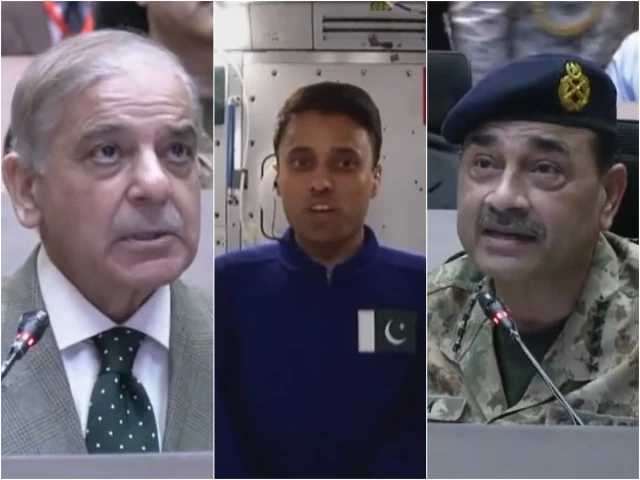
ISLAMABAD: Prime minister and army chief spoke live to Zeeshan Ali, the country’s first astronaut, aboard China’s Tiangong space station on Saturday, with Field Marshal Asim Munir declaring friendship with Beijing “boundless as the universe”.
Shehbaz Sharif and the field marshal, who is also Chief of Defence Forces, took the call at the Islamabad headquarters of the space agency Suparco, with Deputy Prime Minister Ishaq Dar and China’s ambassador, Jiang Zaidong, beside them. Pakistani television channels aired it.
“Zeeshan, today is a great day for all of us sitting here and 240 million people of Pakistan,” Sharif said, congratulating the astronaut on becoming the first Pakistani to orbit the Earth. He recited a couplet by the poet Allama Iqbal and said Ali’s flight had “ignited a renewed spirit of ambition” in a generation eager to push boundaries.
Ties with China had long been called higher than the Himalayas and deeper than the ocean, the prime minister said, and now they had “soared beyond the skies”. The flight fell in the 75th year of diplomatic relations. “What could be a more befitting tribute for this enduring friendship?” he asked. Sharif thanked President Xi Jinping, called China Pakistan’s “iron brother” for making it the first foreign partner in its space programme, and signed off in Chinese: “Thank you, China.”
“We are really proud of you and proud of the armed forces that one of us has gone into space and achieved this great accomplishment,” Field Marshal Munir told the 40-year-old air force pilot. Ali’s presence on the station was a “proud testament to our time-tested strategic partnership”, he said, and the familiar bond for the relationship – higher than the Himalayas, deeper than the oceans, sweeter than honey – now had a new ending: “and now boundless as the universe”.
Space should serve “peaceful purposes and the collective well-being of the entire humanity”, Sharif said, and the experiments Ali was running with his Chinese colleagues would “enrich the collective scientific knowledge of the international community”.
“Everything is going very well over here and according to the plan,” Ali said, orbiting 400km above Earth at 7.9km a second. Representing Pakistan there was “a great honour”, he said, both as its first astronaut in orbit and as the first international astronaut to enter the Chinese station. His message to the country’s young people was to “promote education and to excel in science and technology”. He thanked Mr Xi for a congratulatory note sent to the crew.
Wednesday’s launch from Jiuquan, in north-west China, went at 8.18am Beijing time (5.18am in Pakistan), a Long March-2F rocket climbing into a pink sky. Shenzhou-24 docked three hours and 38 minutes later. Ali, the Chinese commander Tang Hongbo and flight engineer Wu Yi were met with hugs by the three Shenzhou-23 astronauts already aboard. “China Space Station here I come!” Ali said in Chinese, according to state broadcaster CCTV.
Xi and Pakistan’s president, Asif Ali Zardari, swapped congratulatory messages the same day, the Chinese leader calling the station “a vessel for peace, friendship and cooperation”. Beijing’s foreign ministry said it was the first time a foreign astronaut had been welcomed aboard.
Pakistan’s payloads sit in the Wentian and Mengtian laboratory modules, according to Suparco: microalgae grown as a possible source of food and oxygen for future missions, and quinoa seeds exposed to spaceflight. Finishing the agency’s four experiments takes between six months and a year, it says, and Ali’s days aboard are meant to start the work. The Chinese space agency puts the crew’s total at about 90 experiments.
Ali is due home on Shenzhou-23 with Zhang Zhiyuan and Lai Ka-ying, while their commander, Zhu Yangzhu, stays on to complete China’s first year-long stay in orbit. Airspace closure notices cited by the space journalist Andrew Jones point to a landing early on Monday morning, Beijing time. The Chinese space agency has not confirmed the date.
Suparco and China’s human spaceflight agency signed the deal behind the mission in Islamabad in February 2025. Ali and a fellow pilot, Khurram Daud, who served as his back-up, began training in China in April. Learning Chinese was his hardest task, Ali has said; he picked up songs and poetry, practised calligraphy and played table tennis.
“This mission is not a finish line; it is a launch pad,” Ali said before lift-off, adding that what comes after the flight matters more than the flight itself. He hoped cooperation would grow “from one astronaut, one flight to multiple joint flights, to the Moon, Mars and beyond”.
The International Space Station, the only other crewed outpost in orbit, is due to be retired around 2030. China was kept off it and has long said Tiangong would welcome foreign crews. Pakistan is the first to be invited aboard.
Copyright © 2021 Independent Pakistan | All rights reserved