By Staff Reporter
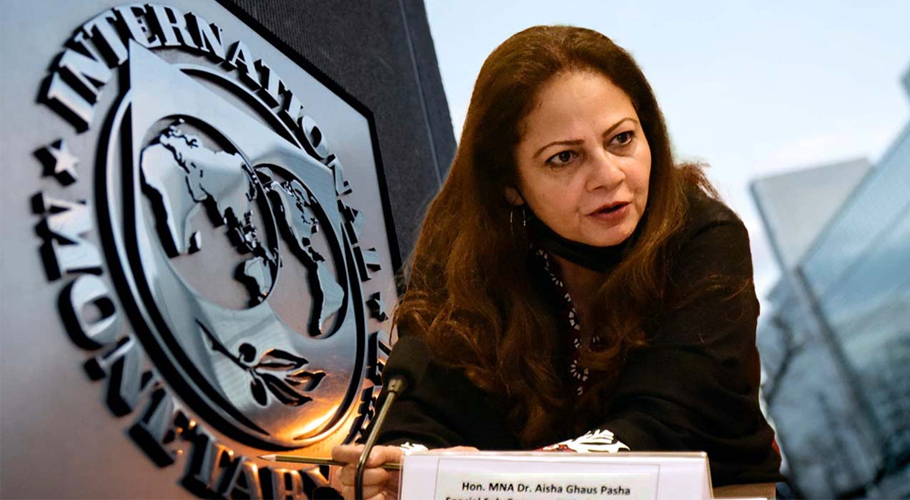
ISLAMABAD: State Minister for Finance Dr. Aisha Ghaus Pasha on Wednesday rejected a statement by a senior International Monetary Fund (IMF) official as “interference” in domestic politics after he spoke about the necessity of maintaining the “rule of law” in the country.
The minister, however, said the government has not received any “official communication” from the IMF.
“We are only looking at the official communiqué, and no such statement has been given by the IMF in writing or during recent meetings,” she told reporters in Islamabad.
Pakistan has been facing significant political turbulence since the ouster of former prime minister Imran Khan from power in a parliamentary no-trust vote last year.
The situation further exacerbated after Khan was arrested on graft charges on May 9, which led to violent protests by his supporters who torched government buildings and military installations.
The country’s civilian and military authorities launched a crackdown against the ex-premier’s Pakistan Tehreek-e-Insaf (PTI) party, saying that some of its protesting members would be tried under military laws.
Discussing Pakistan’s progress in terms of unlocking a stalled IMF loan program, the international lender’s mission chief Nathan Porter said in a statement this week that he hoped that “a peaceful way forward is found in line with the constitution and rule of law” in the country.
Minister Pasha said the IMF does not usually make such remarks and she thinks “it is extraordinary what the IMF has said.”
“The IMF usually doesn’t say such things,” the Pakistani minister noted during a brief media interaction in Islamabad.
The minister’s remarks come after IMF Resident Representative in Pakistan Esther Perez Ruiz shared a statement with media, saying that the statement answers a number of recent press questions.
The statement attributed to Porter read: “We acknowledge recent political developments, and while we refrain from commenting on domestic politics, we hope that a peaceful way forward is found in line with the Constitution and the rule of law.”
“Sustaining strong policies and securing sufficient financing from partners remain crucial for Pakistan to maintain macroeconomic stability.”
“To this end, IMF staff continues to engage with the Pakistani authorities to facilitate a Board meeting before the expiration of the current program in late June.”
A similar statement on Pakistan’s politics was also issued earlier in the aftermath of Khan’s arrest.
The minister said that “interference” in Pakistan’s internal affairs was not part of the IMF mandate.
Pasha termed the IMF’s remarks as “extraordinary,” adding that the multilateral lender does not give such a statement “ordinarily.”
“The IMF should not include these extraordinary things at the moment,” she said. “As for the rule of law, we have to move ahead as per the rule of law. We are promoters of democracy and we want the institutions to perform within the ambit of the constitution.”
“This is an extraordinary thing, as we (government) are a supporter of democracy. We want all institutions to work under the parameters of the constitution and are moving forward under the rule of law,” the minister said.
Pasha said the government remains engaged with the IMF at the technical level, and progress is being made.
“The government has conveyed to the IMF that the continuous delay in revival of the programme is not in the interest of both parties (Pakistan and the IMF). The uncertainty needs to end,” she added.
“We have clearly told IMF Managing Director (Kristalina Georgieva) that the government wants to complete the programme. The IMF chief has also conveyed that she wants to see progress.”
Pasha said any delay in the $6.5 billion loan program signed in 2019 was neither in the interest of Pakistan nor the IMF.
The global lending agency is yet to release about $1.2 billion to help Pakistan’s cash-strapped economy since last November.
“We firmly hope to get the IMF bailout,” the minister said. “We are in the [IMF] program, and certainly there is Plan B. It’s not like the finance ministry is sitting with its eyes closed.”
However, Pasha pointed out her country was fully committed to completing the IMF program.
“We are not even thinking of a scenario without IMF,” she said while expressing her optimism that the country would reach a staff-level agreement before the new budget on June 9.
Pakistan is witnessing a major economic crisis amid declining forex reserves and rapidly depreciating national currency. The country needs external financing, though the IMF loan program continues to remains stalled.
Copyright © 2021 Independent Pakistan | All rights reserved