By Staff Reporter
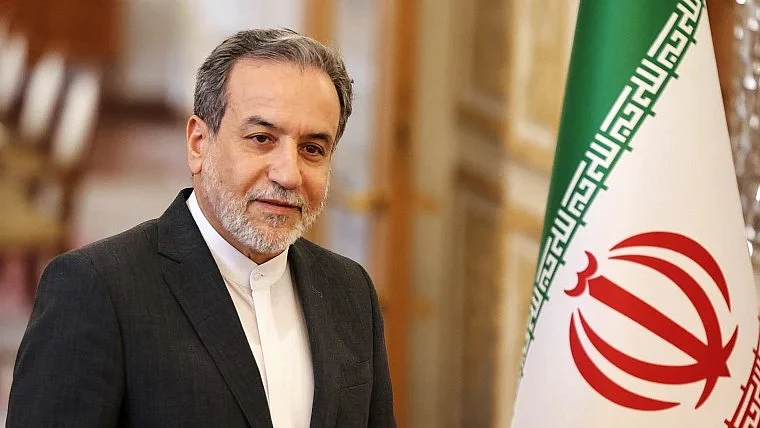
ISLAMABAD: Iranian Foreign Minister Abbas Araghchi is expected to return to Pakistan on Sunday night, Iranian state media reported, even as President Donald Trump on Saturday abruptly canceled a planned visit by two senior US envoys and dismissed Tehran’s latest proposals for ending the war.
Araghchi had left Islamabad only hours earlier Saturday after presenting Tehran’s formal response to American conditions and holding a full day of meetings with Pakistan’s top civilian and military leaders. His swift return — less than 48 hours after departing — underscores the intensity of the indirect diplomacy now flowing through Pakistani intermediaries as both sides struggle to bridge deep differences over the US naval blockade, the sequencing of concessions and the future of the Strait of Hormuz.
The foreign minister flew from Islamabad to Muscat, Oman, on Saturday afternoon for talks with Sultan Haitham bin Tariq al-Said on regional security and the blocked waterway, according to an Iranian foreign ministry statement. He is scheduled to continue to Moscow after the expected stop in Pakistan, the state-run IRNA news agency said.
Araghchi described Saturday’s discussions in Islamabad as “very fruitful” in a post on X. He wrote that he had “shared Iran’s position concerning a workable framework to permanently end the war on Iran” and added, “Have yet to see if the US is truly serious about diplomacy.”
Pakistani officials said he had outlined Tehran’s negotiating demands and its firm reservations about the US naval blockade of Iranian ports and the order in which any concessions would be made. No direct American-Iranian talks occurred during the visit, Iranian officials had said beforehand. Part of his delegation had returned to Tehran to consult with superiors and was expected to rejoin him in Islamabad on Sunday night.
In Washington, Trump told reporters that he called off the trip by special envoy Steve Witkoff and senior adviser Jared Kushner — who had been preparing for an 18-hour flight — because Iran’s latest offer was “not good enough.” Speaking earlier to Fox News, he said he had instructed his team: “Nope, you’re not making an 18-hour flight to go there. We have all the cards. They can call us anytime they want.”
Trump later posted on Truth Social: “Too much time wasted on travelling, too much work! Besides which, there is tremendous infighting and confusion within their ‘leadership.’ Nobody knows who is in charge, including them. Also, we have all the cards, they have none! If they want to talk, all they have to do is call!!!” After the cancellation, Trump said, Iran quickly revised its proposal. “They gave us a paper that should have been better, and interestingly, immediately when I cancelled it, within 10 minutes, we got a new paper that was much better,” he told reporters outside Air Force One, without elaborating. Asked whether scrapping the trip meant a return to open hostilities, he replied: “No. It doesn’t mean that. We haven’t thought about it yet.” He added that Iran “offered a lot but not enough.”
The diplomatic flurry came at a delicate juncture. A ceasefire brokered around April 7 and extended indefinitely has halted large-scale fighting in the conflict that began with US-Israeli strikes on Iran on Feb. 28. Yet fundamental disputes remain unresolved: the US blockade of Iranian ports, restrictions on Iran’s nuclear program and the precise order of any concessions. An earlier round of direct and indirect talks in Islamabad on April 11 and 12, in which Vice President JD Vance led the US side opposite Iranian parliamentary speaker Mohammad Baqer Qalibaf, lasted more than 20 hours without agreement but kept the channel open.
The war has already killed thousands, sent oil prices soaring, fueled global inflation and clouded the outlook for economic growth. Iran has largely closed the Strait of Hormuz, the narrow chokepoint that normally carries about one-fifth of the world’s oil and liquefied natural gas shipments. Iran’s Revolutionary Guards declared on their official Telegram channel that “controlling the Strait of Hormuz and maintaining the shadow of its deterrent effects over America and the White House’s supporters in the region is the definitive strategy of Islamic Iran.”
The United States has imposed a retaliatory blockade of Iranian ports. US Central Command said Saturday that the Navy had redirected 37 ships as part of the operation. One tanker recently added to US sanctions lists was intercepted in the Arabian Sea and escorted toward Iran.
Iranian President Masoud Pezeshkian told Pakistani Prime Minister Shehbaz Sharif by phone that Tehran would not enter “imposed negotiations” under threats or blockade. The United States must first remove obstacles, including its maritime blockade, before serious talks can begin, he said, according to a statement from the Iranian government. Iran’s military warned in a state-media statement that continued US “blockading, banditry and piracy” would draw a response.
Araghchi began Saturday in Islamabad with a meeting with Pakistan’s Chief of Defence Forces and army chief, Field Marshal Asim Munir. State-run Pakistan Television reported that the two sides discussed “matters of mutual interest and the overall regional situation.” A Pakistani source said Araghchi laid out Iran’s “principled positions” on the ceasefire and “the complete end of the imposed war against Iran,” while Munir reaffirmed Islamabad’s readiness to mediate. Later, at the Prime Minister’s House, Araghchi met Sharif, Deputy Prime Minister and Foreign Minister Ishaq Dar, and Iran’s ambassador. Sharif described the roughly two-hour session as “a most warm, cordial exchange of views on the current regional situation” and said the two sides also discussed strengthening bilateral ties. Dar told reporters that Sharif had stressed “the importance of dialogue and diplomacy for peace and stability in the region and beyond.”
On Saturday evening, Sharif spoke by telephone with Pezeshkian for about 50 minutes. According to a readout from the Prime Minister’s Office, Sharif reaffirmed Pakistan’s commitment to acting as an “honest and sincere facilitator” and briefed the Iranian leader on his own recent outreach to world leaders. Pezeshkian thanked Sharif, Munir and Dar and conveyed greetings to Pakistan for Supreme Leader Ayatollah Mojtaba Khamenei. Both sides agreed to maintain close coordination.
After Araghchi’s departure aboard a Gulfstream G600 — reportedly provided by the Pakistani military, though neither side confirmed the detail — two US Air Force C-17s carrying security staff, equipment and vehicles used to protect American officials flew out of Pakistan, two Pakistani government sources told Reuters on Sunday. The departures signaled that any US delegation was unlikely to return for talks soon. Pakistani officials described the mediation effort as fluid, with both sides holding firm in public while the indirect channel through Islamabad remained active. Araghchi’s planned return Sunday night kept the process alive, even as the prospects for a broader diplomatic breakthrough appeared uncertain.
Copyright © 2021 Independent Pakistan | All rights reserved