By Staff Reporter
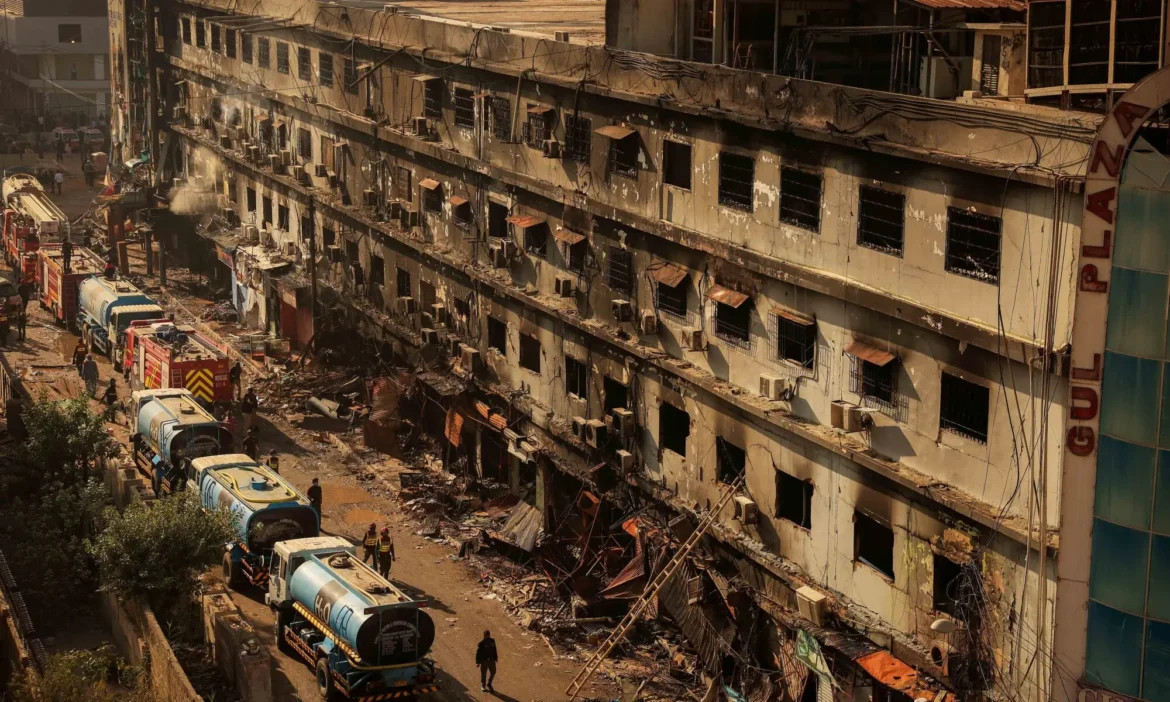
KARACHI: Rescue crews combed through the charred rubble of Gul Plaza on Tuesday, recovering the bodies of 28 people killed in a weekend blaze that gutted one of this sprawling port city’s busiest shopping complexes and left dozens still missing, as grieving families like that of a laborer searching for his 13-year-old son pressed authorities for answers amid a history of deadly fires fueled by lax safety enforcement.
The fire erupted late Saturday in the Saddar business district, tearing through the ground-plus-three-story building that housed some 1,200 shops across 8,000 square yards — an area larger than a football field — and causing parts of the structure to collapse. Officials said the inferno, Karachi’s worst in more than a decade, trapped shoppers and workers inside the densely packed plaza, where overcrowding and outdated infrastructure have long posed hazards in a metropolis of over 20 million.
By Tuesday, smoke still rose from the wreckage as heavy machinery cleared debris, allowing teams to probe the basement and upper floors. South Deputy Inspector General Syed Asad Raza told local media that rescuers had just begun entering the first floor, with at least two overnight recoveries, though cell phone data traced 38 of more than 65 missing people to the site. Officials feared more victims lay buried.
Police surgeon Dr. Summaiya Syed confirmed postmortem exams on the 28 bodies, noting that DNA samples from 50 families were being cross-matched at labs, with seven identifications completed so far. At least 74 people remained unaccounted for, including seven women and seven children, according to a provincial missing persons desk set up though some lists showed duplicates.
At the scene, a crowd gathered behind police barriers, many scanning the smoldering ruins for signs of loved ones. Their faces etched with exhaustion and hope. Sarfaraz, a 42-year-old laborer who gave only his first name, returned repeatedly since the fire, barred from entering due to collapse risks. His son Hamza, who worked at a flower shop to help support the family, remained unaccounted for, while Hamza’s two brothers escaped the flames. “When I come home, his mother asks, ‘What happened to my son?’” Sarfaraz said. “She is not speaking nor eating anything, even with food placed in front of her. She has turned to stone.” When I reached there, my son was not there,” he recalled. “I got mad, the fire was there, there was smoke, but it had not yet turned into flames.”
Nearby, Fazal Malik, from the Keamari area, wiped tears as he questioned the pace of the search for his wife and two relatives. “I don’t know why they are taking so much time in clearing this debris,” he said. “They should have allowed us and our men would have done it much faster.”
From the Edhi rescue group, Muhammad Ameen described what they found late Sunday: five bodies, one a woman’s, but mostly just parts. “Those bodies had only organs left,” he said, “and their identification is not possible.” Fida Hussain, running the government’s missing persons station at the site, said complaints poured in, building the tally. Rescue 1122 folks warned that fragmented remains might mean the death count isn’t final until forensics catch up.
Chief fire officer Muhammad Humayun Khan laid out the fight: the place covered more than two acres, and it took 12 fire trucks, three snorkels and a water tanker to beat back the flames. “You can’t see the flames anywhere,” he said. “The cooling process is going on.” He wouldn’t guess at the cause — that’s for investigators — but he did tell shop owners to get extinguishers and talk to experts.
Mayor Murtaza Wahab, who had been at the site through the night, said the fire was contained but pledged no letup. “All possible help will be provided to the affected families,” he said, with municipal teams on alert until every missing person was found.
The fire spurred national debate. In the National Assembly, Muttahida Qaumi Movement-Pakistan’s Dr. Farooq Sattar demanded it be declared a national tragedy, blasting Sindh’s “inaction, apathy, and corruption” and late arrivals by Shah and Wahab. “This fire was not only in Gul Plaza but in the hearts of the people of Karachi as well,” he said, advocating empowered local governments to manage the city’s burdens. Defence Minister Khawaja Asif agreed, saying Karachi’s structure made effective administration impossible without grassroots power. “If we truly want to represent the people of Pakistan, then provide them representation in their own neighborhoods,” he said.
This kind of horror isn’t new in Karachi, a city bursting with over 20 million souls where old buildings, jammed corridors and spotty safety checks turn fires into killers. The city has seen such disasters before — the 2012 Baldia Town factory fire that claimed over 260 lives, the 2009 Bolton Market arson that razed hundreds of shops. Traders here point to outdated wiring, absent fire exits and lax inspections as chronic risks in commercial hubs.
Sindh Chief Minister Murad Ali Shah offered Rs10 million, about $36,000, to each victim’s family and formed a committee with business leaders to tally losses and relocate shops. Traders estimated the damage at Rs5 billion, or $18 million, hitting up to 10,000 families tied to the plaza’s workforce. “The plaza had at least 8000-10,000 laborers and then those affiliated to them. We can easily say nearly 10,000 families have been affected by this fire,” Atiq Mir, president of the Karachi Tajir Ittehad, said.
An inquiry into the cause was ordered, with calls for stricter safety audits across 145 buildings. But for those like Sarfaraz, the promises rang hollow. “I want my son back,” he said.
Copyright © 2021 Independent Pakistan | All rights reserved