By Staff Reporter
ISLAMABAD: Former Foreign Minister Bilawal Bhutto-Zardari on Wednesday proposed a bold partnership with India to combat terrorism and foster peace, a call that comes as tensions between the nuclear-armed neighbours show no signs of easing.
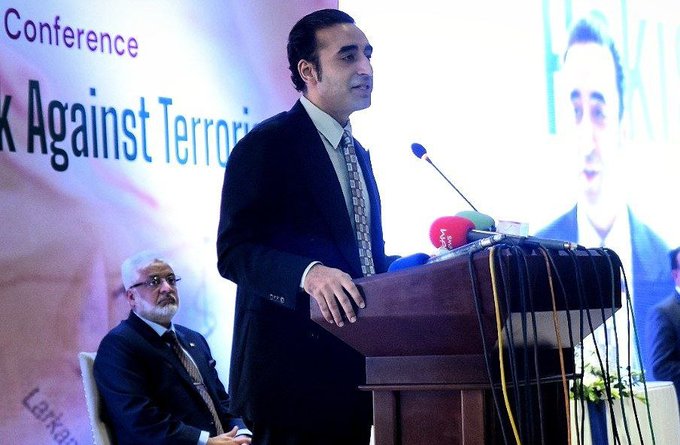
Speaking at an international conference titled “Pakistan Fighting War for the World against Terrorism” at the Islamabad Policy Research Institute, Bhutto-Zardari urged India’s leadership to set aside decades of rivalry.
“Pakistan is ready to forge a historic, phenomenal partnership with India to jointly combat terror,” he said, framing the proposal as a moral imperative. “Not as adversaries playing a zero-sum game but as neighbors who share a moral and civilisational obligation to save a billion souls from the plague of extremism.”
The overture follows months of friction. In April, India accused Pakistan of involvement in the deaths of 26 civilians in occupied Kashmir, a claim Islamabad rejects. The situation spiraled on May 7 when India launched missile strikes into Pakistan, targeting what it described as “terrorist camps.” Days of artillery exchanges, airstrikes, and drone attacks followed until a US-brokered ceasefire took hold on May 10.
Bhutto-Zardari pressed India to address long-standing disputes, including the Kashmir conflict and a water crisis exacerbated by India’s April suspension of the Indus Waters Treaty (IWT). Pakistan contested the move, and the Permanent Court of Arbitration later upheld its position, ruling that the treaty does not permit unilateral suspension.
“Let us end the weaponization of water and build instead a peace as mighty as the Himalayas,” he said, invoking the region’s shared heritage. “Let us return to our shared traditions grounded not in hatred but in the ancient soil of the Indus Valley Civilization.”
The former foreign minister cast terrorism as a “collective menace” transcending borders, urging a unified global response. “Terrorism is a global crisis that needs to be defeated for a sustainable future,” he said, warning of the role of “digital propaganda” in fueling extremism.
He pointed to Pakistan’s own toll. “2024 was the deadliest year in a decade in which 685 service members embraced martyrdom in 444 separate attacks.”
Bhutto-Zardari touted Pakistan’s counterterrorism record, crediting its armed forces and citizens with dismantling Al Qaeda, weakening the so-called Islamic State (Daesh), and pushing the Tehreek-i-Taliban Pakistan (TTP) out of its strongholds. “Operation Zarb-e-Azab drained the northern swamp, Raddul Fasaad uprooted the sleeper cells in our cities and elsewhere,” he said. “Today, operations in Balochistan sever the connection between separatism and foreign-funded terror.”
Yet he expressed frustration with Afghanistan’s Taliban regime, which he accused of failing to stem cross-border attacks despite Pakistan’s support. “They promised the world stability, they delivered a 40 percent surge in militant attacks on Pakistani soil,” he said, demanding they “honor the blood price of the Doha accord or be judged by the company you keep.”
Bhutto-Zardari challenged India’s leadership directly. “All it requires is for India’s leadership to step down from the high horse that is galloping its republic towards the abyss. Pursue peace with Pakistan. Sit with us. Talk to us. Let us resolve Kashmir in accordance with the aspirations of its people,” he said. “It is not a weakness to extend a hand. It is wisdom.”
He also called for international backing, stressing the need for “equitable burden-sharing” and investments in technology and counterinsurgency efforts. “No counterinsurgency has achieved victory without first winning hearts and minds,” he said. At home, Bhutto-Zardari warned “merchants of hate” that “there is no constitutional right to weaponize religion.”
Pakistan’s removal from the Financial Action Task Force (FATF) grey list, he argued, marks it as a serious player in counterterrorism, a transformation he urged India to see as “not a concession but an opportunity”. “We have fought and won the most expensive counterterrorism campaign in modern history,” he said. “Terrorists have no nationality, religion, caste, or creed, and this menace respects no law.”
Bhutto-Zardari’s speech reflects a persistent theme of Pakistan that dialogue as a path to stability. But with India and Pakistan at odds since their last formal talks in 2012, his words face a steep challenge. “If the world demands we outlaw militias, it must also demand that all people live free from collective punishment,” he said, drawing parallels from Kashmir to Palestine.
Copyright © 2021 Independent Pakistan | All rights reserved