By Staff Reporter
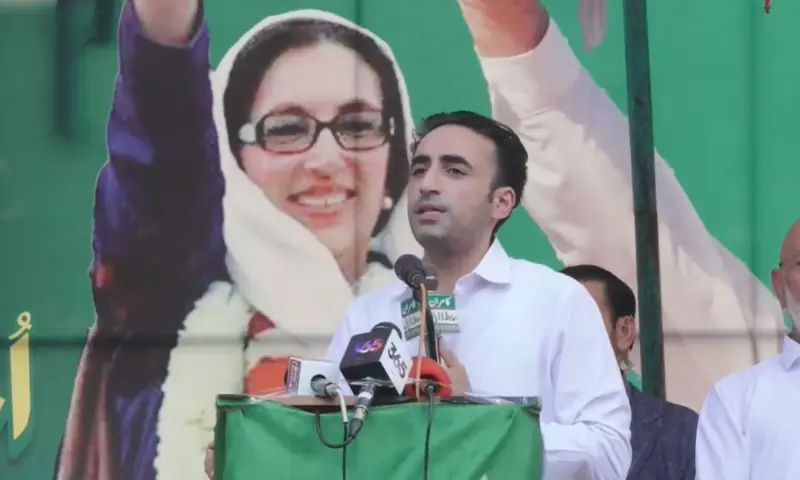
MIRPUR: Bilawal Bhutto-Zardari opened his party’s campaign for this month’s Kashmir elections with a direct challenge to the federal government on Friday, telling a rally here that if Pakistan could broker peace between the United States and Iran, it could just as easily end the monthlong standoff that has cut off food, fuel and medicine to the region.
“If the state of Pakistan can help bring peace between the United States and Iran and reopen the Strait of Hormuz, then it should also reopen Kashmir,” the Pakistan Peoples Party chairman told supporters in Dadyal, a subdivision of Mirpur district, invoking the US-Iran agreement Pakistan helped negotiate last month as the standard by which he wants his own government judged.
Bhutto-Zardari’s appearance in Dadyal marked the formal start of PPP campaigning ahead of the July 27 vote for Azad Jammu and Kashmir’s legislative assembly — an election he cast, in blunt terms, as a referendum on whether Pakistan’s political class can still speak for the territory it governs.
A REGION UNDER STRAIN
The rally came against a backdrop of unrest that has gripped AJK for roughly a month. Authorities declared the Jammu Kashmir Joint Awami Action Committee a proscribed organization under the territory’s Anti-Terrorism Act on June 5, days before the group’s planned protest over the abolition of the 12 assembly seats reserved for refugees who fled Indian-occupied Kashmir after 1947. The demonstrations have continued since, accompanied by disruptions that residents say have blocked essential supplies from reaching parts of the region.
Bhutto-Zardari, addressing the crowd, did not spare either side. He accused the AJK and federal governments of allowing the crackdown to spill onto the broader population, saying authorities had spent the past 30 days “punishing all Kashmiris” rather than confining their response to those responsible for the unrest.
“The protesters may be good or bad, they may even be wrong,” he said, “but the government is not punishing only the protesters. It is punishing all Kashmiris, and it has been doing so for the past 30 days.”
At the same time, he faulted the demonstrators for tactics he said were inflicting more harm on ordinary Kashmiris than on the state. Blocking food, fuel and medicine, he argued, does not pressure Islamabad — it simply punishes the people the protests claim to represent.
“Everyone has the right to protest,” he said, “but protesting in such a way that food supplies cannot reach Kashmir, fuel cannot reach Kashmir and medicines cannot reach Kashmir does not harm the government. It does not harm the state of Pakistan or the state of Azad Kashmir. The burden, the suffering and the hardship are being borne only by the people of Kashmir.”
He urged authorities, if action was warranted, to pursue it narrowly: arrest “the terrorist who had committed terrorism or the robber who had committed robbery,” he said, rather than let the broader population absorb the cost.
A RECONCILIATION PROPOSAL, STILL UNANSWERED
At the center of Bhutto-Zardari’s remarks was a proposal he said he had floated after demonstrators wrote to him directly: the formation of a truth and reconciliation commission empowered to determine responsibility for the crisis — who broke the law, and who did not — as a condition for de-escalation on both sides.
“I have suggested establishing a truth and reconciliation commission,” he said. “If it is formed, I will ask the protesters to suspend their protest.” He said his request would extend to the government as well, asking it to hold off on further measures while the commission did its work — but he acknowledged that more than a month after floating the idea, he had received no response from either side.
“If this is not the way,” he told the crowd, “I ask the government and protesters to tell me what the alternative is.”
A DEMAND FOR CLARITY FROM ISLAMABAD
Bhutto-Zardari also used the rally to press Prime Minister Shehbaz Sharif for a public accounting of federal policy toward Kashmir, pointing to recent comments from cabinet ministers that he said had muddied where Islamabad actually stands.
He singled out Defence Minister Khawaja Asif’s remarks on Kashmir and the refugee seats, saying that if they did not reflect government policy, Sharif should remove him. He was equally pointed about an unnamed federal minister’s reported comment that “12 Kashmir seats are in our pocket,” which he called evidence of a federal mindset dismissive of the region’s electoral process.
“The decision on Kashmir is not in anyone’s pocket,” he said. “It lies only in the hands of Kashmir’s youth.”
CAMPAIGN STAKES
Bhutto-Zardari framed the July 27 election as the most consequential in the territory’s history, telling the crowd that AJK, Pakistan, and the country’s political parties were all being tested by how the vote unfolds. He said politicians had failed for years to carry Kashmiris’ grievances to Muzaffarabad and Islamabad, and pledged that a PPP mandate would change that.
He extended the argument beyond Kashmir, saying Sindh, Khyber Pakhtunkhwa, Balochistan and Gilgit-Baltistan faced comparable neglect, and singled out AJK and Gilgit-Baltistan as regions that have waited generations for fuller integration into Pakistan’s political structure.
Looking past the election, he committed to convening a constitutional convention afterward, with reform proposals to originate from the public while final decisions on refugee-seat allocation and voting rights would rest with constitutional institutions. He said he opposes the current Ministry of Kashmir and Gilgit-Baltistan in its present form, calling instead for fuller regional empowerment, and pledged to seek representation for Kashmiris in Pakistan’s legislative forums, whether through observer status or on a provisional basis.
He described the vote as the last election in which refugee seats would be contested in their current form, in both AJK and Pakistan — a framing aimed squarely at the seats controversy driving the unrest.
The Election Commission has set July 27 for AJK’s general elections. The PPP has named candidates for 35 of the assembly’s 45 seats, left eight constituencies undecided, and allocated two seats to the Jamiat Ulema-i-Islam (Fazl), its electoral partner under a joint-contest agreement the two parties reached June 30.
Copyright © 2021 Independent Pakistan | All rights reserved