By Staff Reporter
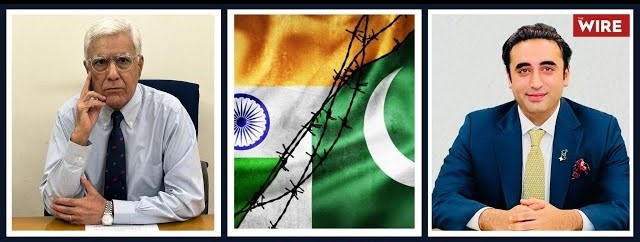
ISLAMABAD: In a fiery exchange with Indian journalist Karan Thapar, former foreign minister Bilawal Bhutto-Zardari categorically denied Pakistan’s involvement in the deadly Pahalgam attack and pressed for an international investigation, an offer New Delhi has flatly rejected.
The interview, aired on The Wire, laid bare the deep tensions between the two nuclear-armed neighborus, with Bhutto-Zardari accusing India of peddling disinformation while calling for a united front against terrorism.
The Pahalgam attack on April 22 left 26 tourists dead in occupied Kashmir, sparking a four-day military escalation with Pakistan from May 7 to May 10.
Speaking to Thapar, Bhutto-Zardari insisted that no evidence tied Pakistan to the assault. “As far as the Pahalgam terrorist attack is concerned, Pakistan has been willing to be part of an impartial international investigation; your government refused that,” he said.
Bhutto-Zardari challenged India’s silence on the attackers’ identities. “To this day, the Indian government has not shared with Pakistan, with the international community, with the Indian public… who exactly are these individuals that were involved in this terrorist attack that are from Pakistan?”
Bhutto-Zardari didn’t hold back, accusing the Indian government and media of orchestrating a “campaign of disinformation to continue to bamboozle the people of India.” “It’s very uncomfortable for you that I point out the truth to the Indian public, that they have been lied to… that Pakistan was involved in this attack when we were not. The government has been unable to provide the evidence.”
The interview turned combative, Thapar himself called it “quarrelsome”, as the host frequently cut in, prompting Bhutto-Zardari to threaten to walk out if not given a chance to respond.
Thapar raised the role of The Resistance Front, the group claiming the attack, noting that China, allegedly at Pakistan’s urging, had blocked its designation as a terrorist organisation by the United Nations.
Bhutto-Zardari shot back that Pakistan was open to cooperating against the group, but pointed out India’s own resistance to UN bans on groups like the BLA and Majeed Brigade, which Pakistan has sought to outlaw.
The exchange came on the heels of Bhutto-Zardari’s remarks to Al Jazeera last week, where he said Pakistan would consider extraditing figures like Hafiz Saeed and Masood Azhar, wanted by India for their alleged roles in attacks including the 2008 Mumbai siege, as a “confidence-building measure,” contingent on New Delhi’s cooperation.
Addressing Saeed’s case with Thapar, he noted the Lashkar-e-Taiba chief was imprisoned and the Mumbai case remained active, but stalled. “The frustration that the courts and the Pakistani government and legal system are having with achieving a conviction is that India is refusing to participate in the trial and produce the witnesses necessary to record their statements,” he said.
Bhutto-Zardari framed Pakistan’s fight against militancy as a decades-long struggle with deep historical roots, tied to the Afghan jihad of the Cold War era. He spoke personally, invoking the assassination of his mother, Benazir Bhutto. “I, too, am a victim of terrorism. I feel the pain of the victims of Pahalgam terrorist attack. I understand the trauma that their families are experiencing in a way more than many others can ever imagine.”
Turning to the Indian people, he urged restraint amid rising tensions. “I just want to tell the people of India that they must be, they must avoid disinformation and hate mongerers. It is easy for this generation to talk about war and tell you that every Pakistani is a terrorist, every Pakistani is your enemy; that is not true,” he said.
He rejected the notion that Pakistan sanctions cross-border attacks, emphasising his country’s own suffering. “We’ve lost 92,000 lives altogether. Just last year, we lost more than 1,200 civilian lives in over 200 different terrorist attacks.” He warned that if current trends persist, “it will be the bloodiest year in Pakistan’s history.”
Bhutto-Zardari touted Pakistan’s counter-terrorism efforts, citing military operations in South and North Waziristan and compliance with the Financial Action Task Force (FATF). “Most recently, we went through a rigorous FATF process with the international community endorsing Pakistan’s actions against said terrorist groups,” he said, adding that the National Action Plan addressed India’s concerns. “So it’s not like you can hide from it.”
He reiterated Pakistan’s call for a global probe into Pahalgam, noting Prime Minister Shehbaz Sharif’s public offer after India’s accusations, a gesture New Delhi dismissed. “I’d like to see the day where India and Pakistan engage in comprehensive dialogue, which should also include the issue of terrorism, so we can collectively combat this menace,” he said.
But he didn’t stop at defence, Bhutto-Zardari accused India of double standards, recalling the 2007 Samjhota Express bombing that killed dozens of Pakistanis with no convictions. “We can’t ignore saffron terror on one side and then hold another standard by which Pakistan is judged,” he said.
The former foreign minister pointed to Kulbhushan Jadhav, an Indian national arrested in Balochistan and convicted of espionage, and said recent attacks, like the Jaffar Express bombing, were linked to Indian intelligence. “Most recently, the Jaffar Express attack can be directly linked to facilitators in your intelligence agency,” he told Thapar.
The former minister also slammed India’s move to suspend the Indus Water Treaty, a decades-old pact governing shared rivers. “Indian Prime Minister and your government are threatening to cut off the water supply to 240 million people of Pakistan. This goes against everything it is to be Indian. It goes against the philosophy of Gandhi. It goes against all we’ve been taught about a secular India,” he said.
Bhutto-Zardari tied Pakistan’s Operation Bunyanum Marsoos to Indian aggression but stressed a desire for de-escalation: “We want peace. We can talk together and sort out all our issues.”
Bhutto-Zardari is the first Pakistani politician who appears on an Indian media outlet after the recent tensions between the arch-rivals. In a tweet afterward, Bhutto-Zardari explained his choice. “I chose to give an interview to Indian media, not because I expected a fair platform, but because I believe in the people of India, especially the youth. The case for peace in our region is not just a Pakistani cause, it is a shared mission for both our peoples. I believe the new generation of Indians and Pakistanis can chart a new destiny.”
“We will be the generation that breaks the shackles of history, that defies the war-mongers, the cynics, and the peddlers of hate,” pledging a future of “peaceful co-existence, cooperation and prosperity.”
Copyright © 2021 Independent Pakistan | All rights reserved