By Staff Reporter
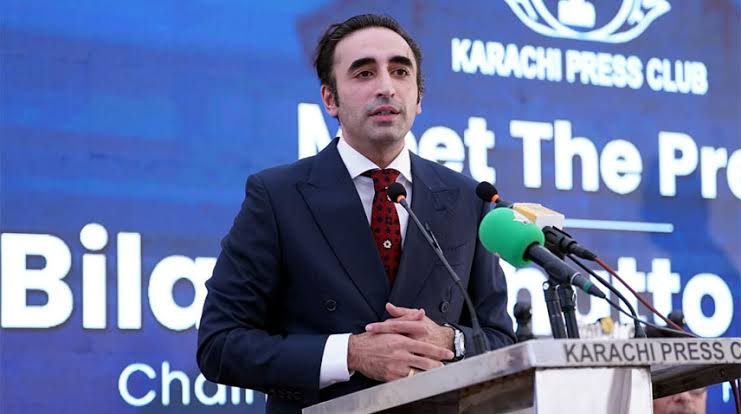
KARACHI: Bilawal Bhutto-Zardari, whose Pakistan Peoples Party sustains the coalition government of Prime Minister Shehbaz Sharif, has said that the governance system did not collapse but “was made to collapse”, and demanded Imran Khan’s release as part of a political reset.
In a speech at the Karachi Press Club on Tuesday that broke with the ruling coalition on almost every front, the PPP chairman also called for the opposition’s reserved seats to be returned without conditions, rejected a referendum on new provinces, and warned that dividing Sindh would bring blood to Karachi’s streets. He described the 27th Amendment, which he strongly advocated when it passed a year ago, as the product of a “brute majority”.
The intervention is aimed squarely at Interior Minister Mohsin Naqvi, who said in July that the system had “collapsed” and needed a “reset” through new administrative units. Defence Minister Khawaja Asif has since spoken of as many as 12 provinces. No formal decision has been taken. Naqvi said last week that he and Bhutto-Zardari were “almost” on the same page and proposed a referendum on the question.
Bhutto-Zardari’s reply was that the page in question had never been written in parliament. “Nobody objects that the system has collapsed, but there is no discussion and debate on why it collapsed,” he said, adding that the proposed remedy was “not an actual remedy to the illness due to which we suffered a system collapse”.
A reset was “definitely needed”, he said, but only a political one. “Why political? Because politicians are the representatives of the people, and if politicians do not play their role, then these fundamental issues won’t be resolved.” He did not exempt himself. “Everyone makes mistakes, but there comes a time when you must fix those mistakes. How do we fix that?”
A prisoner’s cause
The sharpest departure came when he was asked whether Khan, the jailed PTI founder, was a political prisoner. Bhutto-Zardari said he was, and that no such prisoner should remain in Pakistan if the system was to function.
“What a weird country this is; since 1947, whoever becomes the prime minister goes to jail, whoever gets out of jail goes to sit in the Prime Minister House,” he said. “A person becomes the prime minister and is later imprisoned. So I can either accept that every prime minister in the country’s history has been a thief, or I can accept that all prime ministers in our history have been victims of political revenge.”
He had not turned into a PTI partisan. He acknowledged that Khan’s party had made mistakes of its own, and said he hoped that “one day… no prime minister should have to go to jail”. But his message to the government was that Khan’s party should not be treated as a pariah. “You broke [our] back, then ask ‘why did you fall’,” he said. In December he urged the PML-N to give the PTI political space after the Punjab Assembly called for the party to be banned.
The reserved seats
The PTI lost its reserved seats after the 2024 election. The Supreme Court later ruled it eligible for them, but a constitutional bench formed under the 26th Amendment overturned that ruling on review petitions from coalition parties.
Bhutto-Zardari, whose PPP was itself a beneficiary of the case, called what followed “a joke”. The opposition had been deprived of the seats, he said, and “those in the treasury benches also put them in their pockets”.
“And from those same reserved seats, which are not yours, you brought constitutional amendments not once but twice, and are now thinking to bring a third one,” he said. Handing the seats back “without any preconditions” would be “a confidence-building measure”. He also called for the PTI’s party symbol to be restored, recalling that the PPP lost its own in 1988. The public had answered that decision at the polls, he said, and “revoking the symbol from a party is akin to you joking with the public”.
The 26th Amendment, he said, was at least passed with “bilateral agreement, if not complete consensus”, because the opposition’s input came through Maulana Fazlur Rehman. The 27th was “passed neither through political consensus nor bilateral agreement; it was passed with brute majority”. He said he was not seeking to unpick it, but doubted whether the constitutional court it created enjoyed public confidence. “If the lawyers and judges themselves do not have confidence in the courts, then the system did not collapse, but was made to collapse.”
“Blood” on the streets
On new provinces his language was more menacing. The PPP favours more provinces in principle, he said, but not a “forced separation”. “We talk about the garbage on Karachi’s streets, but if Sindh is divided, we will see blood flow through its streets.” The Sindh Assembly had passed several resolutions against division, and “any more discussion on this issue is a slap to the people of Sindh”.
A referendum, he argued, revealed its own purpose. “In our history, a referendum has always been carried out for an undemocratic act and never a democratic one.” If the Constitution already set out how provinces are created, proposing one meant “you were looking for an unconstitutional method”.
He said the proposals were coming from outside parliament, and that neither the cabinet nor parliament had discussed them. “So, how could it be that federal ministers are talking about it of their own accord?” he asked. He said he would like to believe Prime Minister Shehbaz Sharif had “enough authority over his own ministers”, then added: “You are sabotaging your own prime minister, and then you complain that the system has collapsed.”
Of those behind the idea he said: “They have not won even a single election in their lives.” He said his own legislators were under “pressure” but would not yield, and that even he could not deliver them. “If tomorrow, my software is updated and I direct my party to vote for Sindh’s division, there will be a revolt against me.”
The money
He tied the dispute to the 18th Amendment and to money. Sindh, he said, was giving the Centre a Rs585bn surplus, with Rs260bn more provided “in security and national interest”, before counting what he called the province’s rightful share of the petroleum levy, about Rs1.7tr.
“So, you will pickpocket the province, loot our resources and then come and ask us, ‘why the roads are broken and why no schools or hospitals have been built’,” he said. If a province paid in that much, he added, “the federal government should be held responsible for the lack of public spending, not the provincial government”.
He also took up the cause of Maulana Fazlur Rehman, the JUI-F chief, who has traded insults with federal ministers for a month after accusing the Centre of depriving the provinces of their rights. Maulana Fazl also joined the opposition in criticising governor’s rule and an emergency in the PTI-run province of Khyber Pakhtunkhwa, and accused the Centre of reneging on commitments while he tried to mediate.
“It is the opposition’s right to criticise you, and however he does it, it is their right,” Bhutto-Zardari said. Questioning an opposition member’s patriotism, he said, was “the biggest injustice to the country”.
He accused the government of turning on its critics. “When someone from the opposition makes a speech [..] then all of a sudden, you set the National Accountability Bureau on them, arrest their sons… Now, all of a sudden, there is encroachment [around their house].” The remark appeared to refer to a recent Capital Development Authority notice over alleged unauthorised construction at the JUI-F chief’s residence. “This is why the system has collapsed [..] you are making it collapse.”
On Khyber Pakhtunkhwa, where the PPP holds the governorship, he said governor’s rule could not last for ever. “If the PTI is ready to fight against terrorism together with you, then the governor’s rule can also be ended.”
Asked about Naqvi’s suggestion that the two men were in step, Bhutto-Zardari said: “I had heard we were on the same page, and if this is the page we are on, then nothing could be better.” As for the government’s own thinking, he said: “I don’t know what they are thinking.”
Copyright © 2021 Independent Pakistan | All rights reserved