By Staff Reporter
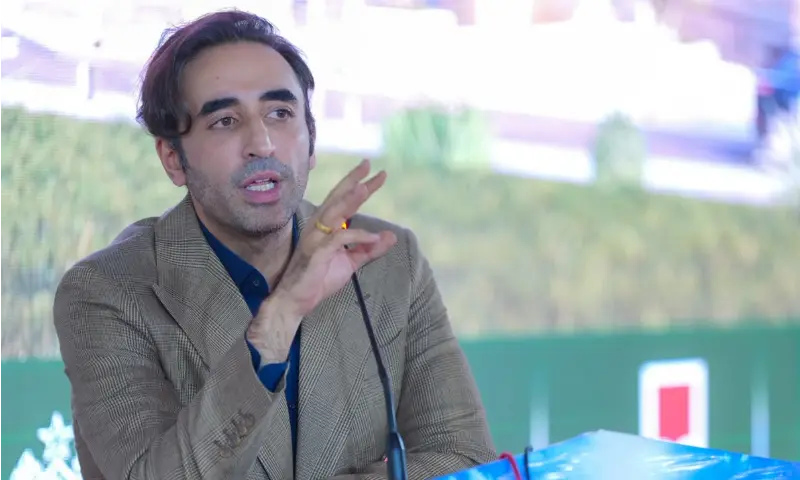
LARKANA: Bilawal Bhutto-Zardari, chairman of the Pakistan Peoples Party (PPP), has urged the government to stop “fighting everyone” and concentrate on the economic hardship facing ordinary people, warning that the fallout from the war on Iran will outlast the fighting.
Speaking at a ceremony in Larkana, in Sindh province, on Friday, the former foreign minister said people around the world were bearing the economic cost of the US-Israeli war on Iran.
“This is a backbreaking burden. We have not seen this phenomenon in the past,” he said, adding that even if the war ended tomorrow, its economic consequences were unlikely to end soon. Whether or not a country was directly involved, he said, supporting its people had become the biggest test for many governments.
His remarks were aimed at the PML-N-led federal government of Prime Minister Shehbaz Sharif, whose budgets the PPP has backed.
“I advise the federal government that this is the time to engage with the political, social and provincial stakeholders rather than fighting everyone,” Bhutto-Zardari said.
At the groundbreaking of a 600-bed hospital, he asked: “Pakistan is facing economic difficulties. If we keep fighting the PTI, Maulana Fazlur Rehman, terrorists, Afghanistan and India, when will we focus on economic development?” If the squabbling continued, he warned, the government might find itself occupied with nothing else. “Our priority should be the problems faced by the people.”
The intervention follows weeks of sharp exchanges between federal ministers and Maulana Fazlur Rehman, head of the Jamiat Ulema-i-Islam-Fazl (JUI-F), who has accused the Centre of depriving the provinces of their rights and of reneging on commitments. Before governor’s rule was imposed, he had been trying to mediate between Islamabad and the PTI after talks on demands, including Imran Khan’s release failed.
The federal government imposed governor’s rule in Khyber Pakhtunkhwa (KP) on 11 October, with an emergency declared in 12 districts, after President Asif Ali Zardari – Bhutto-Zardari’s father – signed the summary on the prime minister’s advice. The Centre cited the PTI-led provincial government’s “deliberate disengagement” from the fight against terrorism. Parliament endorsed the measures over opposition protests.
On 16 October, without naming anyone, Interior Minister Mohsin Naqvi said a “head of a party” was “extremely upset over being denied a role in the new setup in KP and not getting the governorship”. The next day Defence Minister Khawaja Asif and Tallal Chaudhry, the minister of state for interior, rebuked Maulana Rehman directly. He later said his criticism was aimed at policies, not state institutions.
The dispute reached parliament, where the JUI-F chief questioned Asif’s absence and Naqvi’s presence at a meeting in Tehran. Speaking in the Senate on 29 October, Naqvi said the maulana had crossed the line. He accused the JUI-F of “continuously crossing the line” and of “extracting wealth from the state”. A joint PTI delegation and one from the Tehreek-e-Tahafuz-e-Ayin-e-Pakistan alliance later visited Maulana Rehman to express solidarity, condemning what they called personal attacks on him.
Bhutto-Zardari used his Larkana speech to defend the imposition of governor’s rule, rejecting claims that counterterrorism was a pretext for removing the elected PTI government. “This claim is not based on facts,” he said.
“The PPP maintains that the democratically elected governments are always in a better position to deal with all matters, including terrorism,” he added. But he said the recent surge in attacks and deaths had not been seen since around 2007-2008. “After the change of the government in Afghanistan, the terrorists’ threats to Pakistan have increased. This is a ground reality,” he said.
He said the KP chief minister, Sohail Afridi, had failed to combat terrorism or protect the province’s people, leaving the president no constitutional or legal grounds to reject the summary. He blamed Afridi for the collapse of talks between the opposition and the government, which began at the PPP’s urging.
“Even the opposition leaders who were negotiating with us know that they cannot blame anyone, including the prime minister, for this move,” he said.
He nonetheless called for talks to resume. “Even today, I invite the PTI to negotiate and request the government to engage with them. Do not close the door for talks,” he said. If a consensus on countering terrorism were reached, he added, he would be the first to call for an end to governor’s rule.
Bhutto-Zardari also pressed the PTI to join the parliamentary committee on electoral reforms, calling the issue “fundamental”. He said opposition leaders in the National Assembly and Senate had been empowered by Khan to make decisions on dialogue and should “unconditionally” name their representatives. The opposition had previously said Khan should first be released or allowed to meet party leaders, he said.
The National Assembly approved the committee’s formation last week, as a PPP delegation met Senate opposition leader Raja Nasir Abbas to urge him to join. The PTI has objected to the proposed make-up, with its chief whip, Amir Dogar, questioning how reform could be meaningful when the opposition would hold five seats against 15 for the government. He asked for the formula used for the 2013 committee. The PPP submitted its own nominations on 4 November, proposing five members from the National Assembly and two from the Senate.
“After all the efforts, if PTI does not take part in this committee, then the people of Pakistan should not pay heed to their cries against electoral rigging,” Bhutto-Zardari said. He said the opposition bore equal responsibility for weakening parliament. “If the opposition boycotts committee proceedings, then how can it criticise that the Parliament is frail?” he asked. “We have to begin from somewhere.”
He said both PTI and some government representatives had alleged rigging, and that electoral manipulation had also been aimed at keeping the PPP from success.
Bhutto-Zardari described his recent meeting with Sharif as positive, saying the two sides had worked on a joint strategy for national challenges. He thanked the prime minister for better implementation of federal projects in Sindh but said the province had long received an inadequate share of development funding.
Copyright © 2021 Independent Pakistan | All rights reserved