By Staff Reporter
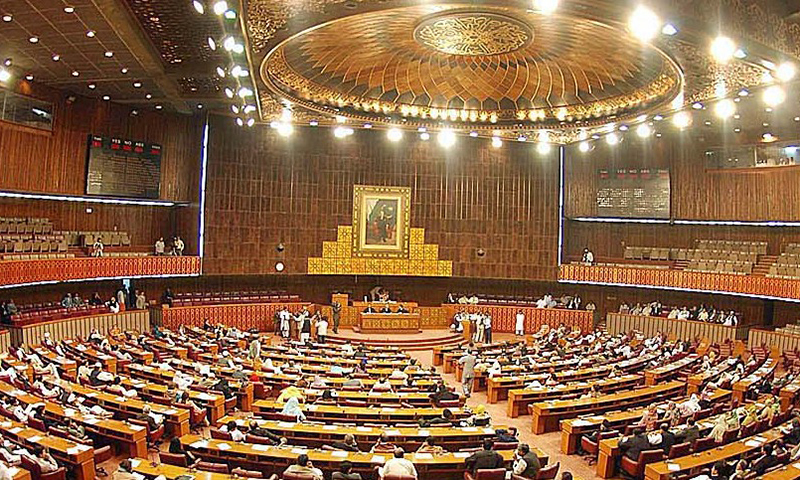
ISLAMABAD: The coalition government has put a contentious constitutional amendment package on judicial reforms on hold, apparently indefinitely, after failing to secure crucial votes from a former ally and adjourned parliament sessions without tabling the legislation.
The government was expected to table the amendments in the National Assembly and Senate on Monday, but intense negotiations a day earlier with the chief of the right-wing religiopolitical party, Maulana Fazlur Rehman, failed to break the deadlock.
Rehman has expressed conditional support for certain amendments but is seeking additional time to scrutinize specific provisions in greater detail, government officials said.
The coalition needs 224 votes in the 336-member National Assembly and a two-thirds majority in the Senate, but numbers suggest it is short of at least a dozen votes in both houses.
Rehman’s backing is seen as pivotal, with his 13 seats in both houses potentially tipping the scales in favor of the government.
The government had touted its ability to muster the required 224 votes in the National Assembly and 64 in the Senate, but the decision to postpone parliamentary sessions has raised questions about its confidence.
The coalition government of Prime Minister Shehbaz Sharif previously said it has enough support from smaller parties to pass the amendment in both houses if Rehman lends his support.
Senator Irfan Siddiqui, a senior lawmaker of the ruling Pakistan Muslim League-Nawaz (PML-N), said sessions of both houses would be prorogued on Monday, with the party seeking more time to prepare the ground for the amendment.
Asked if the matter could be delayed for months, Siddiqui ruled out the possibility, saying the legislation is likely to be tabled within a week or two.
“It was our wish to pass this legislation within two days,” he added.
The proposed constitutional amendment package, comprising 52 changes, remains shrouded in secrecy, with details yet to be officially disclosed.
Reports suggest the package includes measures to establish a federal constitutional court, raise the retirement age of superior judges by three years, and modify the appointment process for the chief justice of Pakistan’s Supreme Court.
The government on Monday also clarified that a proposed constitutional package has not been presented to the federal cabinet for approval. The draft amendments have not been submitted to either the federal cabinet or the Cabinet Committee for Disposal of Legislative Cases (CCLC) for review.
As per standard procedure, any constitutional amendment must first be cleared by the federal cabinet before proceeding further.
The move, however, has drawn criticism from key opposition parties who warn that it undermines judicial independence. They said the amendments are expected to give the executive greater control over key judicial appointments, postings, and transfers of superior court judges, as well as defections during house votes.
The opposition Pakistan Tehreek-e-Insaf (PTI) party, led by jailed former Prime Minister Imran Khan, has criticized the amendments, alleging they aim to grant an extension to current Chief Justice Qazi Faez Isa, perceived to be sympathetic to the ruling PMLN alliance led by Prime Minister Sharif.
Defense Minister Khawaja Muhammad Asif said the constitutional amendment package will be presented to parliament once consensus is achieved among all parties, aiming to address “constitutional imbalances” and restore parliamentary powers.
“We want and desire complete consensus within the House, so this process will continue, and when all parties agree on this document, this draft will be presented in the House,” Asif told the National Assembly, the lower house of parliament, on Monday afternoon.
Asif said the proposals, aligning with the 2006 Charter of Democracy, will not face opposition as they are determined to shape the constitution accordingly.
“A draft has been prepared to address constitutional imbalances, especially those related to parliament, and it is a draft to improve the 19th amendment,” Asif said, adding that the constitution allows for such changes.
The proposed draft recommends reversing a previous addition to Article 63-A, allowing lawmakers’ votes against party policy to be counted, and establishing constitutional courts for “speedy justice,” a practice followed in many democratic countries.
“We aim to reduce the burden on the judiciary and make life easier for plaintiffs and common people. Currently, around 2.7 million cases are pending in courts. Steps for speedy justice and the counting of votes are not politically motivated.”
The draft legislation also proposes merging a parliamentary committee and a judicial commission to enhance parliament’s role in judicial appointments, aiming to reclaim parliamentary rights and avoid being a “rubber stamp” in judge appointments.
“We are trying to reclaim the rights that belong to us as we want to assert the powers of parliament and avoid having them served as a rubber stamp in the appointment of judges,” the minister said.
Copyright © 2021 Independent Pakistan | All rights reserved