By Staff Reporter
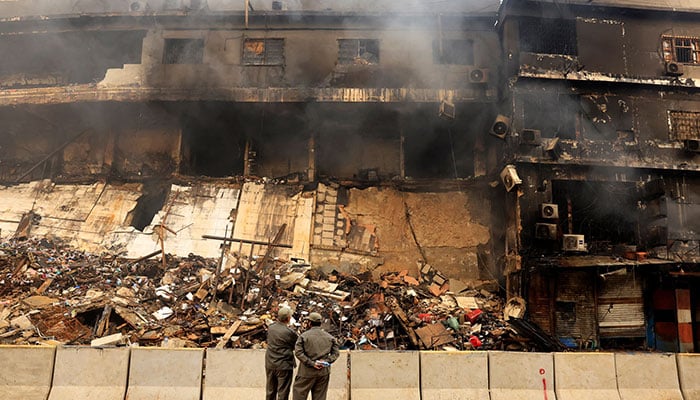
KARACHI: The death toll from a devastating fire that gutted a bustling shopping mall in Karachi climbed to 14 on Monday as rescuers pulled eight more bodies from the charred wreckage and battled rekindled flames amid fears that dozens more people remained trapped inside.
The blaze, which erupted late Saturday at Gul Plaza on MA Jinnah Road in the city’s teeming Saddar district, raged for more than 24 hours before firefighters declared it under control on Sunday. But by Monday morning, smouldering debris reignited, forcing crews to resume operations from the adjacent Rimpa Plaza side, according to Rescue 1122 Chief Operating Officer Abid Jalal.
South District Deputy Inspector General Syed Asad Raza told reporters that the latest recoveries brought the confirmed fatalities to 14, including one firefighter, and warned that the number could rise further as search teams sifted through the rubble. Five of the bodies, some burned beyond recognition, were taken to Civil Hospital Karachi, police surgeon Summaiya Syed said.
The multi-story plaza, home to more than 1,200 shops crammed with clothing, electronics and other goods, was a hive of activity during Pakistan’s peak wedding shopping season, amplifying the economic blow to traders who lost decades of investments in a single night. Preliminary estimates from traders’ representatives pegged the financial damage at over $10 million, with inventories reduced to ash and livelihoods shattered. “We’ve been left high and dry, reduced to zero; 20 years of hard work, all gone,” said Yasmeen Bano, a shop owner who watched helplessly as flames consumed her business.
Sindh Gov. Kamran Tessori, surveying the site on Monday, described the incident as a “national tragedy” and said reports of more than 70 people missing were “extremely alarming.” He voiced particular concern over information that a pregnant woman was among those trapped, saying that saving lives remained the top priority even as investigators worked to pinpoint the fire’s cause — initially suspected to be an electrical short circuit. “I am in constant contact with three major builders of the city for the restoration of the market,” Tessori said, pledging to “stand with the affected people” until their losses were fully compensated.
Karachi Mayor Murtaza Wahab, who arrived at the scene late Sunday — nearly 23 hours after the fire started — faced protests from distraught crowds. He put the number of missing at around 65, while police reported that families of 59 individuals had come forward. Authorities said they had obtained cellphone numbers for the missing and traced 26 signals back to the site, with efforts ongoing to locate the rest.
The fire broke out at 10:14 p.m. Saturday in a shop selling artificial flowers and pots, quickly spreading upward through poorly ventilated floors filled with flammable materials. Rescue 1122 was notified at 10:38 p.m., but the first two fire tenders didn’t arrive until 10:57 p.m., according to fire brigade accounts. “When we arrived, the fire from the ground floor had spread to the upper floors, and almost the entire building was already engulfed in flames,” said Rescue 1122 spokesman Hassanul Haseeb Khan.
Firefighters cited narrow entrances — 14 to 16 in total — clogged with smoke, making access nearly impossible. A water shortage struck within hours, exacerbated by construction work near Guru Mandir that stalled water bowsers. Crowds and poor traffic management further delayed reinforcements, officials said. By Monday, 12 fire tenders, six water bowsers and two snorkels were on site, using foam to douse persistent hot spots. Chief Fire Officer Zafar Khan noted that 90 percent of the blaze was extinguished, but goods inside continued to burn, and the structure’s instability limited how long crews could stay inside. Rescuers entered safer sections briefly, using hammers to break walls and cut windows for entry.
Traders and residents lambasted the delayed response, pointing out that the Saddar Fire Station was just minutes away, yet failed to mobilise quickly. Shopkeepers argued that full resources from the outset could have contained the fire, sparing lives and property. One local resident recalled repeated assurances of water shortages on Saturday night, while others questioned the absence of the mayor and provincial ministers during the height of the crisis.
Jawaid Qureshi, president of the All Pakistan Anjuman-e-Tajiran Sindh chapter, accused the government of incompetence on national television, saying the rescue operation remained incomplete after 34 hours. “The traders are bearing financial and human losses, and they themselves are being blamed,” he said, noting that maintenance fees from shop owners funded security, upkeep and generators — not fire safety upgrades. He acknowledged that the building had unauthorised extensions beyond its permitted ground and first floors, including basement shops.
The Karachi Chamber of Commerce and Industry formed a committee to tally losses, coordinate relief and push for government compensation, drawing parallels to the 2009 Bolton Market fire, where funds rebuilt affected markets and aided nearly 2,000 victims.
Sindh Chief Minister Murad Ali Shah ordered an immediate inquiry by the Karachi commissioner to probe safety lapses or negligence, vowing “strict action” against those responsible. He told reporters that the building’s intensity and limited access points hindered entry, and preliminary reports indicated 58 to 60 missing, though numbers were still being verified.
Prime Minister Shehbaz Sharif spoke with Shah by phone, offering federal support and stressing the need for a “coordinated and effective system” to handle fires in crowded cities. He called for stronger preventive measures and said Islamabad was ready to collaborate on an integrated fire-response framework.
The tragedy drew international condolences. Britain’s high commissioner to Pakistan said she was “heartbroken” by the loss, adding, “May strength be with the community at this time.” The German Consulate in Karachi expressed sorrow on X, saying, “Our thoughts & prayers are with the victims, their families, and those injured.”
Deadly fires plague Karachi, a sprawling metropolis of over 20 million where overcrowding, ageing infrastructure and lax enforcement of safety rules turn minor incidents into catastrophes. Many commercial buildings lack fire exits, sprinklers or alarms, with hazardous wiring and encroachments blocking emergency vehicles. Inspections are rare, penalties rarer still, allowing risks to fester in tightly packed districts like Saddar.
Copyright © 2021 Independent Pakistan | All rights reserved