By Staff Reporter
ISLAMABAD: A court on Saturday sentenced a prominent human rights lawyer and her husband to a combined 17 years in prison for social media posts that authorities said glorified terrorism, spread false information and amounted to cyberterrorism, a verdict that drew swift condemnation from rights advocates and opposition figures who called it a blatant effort to stifle dissent.
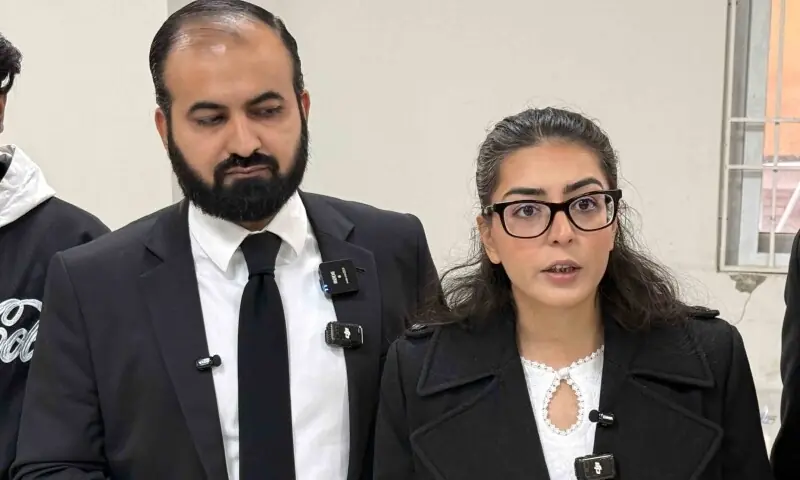
The ruling by Additional District and Sessions Judge Muhammad Afzal Majoka came amid a flurry of legal actions against Imaan Zainab Mazari-Hazir and Hadi Ali Chattha, a lawyer couple already detained in a separate case. They appeared via video link from Rawalpindi’s Adiala jail, where they had been held on judicial remand since their arrest in Islamabad the previous day.
In a detailed written order, Judge Majoka found that the prosecution had proven its case under sections of the Prevention of Electronic Crimes Act (Peca). The couple was convicted of glorifying offences under Section 9, cyberterrorism under Section 10 and disseminating false information under Section 26-A. Under Section 9, each received five years of rigorous imprisonment and a fine of Rs5 million, with an additional year if unpaid. For Section 10, the penalties were steeper: 10 years each and fines of Rs30 million, plus two more years for nonpayment. Section 26-A brought two years each and Rs1 million fines, with six months added for default. The sentences are to run concurrently, and the judge applied a provision allowing time already served to count toward the total.
The convicts, both advocates by profession, “have fully knowledge that Pakistan is not included in the list of terrorist states but they have intentionally in their tweets mentioned Pakistan as a terrorist state, which in fact is the agenda of BLA, TTP,” the order stated, referring to the banned Balochistan Liberation Army and Tehreek-i-Taliban Pakistan. The judgment said posts by Mazari-Hazir from 2021 to 2025 aligned with the narratives of these proscribed groups, inciting ethnic hatred, undermining trust in state institutions and portraying the armed forces as complicit in terrorism and forced disappearances. Chattha was implicated for reposting some of her content. “Both the accused persons portrayed the armed forces as being responsible for the act of terrorism in the country and alleged that the state and its institutions are working in collusion with the proscribed individuals and organisations,” Judge Majoka wrote.
The order cited evidence from five prosecution witnesses, including Sub-inspector Sharooz Riaz, who filed the initial complaint in August 2025, and Imran Haider, an assistant director at the National Cyber Crime Investigation Agency. It noted tweets expressing solidarity with proscribed entities like the Pashtun Tahaffuz Movement and individuals such as Mahrang Baloch, Ali Wazir and Manzoor Pashteen.
Rejecting defence arguments that mere opinions did not constitute glorification, the judge said Peca’s definition, which includes “any form of praise or celebration.” He pointed to posts accusing the state of running torture cells and responding to peaceful Baloch voices with “dehumanisation, alienation and uncalled for crackdown/violence.” On the false information charge, the order observed that “there was no proof with the accused that the state has forcibly disappeared any person but despite that, in number of tweets they claimed that the state is responsible for it.”
The couple’s brief appearance on Saturday descended into disruption. After technical delays, Mazari-Hazir questioned the presence of media, alleged mistreatment in custody — including denial of food and water — and accused the judge. “You are doing your job … everything is happening because of you.” They then boycotted the proceedings, prompting the court to reserve its verdict.
The case started from a complaint filed on Aug. 12, 2025, at the cybercrime agency, accusing Mazari-Hazir of propagating narratives aligned with hostile groups and Chattha of aiding through reposts. The first information report claimed they blamed security forces for missing persons in Khyber Pakhtunkhwa and Balochistan and depicted the military as ineffective against banned outfits.
Arrest warrants were issued in November 2025. After a court-appointed lawyer refused to cross-examine witnesses, citing dictated questions, a new one was assigned. Bail was canceled in January, leading to fresh warrants. The couple challenged the orders in the Islamabad High Court. Separately, they faced charges from a July 2025 protest by the Baloch Yakjehti Committee, in which the high court granted pre-arrest bail, and a September 2025 scuffle outside the court that led to their Friday arrest and 14-day remand.
The sentencing ignited a barrage of criticism. Amnesty International decried the “lack of adherence to due process” and labeled the cases “retaliatory” to silence the pair “for their human rights work and dissent.” The Human Rights Commission of Pakistan condemned the arrests as a “tool to harass, intimidate and ultimately muzzle dissent.”
Shireen Mazari, Mazari-Hazir’s mother and a former human rights minister, called the verdict “totally illegal,” arguing that a pending transfer application in the high court barred the judge from ruling. “They got their pound of flesh [through] an order passed illegally but the emasculated men don’t give a damn,” she posted on X. “It was always about ‘off with their heads.’”
Government officials defended the process. Information Minister Attaullah Tarar hailed it on X. “As you sow, so shall you reap! The first official and final result of Peca. One should fear God.” Rana Sanaullah, the prime minister’s adviser on political affairs, refuted unfairness claims on television. “They were given multiple chances for cross-examination and they insulted the court several times,” he said. “These people curse the uniform and the people who sacrifice their lives for this country. Nobody should go to these lengths, nor should they be allowed to.”
Sanaullah said Mazari-Hazir criticisms of the government, constitutional amendments and efforts to curb judicial independence were permissible, but urged restraint given daily losses among security forces. “If she wants to criticise or curse the government, she is free to do so. But when we are picking up the bodies of martyrs every day, then these people should at least consider the circumstances.”
Legal experts and activists piled on. Digital rights advocate Usama Khilji called the order “completely illegal, unconstitutional and baseless,” warning it made Pakistan “a laughing stock.” Lawyer Jibran Nasir argued the judge lacked jurisdiction due to the pending transfer application, deeming the verdict “coram non judice” and “a nullity.” He said the trial was a “sham” that prejudiced fair trial rights.
The opposition alliance Tehreek Tahafuz Ayeen-i-Pakistan denounced the “harsh” sentences as a product of “unfair and non-independent trials,” linking them to recent constitutional amendments that, it said, stripped judicial independence and prioritised “political objectives over justice.” The group called the decision “a blot on democracy and justice” and demanded the couple’s release.
Pakistan Tehreek-e-Insaf leader Omar Ayub Khan said the “kangaroo court” conviction proved “the legal system in Pakistan is dead,” accusing the judiciary of complicity with a “fascist regime.” Activist Ammar Ali Jan described the pair as victims of “state gangsterism” for speaking up on enforced disappearances and blasphemy cases. “This regime has decimated law and basic decency,” he said. “Everyone’s turn will come if we don’t speak up.” Senate opposition leader Allama Raja Nasir Abbas called it a “grave miscarriage of justice,” arguing the convictions for criticising state abuses revealed “a weaponisation of the law to silence dissent.” He hoped higher courts would intervene.
Copyright © 2021 Independent Pakistan | All rights reserved