By Staff Reporter
ISLAMABAD: Pakistan’s president and prime minister have agreed to recall both houses of parliament on Tuesday, with the government widely reported to be preparing to impose an emergency in Khyber Pakhtunkhwa, the northwestern province run by the opposition Pakistan Tehreek-e-Insaf party of former prime minister Imran Khan.
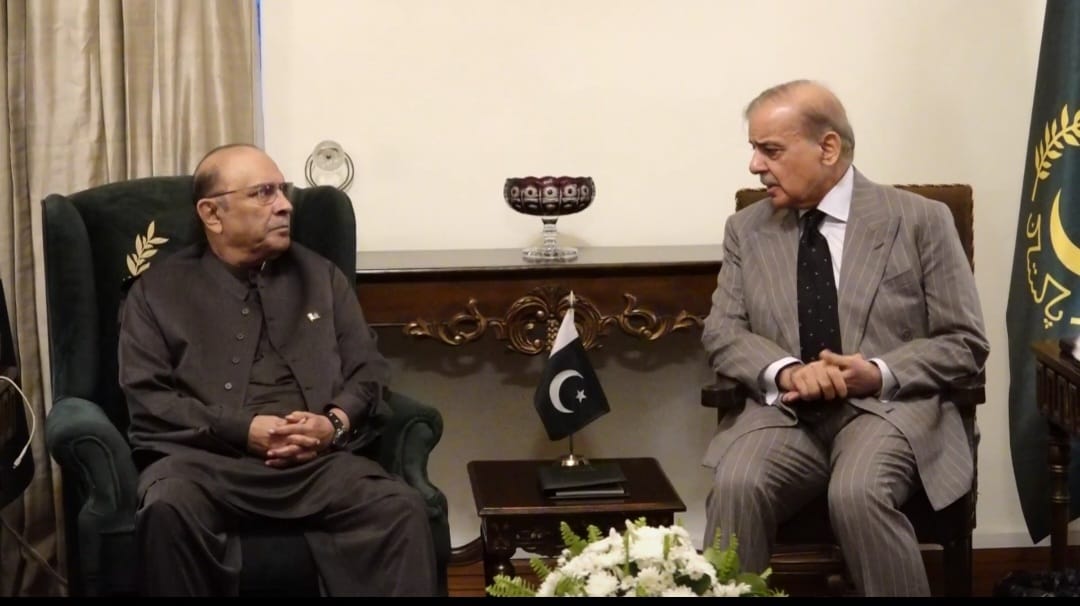
Prime Minister Shehbaz Sharif met President Asif Ali Zardari at the presidency in Islamabad on Saturday to discuss the country’s overall political and security situation. A statement said they agreed to convene separate sessions of the National Assembly and the Senate on 13 October. It did not mention an emergency.
Several Pakistani outlets, citing unnamed sources, reported that the two men had settled on the step. The 35-minute meeting reportedly covered law and order in the province, and Sharif briefed the president on the progress of negotiations and on his contacts with the head of the Jamiat Ulema-e-Islam-Fazl (JUI-F), Maulana Fazlur Rehman. One broadcaster reported that the federal cabinet will be asked to approve an emergency on Sunday, with parliament then called to endorse it. The government had not confirmed those reports by Saturday evening.
Sharif was accompanied by the deputy prime minister and foreign minister, Ishaq Dar; his political adviser, Rana Sanaullah; the interior minister, Mohsin Naqvi; the attorney general, Mansoor Usman Awan; and the law minister, Azam Nazeer Tarar. Sherry Rehman and Syed Naveed Qamar of Zardari’s Pakistan Peoples Party, a key partner in the governing coalition, also attended. Local media reported that participants reviewed a report on law and order by the provincial governor, Faisal Karim Kundi.
The meeting comes after weeks of worsening relations between the coalition government, led by the Pakistan Muslim League-Nawaz (PML-N), and the provincial administration of Khan’s PTI, which sits in opposition in the National Assembly. The central dispute is counterterrorism policy, and it was a main reason talks between the two sides collapsed on 3 October.
The PTI says it is being shut out of security decisions affecting its own province, which the Centre denies. It wants the counterterrorism policy reviewed. Federal ministers, for their part, criticise the provincial government’s record on militancy and object to its stance on dialogue with the Afghan Taliban.
The PTI began a march towards Islamabad on 4 October, demanding the release of Khan and his wife, Bushra Bibi, as well as medical treatment for the jailed former prime minister. It reached Mardan on Saturday, its seventh day. So far the march has stayed inside the province, and federal ministers have warned the party not to take it further. Local media reported that the party plans to take it to the capital on 14 October.
The chief minister of Khyber Pakhtunkhwa, Sohail Afridi, has rejected any move against his government. He has said the province accepts neither governor’s rule nor an emergency. On Saturday he warned against any attempt to suspend constitutional rights, saying such a step would provoke a public reaction. The provincial assembly is likely to be summoned on Sunday.
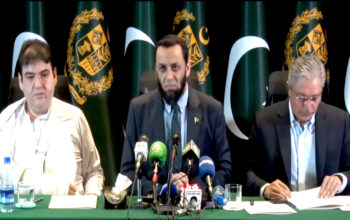
Federal ministers have increasingly linked the policy dispute to the prospect of emergency or governor’s rule. Information Minister Attaullah Tarar accused the provincial government on Saturday of a “lack of governance”, saying it had received 700 billion rupees under the National Finance Commission for development projects. He alleged that it had not upgraded the Counter Terrorism Department, built forensic laboratories, or installed safe-city cameras in the merged districts and at entry and exit points. He claimed the money had instead gone on organising protests. The PTI has not responded to the claim in the material available.
Tallal Chaudhry, the minister of state for interior, struck a more reluctant tone in an interview on a local television channel, while making clear which way the government was leaning. “This is something that requires comprehensive consultations,” he said. “This is not something we are in favour of as we are a democratic government, and this is a last resort.”
He said talks and backchannel contacts had already been tried. “We will try to make sure we think through this last step if there is no other option, but it looks like things are headed towards the last option.”
Chaudhry said relations with the PTI had not been severed, because it is the opposition in parliament and governs the province. He accused the party of declining to share the burden of fighting terrorism. “How many martyrs are the prime minister and chief of army staff going to carry on their shoulders?” he asked. “These people [the PTI] are not ready to carry the burden with us or stand with us, so what other option is left?”
He recalled that during the second round of talks the interior minister had told the prime minister that the provincial government was ready to cooperate. According to Chaudhry, Prime Minister Sharif replied that the province should be given whatever it needed politically to fight terrorism, but must stand with the security forces.
Earlier on Saturday, Sharif met Rehman at the Prime Minister’s House, and the prime minister’s office said they held consultations on “important national and political matters”. Before leaving, Rehman, whose party has contacts across the political spectrum, took PTI leaders into confidence, a JUI-F spokesman said.
The cleric has been trying to broker a way out of the stand-off. On Tuesday he advised the government not to obstruct the march, saying protest was a democratic right of all parties. A day later, Sanaullah, the parliamentary affairs minister, Tariq Fazal Chaudhry, and the National Assembly speaker, Ayaz Sadiq, called on him. On Thursday, the PTI MNA Junaid Akbar said Rehman had offered to help end the deadlock and that his party’s “doors are open”. A JUI-F senator said the same day that the provincial government would share responsibility if an emergency or governor’s rule were imposed, and urged Afridi to meet his constitutional duties.
Defence Minister Khawaja Asif also hinted at attempts to revive negotiations. “I wish a positive result comes out of the efforts of those involved in the talks,” he said. “But, I have little hope.”
The JUI-F spokesman, Aslam Ghauri, said his party was a “facilitator, not a mediator”, because a mediator would be authorised by the opposition parties to decide on their behalf. He said the party’s priority was to bring both sides back to the table and that it had urged the government to convene a multi-party conference at Parliament House. Resuming dialogue would benefit the PTI most, he added, because the provincial government was “virtually being run by someone else and not by Chief Minister Sohail Afridi”.
The PTI’s Khyber Pakhtunkhwa spokesman, Shaukat Yousafzai, said in a video statement that the proposed structure would violate the 18th Amendment, the 2010 constitutional change that devolved powers to the provinces and which the Pakistan Peoples Party, a member of the federal coalition, has long claimed credit for. He said the PTI had never obstructed the fight against terrorism but wanted all stakeholders taken into confidence before any action. He said an all-parties conference had already agreed a 15-point declaration, which had been sent to the federal government.
“I do not think that the emergency and the governor’s rule are the solution to this problem,” he said. “Pakistan needs a political resolution and stability.”
He said the party’s demands were lawful: implementation of High Court and Supreme Court decisions, an end to restrictions on meetings with Mr Khan, his transfer to hospital, hearings in his cases, and relief for his wife and sisters. He also criticised the arrests of provincial ministers, lawmakers and party workers. He rejected remarks by the Pakistan Peoples Party chairman, Bilawal Bhutto-Zardari, that the PTI should abandon confrontational politics. “Is raising your voice for your legitimate rights extremism?” he asked.
The PTI has warned that its members would resign from the national and provincial assemblies if governor’s rule or an emergency were imposed.
Negotiations between the government and opposition on 2 and 3 October broke down when the two sides appeared close to agreement on most contentious issues. The government blamed Mr Afridi. The PTI said the talks failed because Islamabad refused to allow a meeting with Mr Khan. Mr Sharif later offered to resume dialogue if the party ended its march and sit-ins, an offer the PTI rejected.
On 21 September, the interior minister, Mohsin Naqvi, said the government was consulting the law ministry on legal options for the province, including governor’s rule. Two days later, the information minister, Atta Tarar, said there was no plan to remove the PTI administration. The Kashmir affairs minister, Amir Muqam, then said consultations on a “constitutional and legal option” were under way, and the provincial governor, Faisal Karim Kundi, said such a step would be taken if necessary.
Copyright © 2021 Independent Pakistan | All rights reserved