By Staff Reporter
LAHORE: A Pakistani air-quality monitoring group has said the evidence does not support blaming Indian Diwali fireworks for the smog that smothered Lahore this week, a conclusion that complicates the explanation offered by Punjab’s government.
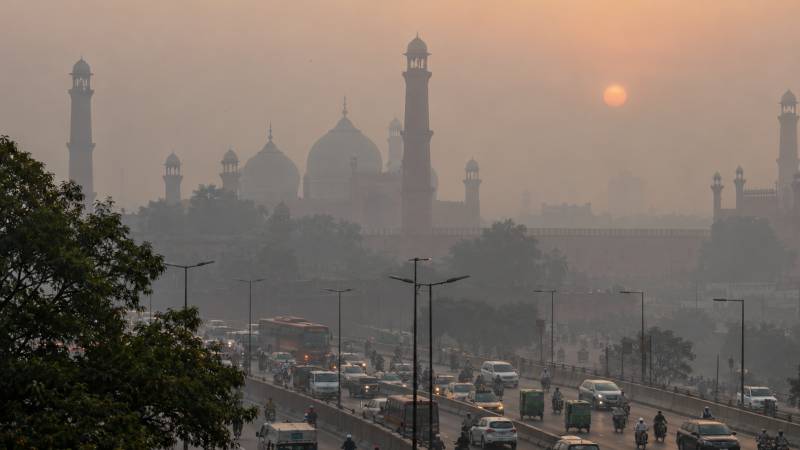
Lahore topped IQAir’s ranking of the world’s most polluted major cities for a second day on Tuesday, with an air quality index reading of 263, classed as “very unhealthy”. Its concentration of PM2.5, the fine particles that can lodge deep in the lungs, was 37.2 times the World Health Organization’s annual guideline.
Marriyum Aurangzeb, Punjab’s environment minister, said light winds had carried pollutants into the province, along with air drifting from India after Diwali. She said pollution should ease gradually from early afternoon as the weather improved and winds changed direction.
The report by the Pakistan Air Quality Initiative (PAQI), released on Tuesday, recorded 16,714 likely crop-residue fires in Pakistan’s Punjab between 1 October and 9 November. That is almost unchanged from the same period last year. Satellites detected 18,825 fires across the province in total, 89 percent of them classed as probable crop-residue burning. The busiest day was 1 November, with 1,102 detections.
The count was 8 percent above the 2020-2025 average, though the comparable satellite record showed a 1 percent fall from 2025.
Sheikhupura recorded the most fires, at 2,559, followed by Jhang (2,192), Okara (2,062), Hafizabad (1,893) and Gujranwala (1,417). Those five districts accounted for 54 percent of all detections.
Lahore’s average PM2.5 concentration over the period was 126 micrograms per cubic metre, eight times the WHO guideline value. It breached Pakistan’s 24-hour National Environmental Quality Standards on every one of the 40 days for which valid data were available, though the average was 11 percent lower than in the same period of 2025.
The analysis found a positive correlation between fire activity upwind and PM2.5 levels in the city. On days when air trajectories crossed areas where burning was under way, Lahore’s average reached 175 micrograms, against 93 on other days. In Multan the gap was wider, at 203 against 88, and in Bahawalpur it was 125 against 65.
The authors cautioned that the pattern did not establish how much crop burning contributes to urban pollution. Stagnant weather and weak atmospheric dispersion also let pollutants build up.
The assessment then turned to Diwali, celebrated in India on Sunday 8 November. Easterly winds carried air from Indian territory towards Pakistan overnight. Of 48 back trajectories arriving in Lahore, Kasur and Sialkot between 9pm that day and midnight on 10 November, 45 had passed over India in the preceding 12 hours, most often near Tarn Taran, Amritsar and Jammu.
The pollution readings told a different story. Lahore’s average PM2.5 between 6pm on Sunday and 1am on Tuesday was 234 micrograms per cubic metre, 10 percent above the average for the same hours over the previous seven days. Kasur rose by 27 percent, while Narowal, also on the border, fell by 2 percent.
The increases were larger further from the frontier. Faisalabad, 130km from the border, recorded a rise of 40 percent, as did Multan, 180km away. Across the four border cities of Lahore, Kasur, Sialkot and Narowal, the average increase was 36 micrograms, compared with 85 in Faisalabad and Multan.
The report said pollution carried across the border would be expected to push up readings near the frontier more than inland, and that the observed pattern did not fit. Sialkot was the exception, with a rise of more than 30 percent and trajectories passing over the Jammu area.
Emissions from Delhi did not reach Lahore in the period studied, according to the report. Air from the Indian capital entered Pakistan near Rahim Yar Khan and Bahawalpur only after 3am on Tuesday, and came no closer to Lahore than 266km.
The authors acknowledged a limit on what satellites and weather models can show. Separating firework emissions from agricultural smoke would need chemical analysis of particulate matter for elements such as potassium, strontium and barium, which Pakistan’s monitoring stations do not measure.
The Punjab Environment Protection and Climate Change Department (EPCCD) said Lahore’s air quality improved on Monday after emergency enforcement and mitigation work. The city’s average AQI fell from 489 at 9am to 232 by 3pm, a drop of 257 points, or about 53 percent.
All 11 monitoring stations showed a decline. Egerton Road went from 500 to 167 and GT Road from 500 to 172. DHA Phase 6, Shahdara, Barki Road, Punjab University, Wagah Border, Gulberg III, Kahna Nau, Safari Park and Multan Road also improved. Anti-smog guns were deployed along busy corridors, dust-prone sites and hotspots, and mist sprinklers covered about 640km of designated routes.
The government had earlier warned that air quality in Lahore, Kasur and neighbouring border districts would worsen on 9 and 10 November. It named Diwali fireworks, crop-residue burning in Indian Punjab, easterly winds and stagnant conditions as likely causes. A special assessment issued on 8 November cited 2,347 crop-burning incidents in Indian Punjab up to 4 November, 1,081 of them in Tarn Taran, Ferozepur and Amritsar. It said smoke from fireworks could reach Lahore within five to 13 hours, depending on the wind.
EPCCD Secretary Silwat Saeed said the department was using its monitoring network and Punjab Climate Watch data to find hotspots and send enforcement teams where action was most urgent. Abdullah Nayyar Sheikh, director general of the Environment Protection Agency, said officials had adopted zero tolerance towards major pollution sources. He said Quick Response Units were being sent to satellite-detected fire anomalies and reports of burning, and that inspections of factories, brick kilns and other polluting units had been stepped up. He called the improvement at all 11 stations encouraging but said enforcement and surveillance would continue.
PAQI’s report points to more difficult days ahead. It forecast a very high number of fires upwind of Lahore on 10, 11 and 12 November, with 642, 668 and 617 expected under predicted wind conditions.
The Provincial Disaster Management Authority (PDMA) forecast rain across most of Punjab over the next two days, saying it was likely to clear some smog but deepen the cold. Its alert named Lahore, Kasur, Sialkot, Narowal, Gujrat, Gujranwala, Hafizabad, Wazirabad and Sheikhupura among the districts expected to see rain, along with Rawalpindi, Mianwali, Jhelum, Mandi Bahauddin, Attock, Chakwal, Khushab, Bhakkar, Sargodha and Murree.
Strong winds, rain and isolated hailstorms are expected in Dera Ghazi Khan, Layyah, Bhakkar and Multan. The authority told commissioners and deputy commissioners to stay alert, and urged the public to avoid unnecessary travel during storms and to stay out of open areas during thunder and lightning.
Pakistan made a similar case in 2024, blaming crop burning in Indian Punjab for its toxic air, but India’s weather department said then that the airflow ran from Pakistan into India. Delhi, ranked the world’s second most polluted major city on Tuesday with an AQI of 188, had its own post-Diwali haze. Indian government data showed firecrackers were responsible for nearly 55 percent of the capital’s PM2.5 the previous day. Prime Minister Narendra Modi’s Bharatiya Janata Party has blamed crop burning in Indian Punjab, which is run by a regional opposition party, for Delhi’s pollution this month. Local media reported a sevenfold increase in farm fires in the state on Diwali itself.
PAQI’s earlier satellite analysis, reported on 5 November, counted 3,712 fire hotspots within 300km of Lahore over a week, 2,753 of them in Pakistan and 957 in India. It also said the analysis did not show crop burning was the only cause of the rise in pollution, and experts cautioned that satellite hotspots should not automatically be classed as crop-residue fires.
A separate report by the monitoring project Hamari Hawa, released on 2 November, argued that Lahore’s pollution is a year-round problem that winter conditions and crop burning make worse. It cited a 2023 emissions inventory based on 2020-21 data, which put transport at about 35 per cent of the city’s PM2.5 emissions and crop-residue burning at 33 per cent. The report stressed those figures were provincial estimates, not a direct measure of Lahore’s current air.
Copyright © 2021 Independent Pakistan | All rights reserved