By Staff Reporter
ISLAMABAD: Pakistan’s opposition parties have agreed to deepen their alliance and set up committees to settle their differences, on the day jailed former prime minister Imran Khan’s party said his blood pressure had risen to 192.
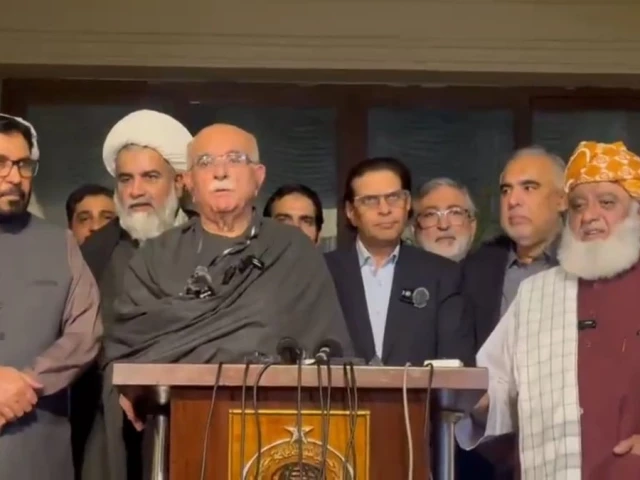
Leaders of the Jamiat Ulema-i-Islam-Fazl (JUI-F) and the Tehreek-i-Tahafuz-i-Ayin-i-Pakistan (TTAP), an opposition alliance, met on Wednesday at the Islamabad residence of the JUI-F chief, Maulana Fazlur Rehman. They discussed the emergency and governor’s rule imposed in Khyber Pakhtunkhwa (KP), and agreed to continue consultations on a multi-party conference.
The TTAP, headed by Mahmood Khan Achakzai, described the gathering as a meeting of a “united opposition”. It said talks also covered the supremacy of the constitution, the protection of democratic rights and a joint strategy for the political situation.
Achakzai, who is the opposition leader in the National Assembly, attended with the Senate opposition leader, Allama Raja Nasir Abbas. Imran Khan’s Pakistan Tehreek-e-Insaf (PTI) party sent Asad Qaiser, its secretary general Salman Akram Raja, National Assembly chief whip Amir Dogar and Senator Noorul Haq Qadri.
Speaking to reporters afterwards, Achakzai said the delegation had come to build an alliance to strengthen parliament. He condemned a character assassination campaign against Rehman and said the opposition stood firmly with him.
Rehman said the opposition would work to strengthen its presence in parliament and protect the interests of every part of the country. He said his party had opposed the 2018 merger of the former Federally Administered Tribal Areas (Fata) into KP, and that the issue was now being linked to a struggle over resources. He also voiced concern over what he alleged were attempts to bring Gwadar, the coastal belt and Sindh’s islands under federal control.
Abbas alleged that governor’s rule had been imposed illegally in KP, and accused the authorities of targeting people who spoke up for the country’s welfare. He said homes were being entered and people detained from their residences, and warned that public confidence in state institutions was falling. Pakistan, he claimed, had reached one of the worst periods in its history.
The government says the security situation in KP, and what it calls the PTI-led provincial government’s “deliberate disengagement” from the fight against terrorism, “compelled” it to act on 11 October.
The presidential proclamation cited an extraordinary surge in terrorist incidents and serious security threats. An emergency was declared in 12 districts under Article 232 of the Constitution, alongside the transfer of powers to the governor. A joint sitting of parliament approved both measures for two months on 15 October. The Peshawar High Court is hearing petitions that argue the constitutional requirements were not met, and the TTAP is among the petitioners.
Imran Khan’s health
The meeting came as the PTI raised fresh alarm over Khan’s health. In a statement, the party said his blood pressure had surged to 192, and demanded his immediate transfer to Shifa International Hospital in Islamabad for independent treatment under his personal physicians.
The reading could not be independently verified. It was relayed by Khan’s lawyer after a meeting at Adiala jail on 2 November, according to his sister, Rubina Khan.
Khan said the lawyer had been allowed only a brief visit, the first in seven months, and called access to a lawyer a basic right of every prisoner. “Imran Khan has never had high blood pressure. As recently as a year ago, his blood pressure was normal,” she said. The family’s medical advisers, she added, found it unusual for a man over 70 to develop the condition suddenly.
She demanded that he be admitted at once to an independent medical institution in the capital, in the presence of his personal doctor and one of her choosing. She said there had been several earlier attempts on her brother’s life, including an assassination attempt, and that the family feared for his safety in prison.
“If he does not receive medical treatment now, anything that happens to him would amount to cold-blooded murder,” she said.
Khan’s son, Kasim, shared her statement on X. “This high blood pressure is not normal. It is the direct result of this isolation,” he wrote. “If he is not freed soon, he will die in this cell.”
Raja called the reports “extremely alarming” and said the party needed an effective strategy on the health of Khan and his wife, Bushra Bibi. That strategy, he said, could not be “based merely on excitement and anger”. He said a “full-force voice” would be raised at home and abroad after consultation with the family and party bodies.
Sheikh Waqas Akram, the PTI’s central information secretary, said protecting Khan’s health was the state’s responsibility. He accused the government of denying him adequate medical facilities, family access and treatment of his choice. He called for the release of Mr Khan, Bushra Bibi and all political prisoners, and said: “Political victimisation and repression must end.”
Khan, 74, has been in prison since 5 August 2023 in multiple cases. The Supreme Court ordered his transfer to Shifa International Hospital on 18 August. Media reports said a team of specialists examined him and he was returned to jail within hours, with fluctuating blood pressure, anxiety, palpitations and headaches recorded. His family says the order for treatment at Shifa under his own doctors has never been implemented.
The government denies withholding care. It says the required treatment is being provided at Adiala, with a diet plan and exercise equipment.
Khan’s right eye condition, central retinal vein occlusion, came to light in January. He has had procedures and check-ups at the state-run Pakistan Institute of Medical Sciences (Pims), but his family wants him treated at a hospital of their choosing.
The Islamabad High Court has allowed him to meet family, lawyers and associates on Tuesdays and Thursdays. Despite repeated court orders, access has been largely restricted in recent months.
Shifting alliances
Wednesday’s meeting followed a day after the PTI said it would welcome Rehman’s support. “It is possible that some may walk with us for one mile, some for 10 miles, and some may go with us till the end,” Mr Raja said. “But why should we reject them?”
Rehman, a veteran politician, has been sharply critical of the government over governor’s rule. He accuses it of reneging on commitments while he tried to mediate between Islamabad and the KP administration. He and key federal ministers have traded harsh words since mid-October, and last week he accused the government of misusing the constitution to impose the emergency. Mr Raja said Mr Rehman was being “punished” for standing with the PTI.
Rehman and Achakzai first announced plans for a “united opposition” on 20 August. Rehman said at the time that the Pakistan Peoples Party, a partner in the governing coalition, would not be part of it.
In September, TTAP and PTI leaders said they planned to call a multi-party conference on new provinces, law and order and the economy. That was before the emergency, and in the days before it tensions were already high after the PTI announced a protest march on Islamabad to demand Khan’s release.
The JUI-F delegation included Senator Maulana Attaur Rehman, its vice-president and KP chief, along with senators Kamran Murtaza and Maulana Attaul Haq Darwish, and party figures Akram Khan Durrani, Aslam Ghauri, Maulana Salahuddin Ayubi, Hafiz Hamdullah and Zahid Durrani. The TTAP side included its spokesman Akhundzada Hussain Ahmad Yousafzai, Mr Khan’s lawyer Khalid Yousaf Chaudhry and Agha Nasir Shirazi.
Copyright © 2021 Independent Pakistan | All rights reserved