By Staff Reporter
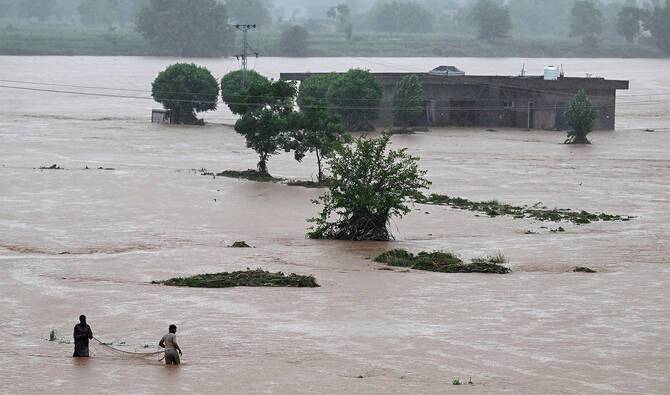
LAHORE: Disaster management officials in Punjab province issued an urgent flood warning on Sunday, cautioning that a potent combination of monsoon rains and an approaching weather system could send rivers surging past danger levels this week, threatening cities and rural districts alike.
The warning, issued by the Provincial Disaster Management Authority, predicted that the Chenab, Jhelum, and Ravi rivers — arteries that wind through some of Punjab’s most densely populated regions — could see significant flooding between Wednesday and Sunday, driven by what officials described as a strong monsoon incursion meeting a westerly wave moving into the province.
The scale of the threat, according to the agency’s advisory, is considerable. Officials said low to medium flooding could hit the Chenab River at Marala and the Ravi River at Jassar within 24 hours, while the days that follow could bring high flood levels to the Chenab at Marala and to the Jhelum upstream of Mangla. The Kabul River, which flows into Pakistan from Afghanistan, was also expected to see elevated flows, along with a network of smaller streams and waterways tied to the Jhelum, Chenab, and Ravi systems.
Officials singled out the hill torrents of Dera Ghazi Khan as particularly vulnerable to flash flooding. Urban centers across the province, meanwhile, were warned to prepare for flooding of their own — a list that includes Rawalpindi, Jhelum, Gujranwala, Sargodha, Khushab, Sialkot, Gujrat, Narowal, Lahore, Okara, Sahiwal, Bahawalnagar, and Faisalabad.
The warning is the latest sign of a monsoon season that has grown increasingly punishing for Pakistan in recent years, and one that has left officials determined not to be caught flat-footed again. Last year’s monsoon rains killed more than 1,000 people across the country and forced the evacuation of millions of residents and their livestock, with Punjab and the neighbouring Khyber Pakhtunkhwa province bearing the brunt of the destruction.
PDMA Director General Umar Abbas Mehla ordered district administrations across the province to complete precautionary measures in line with directives from Punjab Chief Minister Maryam Nawaz, and to do so quickly. Emergency control rooms were told to staff around the clock. Rescue 1122, the province’s emergency response service, was directed to deploy disaster response teams and to secure adequate fuel supplies to keep rescue operations running without interruption.
The instructions extended well beyond emergency services. Commissioners, deputy commissioners, and officials from the Water and Sanitation Agency were placed on alert, alongside the Local Government, Agriculture, Irrigation, Health, Forest, Livestock, and Transport departments. District officials were told to clear drainage systems ahead of the rains, position heavy machinery at locations considered vulnerable to flooding, and send additional personnel and equipment into high-risk areas. The Motorway Police were instructed to issue regular advisories on traffic and road conditions as the storms approach.
Authorities were also directed to begin evacuating people and livestock from riverbeds in areas where the danger is judged to be greatest, and to establish relief camps stocked with food, clean drinking water, and other essential supplies. The PDMA said it would keep the public updated as conditions evolve, and urged residents to heed official safety advisories, cooperate with evacuation orders should they come, and call the agency’s emergency helpline, 1129, if needed.
The warning comes against the backdrop of a country that scientists have repeatedly identified as among the most exposed to the effects of climate change. Pakistan’s climate change minister, Musadik Malik, said in May that the nation’s four most recent major floods have killed more than 6,000 people combined, left roughly 20,000 injured or disabled, and displaced some 40 million residents.
Copyright © 2021 Independent Pakistan | All rights reserved