By Staff Reporter
ISLAMABAD: Antonio Guterres, the UN secretary general, has praised Pakistan’s “pivotal role” in mediating between the United States and Iran and told both sides from Islamabad to end the conflict, return to diplomacy and restore navigational rights under international law.
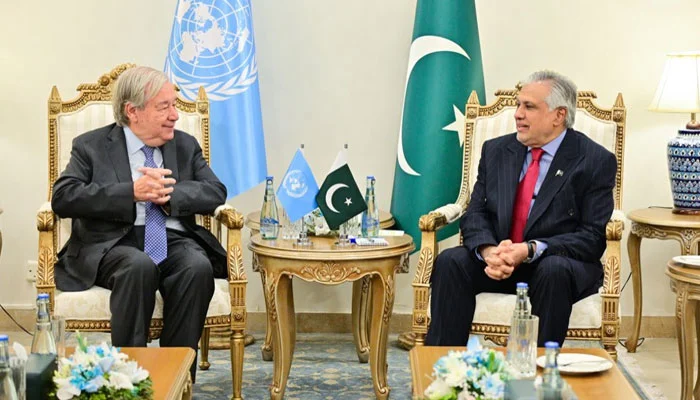
Speaking at a press conference on Tuesday alongside Pakistan’s deputy prime minister and foreign minister, Ishaq Dar, Guterres credited Islamabad with creating the conditions for dialogue between Washington and Tehran.
“Your efforts helped deliver the Islamabad memorandum of understanding, the subsequent ceasefire and the framework for future negotiations,” he said. “Every Pakistani should be proud of that pivotal role.”
He then addressed the warring parties directly. “From Islamabad, I want to send a loud and clear message to all parties: end the conflict, return to diplomacy and restore navigational rights in accordance with international law.” He added that there would never be peace in the region until the right of self-determination of the Palestinian people was recognised, “as Pakistan has long championed”.
The visit comes while Pakistan’s mediation effort is under strain. The US and Israel launched the war on 28 February, killing Iran’s leadership, and Tehran’s retaliatory strikes on Washington’s Gulf allies have sent global energy prices soaring. Shipping through the Strait of Hormuz, which carried about a fifth of the world’s oil before the war, has been badly disrupted.
Pakistan brokered a ceasefire on 8 April and hosted the first direct US-Iran talks in Islamabad days later. A second round planned for later that month never took place. An interim deal reached in mid-June collapsed shortly afterwards, and in July Donald Trump declared the ceasefire “over” following attacks on tankers in the strait, while saying talks would continue. Tehran disputed his account.
Pakistani officials have insisted the Islamabad memorandum remains the framework for peace. In late August, the army chief, Field Marshal Asim Munir, and the interior minister, Mohsin Naqvi, travelled to Tehran, where Pakistani officials reported “significant progress”.
Guterres arrived in Islamabad in the early hours of Tuesday and was received by the acting foreign secretary, Nabeel Munir. He told reporters it was “wonderful to be back in Pakistan”. His visit runs to 8 October. He is due to meet the president, Asif Ali Zardari, the prime minister, Shehbaz Sharif, and Field Marshal Munir, who holds the post of chief of defence forces. He will also visit the headquarters of the UN Military Observer Group in India and Pakistan (UNMOGIP) and attend a briefing at the National Disaster Management Authority.
The secretary general, whose 10-year term ends on 31 December, said he was in the closing months of his tenure, having previously served a decade as UN high commissioner for refugees.
He said Pakistan mattered not only because of its size but because it brought an “essential perspective” to global debates, and that it had shown “compassion and responsibility must go hand-in-hand” even in difficult circumstances.
Guterres noted that Pakistan had for decades opened its doors to millions of Afghans fleeing conflict, and said the UN was committed to ensuring returns “proceed in a voluntary, safe and dignified way”.
He paid tribute to Pakistan’s role in UN peacekeeping, saying more than 180 Pakistanis had died in the service of peace. He highlighted Islamabad’s leadership, with Denmark, on Security Council resolution 2823, which strengthened accountability for crimes against peacekeepers. It attracted 153 co-sponsors, which Mr Guterres said was the largest number for any Security Council resolution in UN history.
On terrorism, he said Pakistan had “endured immense suffering”, with thousands killed and communities still bearing scars. “We stand with Pakistan in confronting this threat,” he said, though he added that the strongest security responses were those grounded in international law, human rights and the rule of law.
He closed with the climate crisis, recalling his last visit, during the catastrophic floods of 2022, which affected about 33 million people and killed 1,700. “Pakistan is on the frontlines of climate chaos despite contributing only a tiny fraction of global emissions,” he said. He welcomed Pakistan’s Loss and Damage Fund and its shift to clean energy, but said leadership from vulnerable developing countries could not substitute for responsibility from rich ones. “The G20 represents 80 per cent of global emissions. We need a drastic reduction in those emissions this decade,” he said.
Dar said he “greatly appreciated” the visit, which he called a reflection of “long-standing and close cooperation” between Pakistan and the UN. He described Mr Guterres as a “great friend” of Pakistan whose solidarity during the 2022 floods would not be forgotten.
The minister said Pakistan had played a “proactive and constructive” role in promoting de-escalation in the Gulf. “Pakistan’s role in facilitating dialogue is consistent with our broader approach at the UN, which is to promote cooperation over confrontation, dialogue over conflict and peaceful settlement over the use of force,” he said.
Dar said Pakistan backed the UN80 reform initiative, provided the priorities of developing countries stayed central. He also pointed to Pakistan’s resolution 2788 on strengthening multilateralism and the peaceful settlement of disputes, which was adopted unanimously by the Security Council.
He used the occasion to raise Pakistan’s own disputes. He said he had briefed Guterres on India’s decision to hold the Indus Waters Treaty in abeyance, which he called a “blatant violation of international law”, and urged India to stop “weaponising water”. India suspended the treaty in April last year.
Dar also voiced “deep concern” at the continued use of Afghan soil for terrorist attacks against Pakistan and asked the UN and the wider international community to help address it. He welcomed what he called the UN’s “consistent position” on Jammu and Kashmir.
Earlier, the two men held a one-on-one meeting covering Palestine, Kashmir, Afghanistan, counter-terrorism and the future of multilateralism, according to Pakistan’s Foreign Office. It said Dar reaffirmed Islamabad’s call for a just resolution of the Kashmir dispute in line with Security Council resolutions, and that Mr Guterres thanked Pakistan for its efforts to promote dialogue and mediation.
Sharif met Guterres on the sidelines of the UN General Assembly in New York last month, when they discussed developments in the Middle East. Mr Guterres said in September that he would visit Pakistan soon and described it as one of the key mediators in the US-Iran conflict. His first visit to Pakistan as secretary general was in February 2020.
Copyright © 2021 Independent Pakistan | All rights reserved