By Staff Reporter
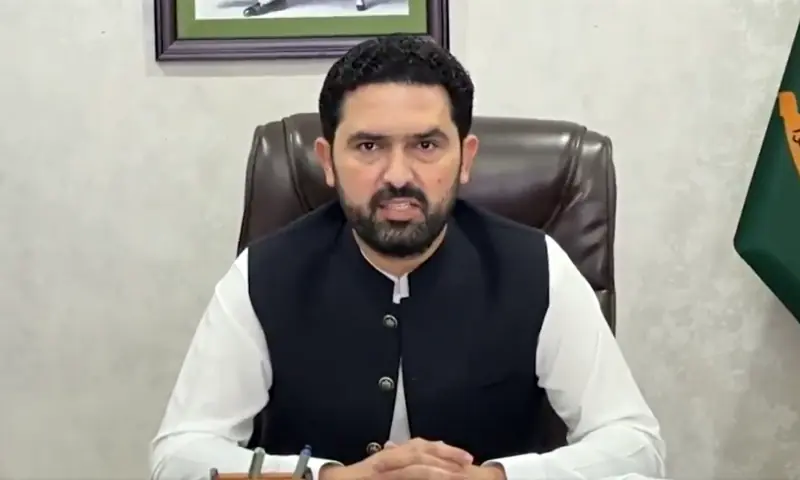
PESHAWAR/ISLAMABAD: The chief minister of Khyber Pakhtunkhwa province has said he would give up his office rather than bend to Islamabad, as a bitter dispute over how to confront a surge in militant violence hardened into an open constitutional standoff.
Sohail Afridi, who leads Pakistan Tehreek-e-Insaf (PTI) government in the province, dismissed threats to impose governor’s rule or an emergency, saying: “If anyone tries to frighten me by saying that governor’s rule will be imposed here or an emergency will be imposed, then I curse this chair if it makes me abandon my ideology.” “I have no concern for this chair,” he added.
His remarks, made at a law-and-order meeting in Peshawar on Monday, came hours after two federal ministers accused his administration of failing its security forces and, in the case of the information minister, of facilitating the very militants who are killing people in the province.
The exchange lays bare a widening rupture between the PMLN-led federal government and the party of the jailed former prime minister Imran Khan, at a moment when Khyber Pakhtunkhwa is suffering some of its worst violence in years and Pakistan’s relations with neighbouring Afghanistan are deteriorating fast.
A fortnight of bloodshed
The province has been struck by two major attacks in just over a week. On 18 September, militants stormed the Police Lines in Kohat, striking a mosque during Friday prayers. At least 23 people were killed, most of them police officers, and around 100 were injured, according to officials and local reports. Casualty figures for both incidents varied between agencies.
On Saturday, a suicide bomber drove an explosives-laden vehicle into a police checkpoint in the Darazinda area of Dera Ismail Khan. Officials said 12 people were killed and up to 35 injured. The regional police officer said no law enforcement or security personnel were among the dead, who included a customs official and civilians. Some reports put the toll at 11 and others said victims included women and a two-year-old child.
Two rescue workers were also killed when a Rescue 1122 ambulance carrying victims’ bodies came under fire.
Afridi said the violence was not isolated. “We repeatedly stated that the state’s current policy was flawed. The blood of our Pakhtuns will flow again,” he said, complaining that federal ministers “dismissed our repeated warnings as propaganda and lies”.
He called the approach followed for 22 years a failure, and said peace secured at a heavy price after two decades of sacrifice had been lost again. “More than 80,000 of our civilians have made sacrifices to establish this peace in KP,” he said.
“Policy shift”
The chief minister argued that money alone would not fix the problem. He said his government had diverted Rs35 billion from the development budget to the police since he took office, and raised the provincial police budget for 2026-27 to Rs191.4 billion, an increase of 103 percent.
But he insisted that resources were secondary to strategy. Afridi said peace could be restored within 100 days if the policy he advocated were adopted, and called for the provincial government, police and other stakeholders to help shape security policy rather than have decisions made “behind closed doors”.
“Change your policy. Bring a policy shift. Save our armed forces personnel, our police department personnel and our ordinary civilians from this bloodshed,” he said.
He also accused opponents of relying on “paid media” and political proxies to build false narratives about the province, and said the people of Khyber Pakhtunkhwa were being treated as a “laboratory” for policy experiments.
“B team” of the Taliban
In Islamabad, Information Minister Attaullah Tarar, speaking alongside Minister of State for Interior Talal Chaudhry, went considerably further than a critique of policy.
Tarar accused the provincial government of facilitating terrorists “because of your political and financial interests”, and repeated his description of the PTI leadership as the “B team” of the banned Tehreek-e-Taliban Pakistan (TTP). He alleged the party profited from illegal mining and contracts, and said it was spending funds “on sit-ins instead of the police”.
“I stand by my position that the PTI leadership in KP is the ‘B’ team of the banned TTP,” he said. In earlier remarks, he also described the PTI as the “C team” of the Afghan Taliban.
Tarar contrasted Khyber Pakhtunkhwa unfavourably with Balochistan, another province ravaged by militancy, whose chief minister, Sarfraz Bugti, he said “should be saluted”.
Resources and the question of Afghanistan
Chaudhry focused on capacity and accountability. He said a political leadership could provide three things in a fight against terrorism: leadership, resources and powers. The PTI, which has governed the province since 2013, had failed on all three, he said.
“Your forces cannot fight unarmed,” he said, claiming officers lacked bulletproof jackets, vehicles, training, a functioning Counter-Terrorism Department across the province, a Safe City network and a forensic laboratory. He questioned what had become of the province’s share of the National Finance Commission award, which he put at around Rs800 billion. “Even today, your counter-terrorism forces live in rented homes,” he said.
He criticised the new Khyber Pakhtunkhwa Police Act, which he said weakened the force’s institutional authority, and rejected PTI complaints of exclusion, saying provincial representatives had not attended national security meetings to which they were invited. “You come to Islamabad to demand NFC funds, but your CM does not show up for anti-terrorism meetings,” he said.
Chaudhry also pressed the provincial leadership to name Afghanistan. “Why do you have a soft attitude towards Afghanistan?” he asked. He said Afghan nationals accounted for about 70 percent of those involved in terrorist activity over the past two-and-a-half to three years, and described Afghanistan as a “super-proxy”.
On the Dera Ismail Khan attack, he said investigators had found no record of one suspected attacker in Pakistan’s national databases. Using open-source intelligence, he said, they had traced an image of the same man to Kabul’s Pakhtunistan Square, which he offered as evidence of an Afghan connection. Islamabad has repeatedly urged the Taliban administration in Kabul to dismantle militant sanctuaries on Afghan soil. Officials say those appeals have gone unanswered.
Referring to the attack on the rescue ambulance, he asked: “Is this jihad?” Tarar told the PTI it would have to choose. “You will now have to decide if you are with Pakistan or with Afghanistan,” he said.
Governor’s rule
The war of words is unfolding against open talk in Islamabad of removing the elected government altogether.
Faisal Karim Kundi, the provincial governor and a member of the Pakistan Peoples Party, said last week that consultations had taken place on imposing governor’s rule, and that the Constitution allows it. On Monday, he urged the PTI to postpone a planned march on Islamabad and said such a move could be taken if the federal government considered it necessary “to save the province”. He warned the PTI government not to “force the Centre” to act.
Rana Sanaullah, an aide to Prime Minister Shehbaz Sharif on political affairs, has confirmed that governor’s rule remains an option, though he said no final decision had been taken. Tarar told reporters at Parliament House that it would be premature to give a definitive view on an emergency or governor’s rule.
Afridi has warned of an “unprecedented” reaction if governor’s rule is imposed. Local media reports say he has also indicated to party colleagues that he would be prepared to dissolve the provincial assembly if the PTI’s parliamentary party approved, a move seen by analysts as both a pressure tactic and a test of loyalty. The PTI holds 93 of the assembly’s 145 seats.
March on the capital
The dispute is entangled with the PTI’s campaign to secure Khan’s release. The party’s long march on Islamabad, first set for 27 September, has been postponed to 4 October, when it will leave Peshawar. Afridi has said the postponement reflects “political strategy” and that talks will continue.
Kundi has said the march will yield “zero” and that “we are picking up bodies every day”. The government has closed or restricted major highways towards the capital and warned the party against proceeding.
The row is also playing out against a sharp deterioration in relations with Afghanistan. Pakistan carried out air strikes inside Afghanistan last week, saying it killed 28 militants. After eight drones entered Pakistani airspace on 23 September and were shot down, Islamabad struck 10 further locations in Afghanistan. The Foreign Office said a formal protest, demarche, was delivered to the Afghan side. Kabul has separately accused Pakistan of backing militants in the northeastern province of Nuristan. Islamabad denies this and says no evidence has been produced.
Copyright © 2021 Independent Pakistan | All rights reserved