By Staff Reporter
ISLAMABAD: Pakistan’s iCube Qamar satellite will orbit the moon as part of China’s Chang’e-6 lunar mission, marking a historic first for the South Asian nation, Prime Minister Shehbaz Sharif said on Friday.
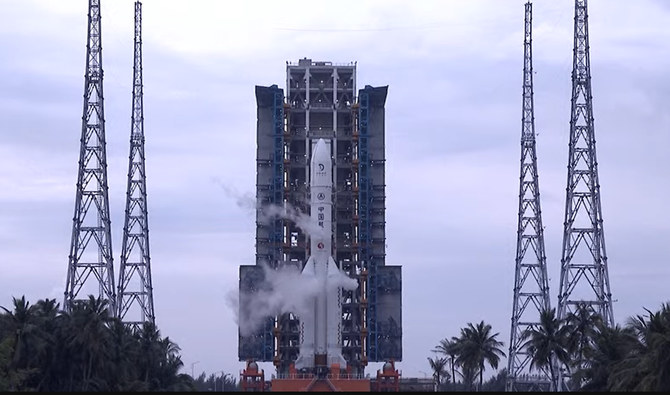
The mission, set to explore the moon’s “dark side,” was launched from Wenchang Space Launch Center on Hainan island at 5:27 p.m. Beijing time (0927 GMT). The Long March-5, China’s largest rocket, carried the Chang’e-6 probe, weighing over 8 metric tons.
The historic lunar module iCube-Q, designed by the Institute of Space Technology (IST) in Pakistan, in collaboration with China’s Shanghai University (SJTU) and Pakistan’s national space agency Suparco, is equipped with two optical cameras to image the lunar surface.
The country joined an elite club of nations with lunar exploration capabilities.
The iCube-Q is a CubeSat, a type of miniature satellite known for its small size and standardized cubic design. CubeSats, due to their compact size and relatively low cost, provide opportunities for universities, research institutions, and commercial entities to participate in space missions and gather valuable data for scientific advancement and innovation.
Scientists, diplomats, and space agency officials from France, Italy, Pakistan, and the European Space Agency, all of which have payloads aboard Chang’e-6 for studying the moon, attended the launch.
Sharif said this achievement would enhance Pakistan’s capabilities in satellite communications, create new opportunities for scientific research, economic development, and national security, and mark a historic moment in the journey of technological development.
“ICUBE-Qamar satellite is Pakistan’s first step into space,” the prime minister said in a statement.
“This is a very historic moment in the journey of technological development, with this important achievement Pakistan has entered a new era of purposeful use of space.”
“Our sons of soil have proved that they have the capability، passion and expertise to explore space. God willing, Pakistan will achieve excellence in the fields of space and economy too as it had done in the field of nuclear technology on May 28, 1998.”
Approximately 100 students from IST contributed to the development of the ICUBE-Q satellite. The China National Space Agency (CNSA) accepted Pakistan’s proposal to build the satellite from plans submitted by eight member states of the Asia-Pacific Space Cooperation Organization (APSCO).
The design, development, and qualification of the ICUBE-Q satellite were led by faculty members and students of the IST, in collaboration with SJTU, with support from SUPARCO.
The satellite launch was broadcast live on the IST website from the Wenchang space launch site in Hainan, China.
Copyright © 2021 Independent Pakistan | All rights reserved