By Staff Reporter
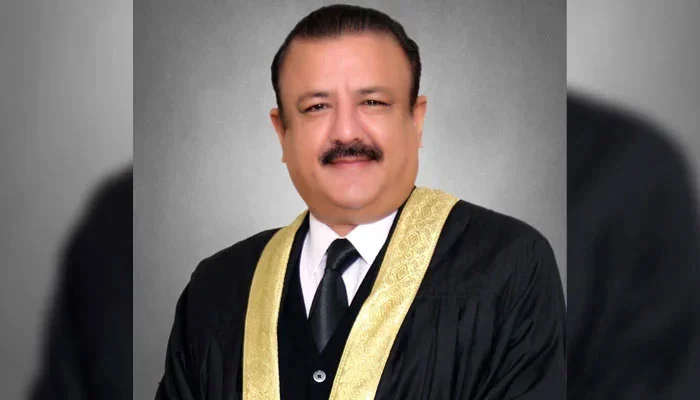
ISLAMABAD: The Islamabad High Court on Monday barred Justice Tariq Mahmood Jahangiri from judicial duties pending a Supreme Judicial Council ruling on allegations that his law degree is fraudulent, a decision that intensifies scrutiny of Pakistan’s judiciary at a time of heightened tensions over its independence.
A two-judge panel, led by Chief Justice Sardar Mohammad Sarfraz Dogar and including Justice Mohammad Azam Khan, issued the order during a hearing on a petition challenging Jahangiri’s appointment. The controversy stems from a letter that surfaced on social media last year, allegedly from the University of Karachi’s controller of examinations, questioning the validity of Jahangiri’s LLB degree, the cornerstone of his legal career and judicial appointment.
A formal complaint was lodged with the Supreme Judicial Council in July 2024, followed by a petition filed earlier this year under Article 199 of Pakistan’s Constitution, seeking a writ of quo warranto to challenge the legitimacy of his office.
The bench not only suspended Jahangiri but also appointed Barrister Zafarullah Khan and former attorney general Ashtar Ausaf as amici curiae to assist in the proceedings. It further sought the attorney general’s guidance on the petition’s maintainability and adjourned the case until the council delivers its verdict.
“The court has to consider an important question, that if a matter is under adjournment in the Supreme Judicial Council, can the high court be approached on it,” the bench observed.
Raja Aleem Abbasi, representing the Islamabad Bar Association, emphasised the stakes for the legal community. “We believe in the rule of law,” he said, noting that bar associations are key stakeholders. Abbasi warned that allowing such petitions to proliferate could be “dangerous” and urged the court to uphold objections raised by the registrar’s office.
Chief Justice Dogar responded that all parties are entitled to a fair hearing and that the court must address the registrar’s objections directly. Following the ruling, the high court issued a revised duty roster, which excludes Jahangiri from any bench assignments.
The petition hinges on official correspondence from the University of Karachi, attached as evidence, alleging serious irregularities in Jahangiri’s credentials. It claims he used two different enrollment numbers — AIL-5968/87 for LLB Part-I and AIL-7124/87 for Part-II — despite the university’s assertion that it is “impossible to allot two enrollment numbers to a student for one programme.” Records show the first number was assigned to another student, Imtiaz Ahmad, son of Muhammad Ellahi.
A letter from the principal of Government Islamia Law College in Karachi further states that a “Tariq Mehmood s/o Qazi Muhammad Akram” under the second enrollment number was never admitted to the LLB program during the relevant period. The university’s controller of examinations concluded in an official letter that the degree and mark sheets are “invalid.”
The petitioner argues that appointing a judge without proper qualifications is not a mere administrative oversight but a violation of citizens’ fundamental rights, asserting that it “shakes public confidence” and “tarnishes the image of the judiciary as a neutral arbiter.”
Jahangiri’s case unfolds amid broader judicial discord. He was among five judges who last year challenged Chief Justice Dogar’s transfer to the Islamabad High Court, alongside Justices Khadim Hussain Soomro and Mohammad Asif. He also joined colleagues in a letter to the Supreme Judicial Council alleging interference by intelligence agencies in judicial matters.
Days before the degree controversy emerged, Jahangiri was overseeing expedited hearings on election petitions alleging rigging in all three of Islamabad’s national assembly constituencies, a role that placed him at the center of Pakistan’s fraught political landscape.
Copyright © 2021 Independent Pakistan | All rights reserved