By Staff Reporter
ISLAMABAD: A long-dormant argument over how Pakistan should be governed has burst back into public view this week, pitting the country’s two largest ruling parties against each other and drawing in a president, a prime minister, and at least three federal ministers.
At issue is a proposal, floated by members of Prime Minister Shehbaz Sharif’s own cabinet, to redraw Pakistan’s internal map — potentially carving the nation’s four provinces into a dozen or more smaller administrative units. The idea has been circulating since July, when Interior Minister Mohsin Naqvi said that the country’s governance system had “collapsed.” But it took on new urgency this week after the Sindh Assembly, controlled by the Pakistan Peoples Party, passed a resolution flatly rejecting any division of the province, and Bilawal Bhutto-Zardari flew to London for a five-hour meeting with his father, President Asif Ali Zardari, to plot the party’s response.
The result is a rare public airing of tension inside Sharif’s coalition, one that has already spilled into parliamentary committee rooms and delayed unrelated legislation on natural gas revenue.
“We want to know what the stance of the prime minister on new provinces is, as no statement is coming from him, whereas a number of federal cabinet members are apparently supporting the plan,” said Nayyar Hussain Bokhari, secretary general of the PPP’s parliamentary wing, to a local television channel. “It is a very serious issue which has jolted the existing federating units, but the PM is silent on such an important issue.”
Sharif has not spoken publicly on the matter.
An old debate, revived
Pakistan has operated with four provinces — Punjab, Sindh, Khyber Pakhtunkhwa, and Balochistan — for decades, alongside more contentious territories including semi-autonomous territories under Islamabad’s administrative control. Proposals to redraw those boundaries have surfaced periodically, usually going nowhere. This round began differently: from inside the government itself.
Naqvi, the interior minister, opened the door in July, arguing that Pakistan’s administrative structure had broken down over eight decades and needed to be replaced with new units — whether they were called provinces or something else — paired with a genuine transfer of power to local governments. He later said he stood by his assessment, clarifying he meant the system had deteriorated gradually rather than collapsed all at once.
Planning and Development Minister Ahsan Iqbal went further, proposing the creation of 12 to 15 new provinces and calling on Sharif to form a committee, run through the law ministry, to study Pakistan’s administrative structure and open a national conversation. Iqbal has argued that even after the devolution of powers under the 18th Constitutional Amendment, Pakistan’s four provinces have grown more centralized, not less — with Karachi, Lahore, Peshawar, and Quetta struggling to effectively govern territory far from their provincial capitals. He has floated an alternative: roughly 160 empowered district governments spread across the existing four provinces, warning that pressure for entirely new provinces will only grow if that kind of devolution doesn’t happen first.
Defence Minister Khawaja Asif accused PPP of a “double standard” in a post on the social media platform X. The party has shown sympathy for a proposed Saraiki-speaking province carved from southern Punjab, he wrote, but reaches for the old separatist slogan of “Sindhudesh” whenever broader provincial restructuring is discussed. Asif said he believed something else was driving the PPP’s position and would explain what “at some point,” while insisting that Pakistan’s 36 existing administrative divisions could serve as a ready-made foundation for a new provincial map. Devolution of power, he argued, is “inevitable.”
Media reports have floated figures ranging from eight new provinces to as many as 30, though the government has not put forward an official plan, and no bill or resolution on the subject has been introduced in parliament.
Sindh draws a line
For the PPP, which has governed Sindh for most of the past two decades, the proposal touches a particular nerve. The party’s political identity is bound up with the province, and any suggestion of dividing it — a live question given Karachi’s large Urdu-speaking population, historically represented by the Muttahida Qaumi Movement-Pakistan — is treated as an existential threat.
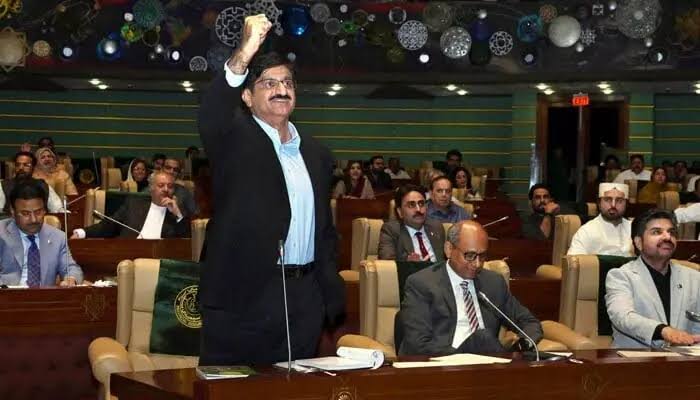
The Sindh Assembly answered on Wednesday, passing a resolution rejecting any division of the province, any alteration of its boundaries, and any creation of new administrative units carved from its territory. The assembly declared it would not consent to any territorial change involving Sindh. The MQM-P, a PPP rival that also sits in Sharif’s coalition in Islamabad, boycotted the session.
Speeches on the assembly floor grew heated enough that they drew a rebuke from Rana Sanaullah, Sharif’s adviser on political affairs, who complained that lawmakers had unnecessarily dragged the National Assembly into their remarks. “The heat and intensity created over the issue of provinces yesterday was unnecessary,” Sanaullah said Friday on a local television channel, describing the resolution as consistent with similar measures the assembly has passed in the past.
Sanaullah, whose Pakistan Muslim League-Nawaz leads the governing coalition, has staked out a middle position: no discussion of new provinces is currently underway, he said, and any such move would first require consultation and consensus among political parties before a bill or resolution could even be introduced in parliament. He acknowledged, though, that the question of Sindh’s division carries particular weight for the PPP’s politics, and he suggested the party’s public objections have as much to do with positioning as with principle — accusing PPP lawmakers of using the resolution and the speeches around it to score political points.
He also rejected a claim by his cabinet colleague Mustafa Kamal, the federal health minister and a senior MQM-P leader, that the MQM-P had been kept in the dark about consultations surrounding last year’s 26th constitutional amendment. Sanaullah said those consultations did take place, recalling that the party spent roughly six weeks camped outside the residence of Jamiat Ulema-e-Islam-Fazl chief Maulana Fazlur Rehman during that period.
Kamal, for his part, argued that Pakistan’s political stakeholders have already concluded the country cannot continue under its existing structure. He said his party had twice tried to advance a constitutional amendment strengthening local governments, and asked pointedly what options remain if such efforts keep failing. He also revived a long-standing MQM-P grievance, accusing the PPP of dividing Karachi — once administered as a single district — into seven separate districts for political advantage. Why, he asked, has Sharif stayed silent on the provinces question?
The Bhutto family responds
The PPP’s leadership took the debate to London this week. Bilawal Bhutto-Zardari, the party’s chairman, met for five hours with his father at the elder Zardari’s residence there, a sitdown also attended by Bilawal’s sister, Bakhtawar Bhutto-Zardari. The three reviewed Pakistan’s broader political situation and specifically discussed the party’s stance on Sindh’s status, the people said, along with a recent speech by PPP leader Faryal Talpur. The meeting ended, they said, with a decision to hold firm against any division of the province.
Bilawal remained in London afterward, telling reporters he intended to stay for several more days. He has said previously that the PPP’s position on new provinces is straightforward — that any such change should come only through consensus — and that decisions about Sindh specifically belong in the provincial assembly.
A coalition under strain
The dispute has already had practical consequences. The PPP is not formally part of Sharif’s coalition but has propped up the government’s two-thirds majority in the National Assembly — a majority the PML-N would lose if PPP support were withdrawn, giving the party outsized leverage over any constitutional change. That leverage was on display Friday, when the PPP blocked a National Assembly committee from taking up two government bills related to natural gas revenue, citing unresolved grievances that go well beyond the provinces debate, including recent elections in Azad Kashmir and judicial appointments.
At a meeting of the National Assembly’s Standing Committee on Petroleum, PPP lawmaker and former federal minister Syed Naveed Qamar asked the panel to set aside the Natural Gas (Development Surcharge) Amendment Bill and a related measure amending the Gas Infrastructure Development Cess. The GIDC legislation would broaden how roughly $1 billion in unutilized development funds can be spent on strategic oil and gas reserves, expanding beyond its current mandate covering cross-border pipeline projects with Iran and Turkmenistan.
“The PPP was not a coalition partner but had been supporting the government, and that relationship could not be carried forward unilaterally forever,” Qamar told reporters afterward, adding that the government had promised to address the party’s concerns but shown no progress. He also renewed the party’s objection to a separate Islamabad local government bill, which he said the PML-N had tried to push through committee a day earlier over PPP’s dissent.
Committee chairman Mustafa Mehmood ultimately deferred both gas-related bills, though not before weighing in on a different question — whether subsidized gas should continue flowing to fertilizer companies if the savings aren’t passed on to farmers.
Bokhari, the PPP parliamentary secretary general, said any move to redraw provincial boundaries would face a steep procedural climb regardless of the political noise surrounding it. Creating new provinces requires a constitutional amendment passed by two-thirds majorities in both the National Assembly and Senate, he noted, along with the consent of the affected provinces under Article 140-A. He pointed to history as a cautionary note: negotiations over Pakistan’s original 1973 constitution took months, he said, and consultations ahead of the 18th Amendment stretched beyond a year.
For now, no bill exists, no formal proposal has been submitted, and the prime minister — whose silence has become almost as much a subject of debate as the provinces themselves — has yet to say where he stands.
Copyright © 2021 Independent Pakistan | All rights reserved