By Staff Reporter
In the end, it took the full machinery of international cricket’s diplomacy – late-night talks in Lahore, interventions from the ICC, quiet words from friendly nations – to ensure that the fixture everyone knew had to happen actually would. For a few fraught days this month, the T20 World Cup’s marquee clash between India and Pakistan teetered on the edge of cancellation, another casualty of the region’s tangled politics. That it survived, to be played on Sunday evening at Colombo’s R. Premadasa Stadium, says something profound about the strange, stubborn power of this particular contest. It does not merely sustain cricket; in many ways, it defines it.
The numbers tell one story. India have won 12 of the last 16 T20 internationals between the sides, and six of the eight meetings in World Cups (with one tie). In last year’s Asia Cup they beat Pakistan three times in three different ways: with the ball, with the bat, and, most painfully for their opponents, with the mind. Suryakumar Yadav’s side arrive in Colombo with a 2-0 record in the tournament, their top order devastating, their middle order weighted with power, their attack featuring Jasprit Bumrah at his imperial best and a spin arsenal of bewildering variety. Pakistan, too, are 2-0, having scraped past the Netherlands and beaten the USA with something to spare. But the ledger of the rivalry is merciless. In the past decade they have managed just three victories over India, two of which – the 180-run chase in the 2021 World Cup and the 152-0 demolition in the 2022 Asia Cup – have passed into folklore, referred to in Pakistan simply by their scores. The 17 defeats have blurred into a single, dispiriting blur.
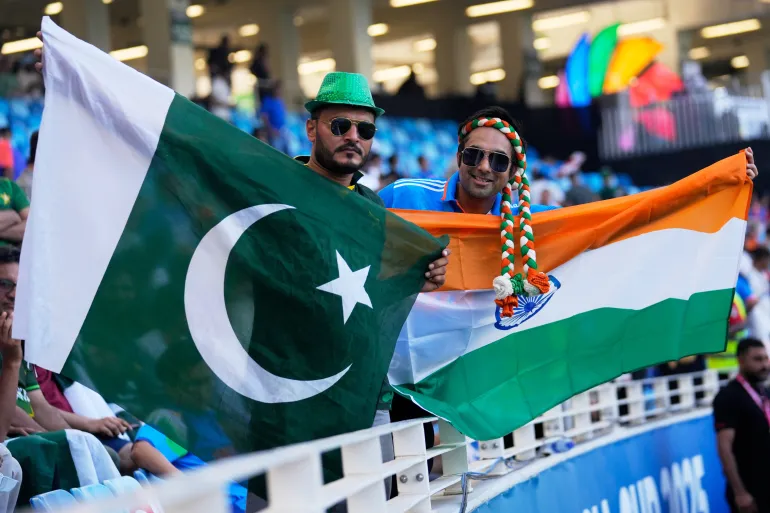
Yet statistics have never been the point. This is the match that still packs stadiums more reliably than any other, that draws more eyeballs than games against ostensibly stronger sides. In Pakistan, a win against India remains the ultimate currency. In India, the crowds may have grown more discerning about the quality of opposition, but the fixture retains its primal pull. Suryakumar himself, after one of those Asia Cup victories in Dubai, tried to declare the rivalry over as a competitive contest. The stands, and the television figures, have yet to agree.
The politics, as ever, refuses to stay off the pitch. The near-boycott was framed as solidarity with Bangladesh, expelled from the tournament after refusing to play in India over security concerns. Pakistan initially followed suit, only to reverse course after intense negotiations. The echoes of last year’s Asia Cup final linger: no handshakes, India’s refusal to accept the trophy from Mohsin Naqvi (ACC chairman and Pakistan’s interior minister), fines for provocative gestures. On Saturday, Suryakumar was studiously non-committal when asked whether the custom would be observed on Sunday. “Wait for 24 hours,” he said. “We are here to play cricket.” Salman Ali Agha, Pakistan’s captain, was more pointed. “The game should be played in the true spirit but whatever way they want, we will only know tomorrow.”
The pitch at the Premadasa – the same surface used for Australia’s surprising defeat by Zimbabwe – is expected to be slower and lower than usual for the venue, with a touch of grass still visible on Sunday. Spin will be king. India are likely to bolster their options by bringing in either Washington Sundar or Kuldeep Yadav for Arshdeep Singh, with Abhishek Sharma returning from a stomach bug to open alongside Ishan Kishan. Their probable XI reads like a statement of intent: Kishan, Abhishek, Tilak Varma, Suryakumar, Hardik Pandya, Shivam Dube, Rinku Singh, Axar Patel, Kuldeep, Varun Chakravarthy, Bumrah. Pakistan’s selection is more settled, though there is talk of Fakhar Zaman coming in, possibly at the expense of Usman Khan, with Sahibzada Farhan keeping wicket. Agha has stuck with Babar Azam in the middle order after his recent form. The wild card is Usman Tariq, the 30-year-old off-spinner whose double-jointed, slingshot action has been reported and cleared twice by the ICC. Inspired, improbably, by the Dhoni biopic he watched while working as a salesman in Dubai, Tariq has taken 11 wickets in four T20Is since his debut. Agha calls him the “X-factor”. In the humid Colombo evening, against a batting line-up that has rarely been troubled this tournament, he may need to be.
For Pakistan, the psychological burden is heavy. They have come agonisingly close in recent World Cup meetings – Melbourne 2022, New York 2024 – only to let victory slip. Farhan, who bludgeoned Bumrah for three sixes at a strike rate of 150 during the Asia Cup, offers hope of an explosive start. Hardik Pandya, meanwhile, has made something of a speciality of this fixture, his all-round contributions against Pakistan superior to his overall T20I record.
Off the field, Colombo is already feeling the windfall. Hotels have doubled in price, flights from India, Europe Dubai have soared, and an estimated 20% of the 100,000 visitors to Sri Lanka in the first 10 days of February were here for this match. The island, still recovering from economic crisis and a devastating cyclone, is positioning itself as the neutral venue of choice for a rivalry that can no longer be contained at home. In the grand scheme of the tournament, Sunday’s result may not matter much. Both sides are almost certain to progress. But that has never been the measure of India vs Pakistan. This is a game that exists for its own sake, a reminder that cricket’s most lucrative, most watched, most emotionally charged contest is sustained not by logic but by something deeper: absence, memory, and the stubborn refusal of two nations to stop caring so intensely about 22 men in coloured clothing. For a few hours on Sunday, the politics, the handshakes (or lack of them), the broader geopolitics can recede. What remains is the contest itself. And that, in the end, is why the game had to go ahead. Cricket, for all its flaws and compromises, still knows what matters.
Copyright © 2021 Independent Pakistan | All rights reserved