By Staff Reporter
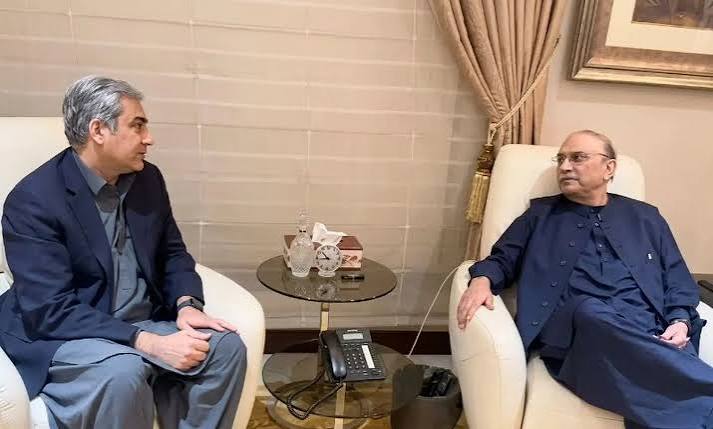
ISLAMABAD: Interior Minister Mohsin Naqvi flew unannounced to Nawabshah on Thursday night for an hour-long meeting with President Asif Ali Zardari, hours after publicly proposing a referendum on creating new provinces.
Sources said the talks centred on proposals for new provinces, the possibility of a referendum and potential action against the Jamiat Ulema-e-Islam-Fazl (JUI-F), the religious party led by Fazlur Rehman. They claimed Naqvi had travelled urgently, carrying an important message from a senior national figure, and wanted to take the president into confidence. The figure was not named.
Naqvi arrived from Islamabad on a special aircraft and was received at Nawabshah airport by Sindh home minister Zia Ul Hassan Lanjar, works and services and prisons minister Haji Ali Hassan Zardari, deputy commissioner Abdul Samad Nizamani and SSP Dr Sameer Noor Channa. He was driven to Zardari House under tight security. The meeting reportedly lasted 59 minutes, after which he flew back to Islamabad.
Pakistani broadcasters reported that the two men also discussed the political and security situation. Another report said the 28th Constitutional Amendment was on the agenda, along with the recent meeting between the imprisoned PTI founder and his lawyers and the release of his sisters. None of this has been confirmed. No official statement has been issued on the meeting or the message it was said to involve.
Earlier on Thursday, Naqvi told a press conference at the National Cyber Crime Investigation Agency that he and Zardari’s son, Pakistan Peoples Party (PPP) chairman Bilawal Bhutto-Zardari, were largely on the same page over a reset of the system.
He was referring to remarks Bhutto-Zardari made on Wednesday, when he said there was indeed a need to “reset” the system but argued the country should be run by the people “instead of traders and businessmen” and through greater unity. Bhutto-Zardari said Pakistan, like much of the world, faced an economic crisis and its politics needed to be reset to meet it.
Naqvi drew a distinction. Bhutto-Zardari had spoken of the “political system”, he said, whereas his own proposal was for an “overall reset”. He insisted that “no decision would be taken without the consent of the parties concerned”, dismissed social media talk of rifts among coalition partners, and urged parties to seek public opinion through a referendum on new provinces.
The PPP matters because it is a key ally of the ruling coalition led by Prime Minister Shehbaz Sharif’s PML-N. Defence minister Khawaja Asif has pointed out that a constitutional amendment needs a two-thirds majority in both the National Assembly and the Senate. Recent reports have suggested a plan to reorganise Pakistan into 12 provinces is under consideration, with a nationwide referendum envisaged before a possible 28th Amendment.
Months of dispute
The debate gathered pace on July 30, when Naqvi told the Pakistan Economic Summit 2026 in Islamabad that the governance model had effectively “collapsed” after decades of failure. He called for new administrative units or provinces, arguing that decentralisation was essential to better public services, timely justice and opportunities for young people. On the same day he met Zardari at Bilawal House in Karachi.
The response was mixed. Several PML-N figures criticised him, among them the prime minister’s political aide Rana Sanaullah, who asked how Naqvi could condemn a system that had carried him to the interior ministry in three and a half years. Asif said he largely agreed with the assessment. The PPP’s Sindh chapter demanded Naqvi’s resignation. The JUI-F chief asked why he remained in cabinet if he believed the system was not working, and voiced scepticism over what the government might try to include in a 28th Amendment.
Naqvi has since met Zardari in Lahore and in London on September 3, where sources said the president told him he would stick to his position on new provinces. Nawabshah is at least the fourth reported meeting.
The next day, the Sindh Assembly passed a resolution rejecting any attempt to divide the province or create new administrative units. Chief minister Syed Murad Ali Shah declared that “there will be no compromise on Sindh’s geographical unity”. Two days later, Naqvi renewed his call for a reset. Mr Bhutto-Zardari, speaking in London, said the issue should be debated in parliament, and acknowledged that he and Mr Naqvi could hold differing views.
Muttahida Qaumi Movement-Pakistan leader Mustafa Kamal, the federal health minister, has long advocated carving new provinces out of Sindh, and his party has called for a countrywide referendum. On November 8, Asif said Pakistan could have as many as 12 provinces, provided they were drawn on administrative rather than ethnic, linguistic or political lines. Sanaullah has said the government cannot hold a referendum on its own decision and would need parliament’s approval.
Legal experts cited by local media say a public vote alone cannot create a province. Any change to provincial boundaries must follow the constitutional amendment procedure, including approval by the relevant provincial assembly. A referendum could lend democratic legitimacy to such a move, they say, but would not replace those requirements.
Copyright © 2021 Independent Pakistan | All rights reserved