By Staff Reporter
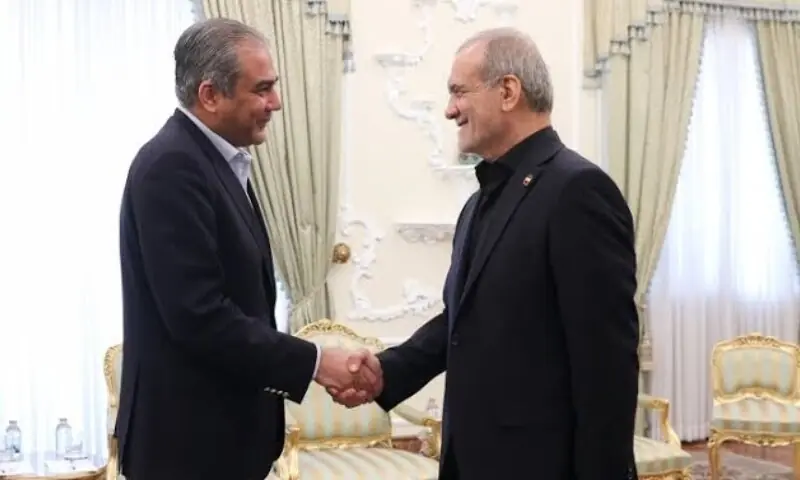
ISLAMABAD: Interior Minister Mohsin Naqvi met on Sunday with Iranian President Masoud Pezeshkian and Parliament Speaker Mohammad Bagher Ghalibaf in Tehran, part of an intensifying Pakistani effort to salvage faltering negotiations between Washington and Tehran more than a month after a fragile ceasefire halted six weeks of open conflict.
The 90-minute meeting with Pezeshkian focused on bilateral relations and Pakistan’s role as mediator, Iranian state media reported. Naqvi’s visit comes as the two sides remain deadlocked over Iran’s nuclear program, its missile capabilities and control of the Strait of Hormuz, the narrow waterway through which about one-fifth of the world’s oil and liquefied natural gas passes.
Pezeshkian told Naqvi that the US-Israeli strikes on Iran that began Feb. 28 were intended to sow internal insecurity but ultimately failed because regional countries, including Pakistan, Iraq and Afghanistan, refused to let their territory be used for the attacks. He thanked the three nations explicitly for denying Tehran’s adversaries access to their soil, according to accounts in Iranian media.
Naqvi also held a separate meeting with Ghalibaf, a senior member of the Iranian delegation that traveled to Islamabad for the first round of direct US-Iran talks in mid-April. Iranian state media described the exchange as covering “key matters” without providing further details. The state-run IRNA news agency said afterward that “official meetings of the mediator’s representative in Tehran with senior Iranian leaders continue.”
Naqvi arrived in the Iranian capital on Saturday for a two-day official visit explicitly aimed at advancing regional peace, the Pakistani embassy in Tehran said in a statement posted on Telegram. He was met at the airport by Iranian Interior Minister Eskandar Momeni, who praised the “sincere and committed efforts” of Pakistan’s military leadership, particularly Field Marshal Asim Munir, the chief of army staff and chief of defence forces. “Iran has always been a supporter of peace and we deeply appreciate Pakistan’s efforts in this regard,” Momeni was quoted as saying by the embassy. “We view Pakistan’s initiatives with great respect and admiration.”
Pakistan has cast itself as the indispensable go-between since the conflict erupted. The fighting began with coordinated US-Israeli strikes on Iran on Feb. 28. Iran responded by attacking Israeli targets and US bases across the region and effectively blockading the Strait of Hormuz. A ceasefire brokered with Pakistani help took effect April 8, but the first round of face-to-face talks in Islamabad on April 11 and 12 produced no agreement on the core disputes.
Last week, Pakistani officials confirmed they had received Tehran’s formal response to the latest US proposal and had passed it along to Washington. Prime Minister Shehbaz Sharif told an audience in Islamabad on May 10 that Munir had informed him of the Iranian reply but said he could not discuss details. The Foreign Office later said in a statement, “The US-Iran peace process is underway. We are engaged in it and remain hopeful.”
Iranian media portrayed the American counterproposal as offering little in return. The Fars news agency reported that Washington presented a five-point list that included a demand that Iran operate only one nuclear site and transfer its stockpile of highly enriched uranium to the United States. Mehr news agency said the US position sought “concessions that it failed to obtain during the war,” predicting an impasse.
A second round of talks had been tentatively scheduled for last month, but US President Donald Trump canceled the planned visit by an American negotiating team, citing differences with Iran’s proposals. Pakistan, which maintains close ties with both Washington and Tehran, has been accepted by both governments as the chief mediator. Officials in Islamabad hope a successful agreement would help ease the economic shock waves still rippling through global energy markets and developing economies, including Pakistan’s own.
The brief war drove up oil prices sharply and contributed to inflationary pressures in countries already struggling with high energy costs. Pakistani officials have repeatedly described their mediation effort as an attempt to stabilize the region and protect their own economic interests.
Copyright © 2021 Independent Pakistan | All rights reserved