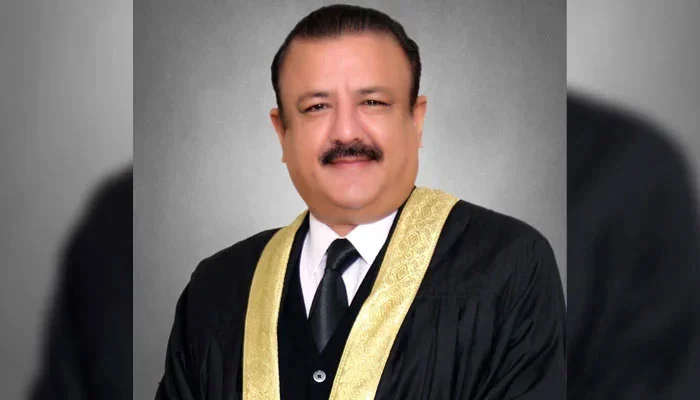
By Staff Reporter
ISLAMABAD: A high court judge has appealed to the Supreme Court of Pakistan to overturn a restraining order that barred him from carrying out his judicial duties amid questions over the validity of his law degree, arguing that the move amounts to an unconstitutional encroachment on judicial independence.
Justice Tariq Mehmood Jahangiri, who sits on the Islamabad High Court, filed the appeal in person, seeking to have the Sept. 16 order set aside and suspended while the petition is pending. He also asked the Supreme Court to direct the division bench that issued the order to refrain from further proceedings in the matter.
The restraining order stemmed from a writ petition brought by lawyer Mian Dawood under Article 199 of the Constitution, which sought a writ of quo warranto — essentially questioning “by what authority” Justice Jahangiri holds judicial office.
A two-judge bench of the Islamabad High Court, headed by Chief Justice Sardar Mohammad Sarfraz Dogar and including Justice Mohammad Azam Khan, issued the interim order after raising serious questions about the validity of Justice Jahangiri’s law degree from Karachi University.
In his appeal under Article 185(3) of the Constitution, Justice Jahangiri invoked a 2010 Supreme Court ruling in the Iftikhar Chaudhry case. That decision held that the Constitution did not permit any restraint on the exercise of judicial powers by a judge or any limitation on him during proceedings envisaged by Article 209.
The ruling also held that even a temporary disability placed on a judge in the discharge of constitutional and official obligations amounts to removal from office and is therefore not permissible under the Constitution.
The appeal described the Sept. 16 order as patently mala fide in its conception and contrary to what transpired in open court. It added that the restraining order was passed in a palpable conflict of interest, opening the door to an egregious encroachment on judicial independence, allowing a larger bench of the high court to restrain fellow judges from performing their judicial functions.
Justice Jahangiri’s filing stressed that although interference in interlocutory matters is an exception to the general rule, an exception arises when an order is arbitrary, capricious and contrary to settled principles of law.
In such cases, he argued, the Supreme Court is bound to intervene to prevent miscarriage of justice. It is a settled principle that no injunction may be granted without the three prerequisites of a prima facie case, irreparable loss, and balance of convenience being satisfied, according to the appeal.
However, the Sept. 16 order, which the appeal described as a non-speaking order, contains no discussion of these indispensable elements, thereby lacking legal foundation. The appeal further argued that the order overturns the convention that the court is a collegiate body of judges, each exercising equal judicial power, who are required to discharge their duties in a manner that upholds comity among them.
Copyright © 2021 Independent Pakistan | All rights reserved