By Staff Reporter
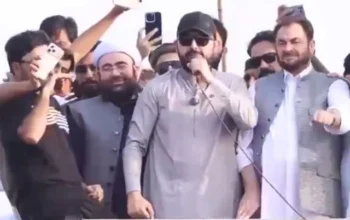
PESHAWAR/ISLAMABAD: The chief minister of Khyber Pakhtunkhwa has accused the province’s governor of mounting an “attack on the Constitution and democracy” by chairing a security meeting, deepening a confrontation with Islamabad, while his party’s long march continues.
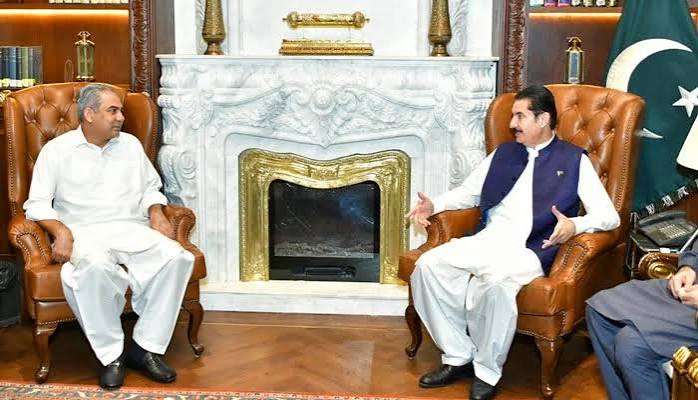
Sohail Afridi, of Imran Khan’s Pakistan Tehreek-e-Insaf (PTI), spoke on Wednesday at the 60th meeting of his cabinet in Peshawar. A day earlier, Faisal Karim Kundi, the governor and a member of the Pakistan Peoples Party (PPP), had met the provincial chief secretary and inspector general of police to discuss the security situation in the northwestern province, which borders Afghanistan.
Afridi described the gathering as “drama”. “The governor convening such a meeting in the presence of a provincial government with a two-thirds majority is unacceptable,” he said, insisting that the assembly, cabinet and government were “fully functional and intact”. He said the aim was to provoke his administration into a reaction, and urged PTI supporters to stay peaceful. “We have to talk about the Constitution and the law.”
Afridi added that the constitution already provides a way to remove a chief minister, through a vote of no confidence. He said he would consult the provincial advocate general on the legal standing of Tuesday’s meeting and, if necessary, bring legislation to the assembly.
The advocate general, Shah Faisal Utmankhel, told the cabinet that a governor in a parliamentary system “is a ceremonial head” and that executive power rests with the elected government. He said the constitution requires the chief minister to keep the governor informed of provincial business, but “there is nowhere written that on his own he can call someone, ask them questions or give instructions or directions”. Such powers, he said, arise only under Article 234, when a province’s constitutional machinery has failed and governor’s rule is imposed. “At the moment, the provincial government is in the field,” he said.
Afridi told the chief secretary and police chief not to follow any unconstitutional or illegal order. “I am a soldier of Imran Khan, and he has trained us throughout our lives not to do anything unconstitutional or illegal.”
He also turned on the governor’s party. He blamed Zulfikar Ali Bhutto, the PPP’s founder, and General Yahya Khan for the separation of East Pakistan, now Bangladesh, and accused President Asif Ali Zardari of “intending to make another East Pakistan here”. “We will not allow any conspiracy to break up Pakistan to succeed,” he said.
Security and money
The chief minister repeated his objections to the federal government’s counterterrorism policy. He said his administration had strengthened the police, the Counter-Terrorism Department and the Special Branch, which he called the province’s “eyes”, since he took office on 15 October 2025.
He said Islamabad had treated the province as a “stepchild”. The former tribal districts were merged into Khyber Pakhtunkhwa in 2018 but, he said, still had not been integrated financially, and the funds promised at the time had not arrived. He claimed that federal governments had imposed military operations on the province since 2004, and that about Rs100bn in compensation for displaced families was outstanding. Tribal households had been allocated only Rs400,000 each, he said, and displaced people at the Baka Khel camp in North Waziristan were not receiving the Rs370m to Rs380m a month they were promised. His government, he said, had paid out Rs21bn to displaced people.
He asked the federal government to raise the province’s share under the National Finance Commission award and to pay about Rs125bn in dues, noting that the province had lost 80,000 lives to militancy. “If peace has not been established despite the sacrifice of 80,000 lives over 22 years, it means your policy has failed,” he said. He cited 14,000 intelligence-based operations and 22 major military operations in that time. He said Balochistan, whose government cooperates with Islamabad, had fared no better, and claimed peace could be restored in Khyber Pakhtunkhwa within 100 days under a different approach.
Afridi also complained that the police were being treated as “personal servants”. He said a provincial minister, Fazal Shakoor Khan, had been detained and ordered an inquiry into the station house officer in Lachi, whom he accused of taking money from people at gunpoint.
Islamabad hits back
Khawaja Asif, the defence minister, said in Islamabad that the government was trying to avoid imposing governor’s rule, which he called the “last option”. “If there is no other way left, then we can use that option,” he said. He urged the PTI to “play the role of a political party rather than a terrorist organisation”.
In a post on X, he accused the provincial government of “complete collusion” with militants and said it had ignored Tuesday’s attack in Dera Ismail Khan, which killed five people, including two customs officials. He said the chief minister and his cabinet had offered no condolences and were absorbed in the march. “KP cannot be left any longer to the mercy of incompetent, insensitive rulers and Taliban allies,” he said. He contrasted the PTI with the Pakistan Muslim League-Nawaz, whose leaders were jailed under Khan’s government. “It did not ally with the Taliban,” he said.
Rana Sanaullah, the prime minister’s adviser on political affairs, said that “the doors for talks are open” but that negotiations would not be allowed to become a tactic to “hold the state hostage”.
The governor’s rule question has been live for weeks. On 21 September the interior minister, Mohsin Naqvi, said the government was consulting the law ministry on options including governor’s rule if the march went ahead. Two days later the information minister, Atta Tarar, said there was no plan to remove the PTI administration. On 26 September Afridi warned that imposing governor’s rule would provoke an “unprecedented” public reaction.
Talks between the government and the opposition over the weekend ended in deadlock. Prime Minister Shehbaz Sharif said the PTI had demanded last-minute changes to an agreed draft, while the PTI said the talks failed because the government refused a meeting with Khan, who has been jailed since August 2023, and would not pursue a joint counterterrorism strategy. Sharif has since offered talks if the march ends, an offer the PTI rejected.
Copyright © 2021 Independent Pakistan | All rights reserved