By Staff Reporter
ISLAMABAD: The law minister called on the country’s media Tuesday to tread carefully in discussing the nation’s foreign policy, warning that loose talk and speculation amid the escalating conflict between Iran, the United States and Israel risk unsettling key diplomatic partners and crossing constitutional boundaries.
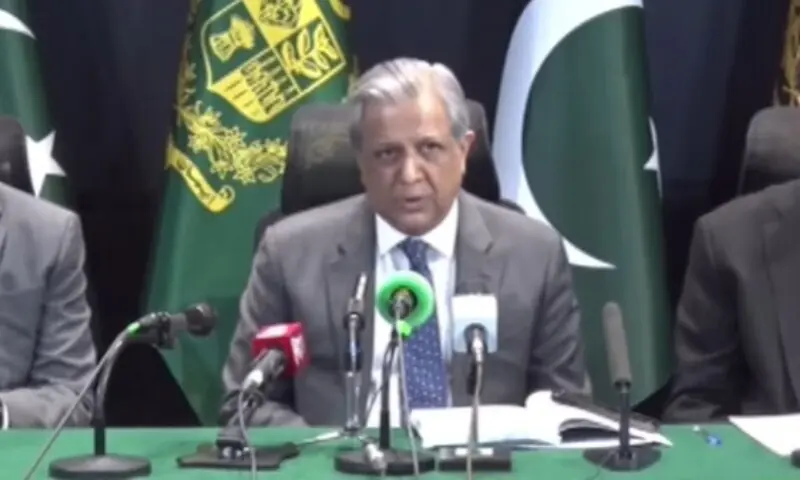
Azam Nazeer Tarar, addressing a joint news conference with Information Minister Ataullah Tarar and Minister of State for Interior Tallal Chaudhry, said analyses emerging from Pakistani television, social media and newspapers had already prompted “unease” from at least one friendly country. Diplomats, he said, had asked whether certain public comments represented Islamabad’s official position or merely the views of individuals.
“As a nation, we must keep in mind that when expressing our views, we have to keep the constitution and Pakistan’s foreign policy under consideration,” Tarar said. “We have been asked if this was Pakistan’s stance or an individual one.”
The remarks came against the backdrop of a rapidly deteriorating situation in the Middle East. Iran has been locked in open conflict with the United States and Israel since Israeli strikes on Feb. 28, which prompted Tehran to launch retaliatory attacks on neighboring countries hosting US military bases. The crisis has forced regional powers, including Pakistan, to navigate a delicate balancing act among longstanding ties to Gulf Arab states and historic relations with Iran. Pakistan, a nuclear-armed nation with deep economic and security stakes across the Muslim world, has repeatedly called for diplomatic de-escalation.
Tarar opened the news conference by reiterating that Islamabad has been “pushing for efforts to find a diplomatic solution” and coordinating with “brotherly countries” to ease tensions. Prime Minister Shehbaz Sharif has held multiple telephone conversations with regional leaders in recent weeks. Yet the minister made clear that the government expects domestic commentators to show similar restraint. He read aloud Article 19 of Pakistan’s Constitution, which guarantees freedom of expression but subjects it to “reasonable restrictions” in the interest of the glory of Islam, the integrity and defense of the state, and “friendly relations with foreign states.” “You have the fundamental right to freedom of expression, but you must be careful,” Tarar told journalists. Citizens may express opinions, he added, but “we must not abandon the limits laid out in the constitution.”
The minister singled out a particular form of commentary that has apparently irritated diplomatic partners: speculative framing of Pakistan’s choices in zero-sum terms — whether the country is “with Iran” or aligned with Saudi Arabia and the United Arab Emirates. Such discussion, he said, should be left entirely to the state. “Leave that to the state to decide,” Tarar said, urging Pakistanis to have “faith” in official decision-making. “As far as Pakistan’s foreign policy is concerned and its relations with the Gulf … we cannot speculate if Pakistan is with Iran, then what could it mean for its relations with Saudi Arabia … or if we are with the UAE, then what does that mean for our relations with Saudi Arabia.”
Information Minister Ataullah Tarar said Pakistan maintains a careful balance in its relations with Muslim countries and an equilibrium should not be undermined by individual interpretations or by treating complex diplomacy like domestic partisan politics. “Pakistan has its foreign policy, and it maintains a balance in terms of the relations we share with our respective Muslim countries,” the information minister said. “We should not discredit it for views and provide our own interpretations instead.”
When asked directly whether any specific vlog or social-media post had damaged Pakistan’s relations with another country, Law Minister Tarar replied firmly: “No relation has been impacted, and neither will it.” The government was simply asking for “responsible journalism” at a sensitive moment, he said, stressing that Pakistan remains a responsible state with “its own identity and its own stance in terms of its defence and foreign policy.”
The unusual public admonition reflects the government’s broader concern that uncontrolled domestic debate could complicate its efforts to protect economic lifelines in the Gulf while preserving ties with Tehran. Pakistan relies heavily on remittances and energy imports from Saudi Arabia and the UAE, yet shares a long border and cultural links with Iran. Any perception that Islamabad is tilting one way or the other risks real diplomatic and financial consequences.
Copyright © 2021 Independent Pakistan | All rights reserved