By Staff Reporter
ISLAMABAD: Pakistan’s most senior army officers have warned that any attempt to stir unrest or recreate the violence of 9 May 2023 will be met with “decisive force”, days before the party of the jailed former prime minister Imran Khan sets out on a march towards the capital.
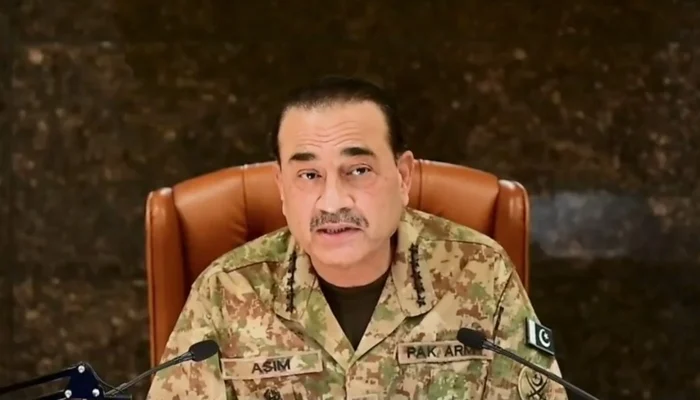
The warning came on Friday at the 277th Corps Commanders’ Conference at General Headquarters in Rawalpindi, chaired by Field Marshal Asim Munir, who serves as both Chief of Army Staff and Chief of Defence Forces.
In a statement, the military’s media wing, Inter-Services Public Relations (ISPR), said the forum had stressed the importance of internal stability. It resolved that any attempt “to cause agitation or create [a] May 9-like situation, on any pretext whatsoever, will be dealt with decisive force and rule of law, without hesitation and discrimination”.
The military did not name Khan’s Pakistan Tehreek-e-Insaf (PTI) party or explicitly link the warning to its planned march. The timing, however, was hard to miss.
The PTI is preparing to lead a long march to Islamabad to demand Khan’s release. The protest was originally planned for 27 September, but the party moved it to 4 October after authorities blocked routes towards the capital with shipping containers and deployed security forces. The party has described 4 October as the date of departure, not the date protesters would reach Islamabad.
The PTI said earlier on Friday that the march remained on schedule.
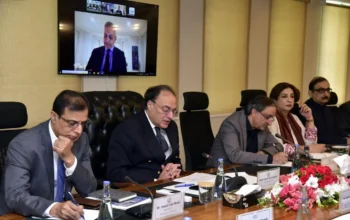
The warning came on the day the government and the PTI opened negotiations. The talks were held in the National Assembly speaker’s chamber. The six-member opposition team was led by the PTI chairman, Barrister Gohar Ali Khan. The government side included the interior minister, Mohsin Naqvi, the prime minister’s political adviser, Rana Sanaullah, and the Pakistan Peoples Party’s Sherry Rehman.
Naqvi briefed the meeting on the law and order situation in Khyber Pakhtunkhwa. The PTI reconstituted its delegation after Mahmood Khan Achakzai, who heads the opposition alliance Tehreek-e-Tahafuz-e-Ayin-e-Pakistan, declined to attend. Mr Achakzai said he would join only if the talks were held at a neutral venue.
The first round ran in two sessions, with a break for Friday prayers. The next is due at 2pm on Saturday in the same chamber.
Neither side appears to have shifted. Gohar has said the long march will continue until the party’s demands are met. Sanaullah has said arrangements are in place to stop marchers entering Islamabad if the PTI does not call off the protest. Speaking on Friday, he urged the party to withdraw the call, saying long marches were no solution and that matters before the courts must be decided by the courts.
The federal government is also keeping open the option of imposing governor’s rule in Khyber Pakhtunkhwa, the province the PTI governs.
Khan’s arrest on 9 May 2023 set off riots across the country. Government buildings and military installations, including the army headquarters in Rawalpindi, were stormed and vandalised. A crackdown on the PTI followed, with dozens of terrorism cases lodged against its leaders and supporters.
Khan denies inciting the violence, and the PTI says the cases against him are politically motivated. A previous march on Islamabad, in November 2024, ended in deadly clashes with security forces. Authorities cite that unrest in defending restrictions on the current protest, while the PTI says its march will be peaceful.
Afghanistan and the Gulf
The conference also turned to security on Pakistan’s western border. The forum reaffirmed Pakistan’s right to self-defence and the need for “targeted action” against terrorism emanating from Afghanistan. It said “only the Taliban’s delusional leadership, facilitating terrorism on behalf of India, bears responsibility for its consequences”.
Since 21 September, after a series of terror attacks in Khyber Pakhtunkhwa, Pakistan has carried out three strikes on suspected militant hideouts in Afghanistan. The ISPR director general, Lt Gen Ahmed Sharif Chaudhry, said a day earlier that Pakistan had the right to self-defence and that “everything that is necessary will be done”.
The commanders praised recent counter-terrorism operations but stressed the need to pair military action with non-military measures. These included “people-centric governance at [the] grassroot level”, public engagement, police capacity-building and the dismantling of a terror-crime nexus operating under the patronage of vested interests. They tied this to the National Action Plan and the Azm-i-Istehkam campaign.
On the Gulf, the forum welcomed the defence pact between Pakistan, Saudi Arabia and Turkiye, signed on 7 August. The agreement aims to strengthen collective deterrence and treats an attack on one signatory as an attack on all. It came after the three countries’ military chiefs met in Riyadh to develop the alliance’s framework.
The commanders also condemned Houthi attacks on Saudi Arabia, expressed solidarity with Riyadh and affirmed Pakistan’s commitment to the security of the Haramain Sharifain, the two holy mosques in Makkah and Medina. The Houthis declared a maritime blockade on the kingdom in July. They have since launched repeated missile and drone attacks and targeted Saudi-linked vessels in the Red Sea, as well as airports and energy facilities. Saudi air defences have intercepted many of the projectiles.
The conference restated Pakistan’s position on Indian-occupied Kashmir and it backed a resolution in line with UN Security Council resolutions and the wishes of the Kashmiri people.
In closing remarks, Field Marshal Munir commended the formations for their operational readiness and professionalism. He directed commanders to strengthen intelligence-based operations and to improve combat capability through modern technology, training and multi-domain integration. ISPR said he expressed confidence that the armed forces, “with unwavering support of the nation”, remain fully prepared to safeguard Pakistan’s sovereignty, territorial integrity and national security. The forum offered prayers for members of the armed forces, law enforcement agencies and civilians killed in the line of duty.
Copyright © 2021 Independent Pakistan | All rights reserved