By Staff Reporter
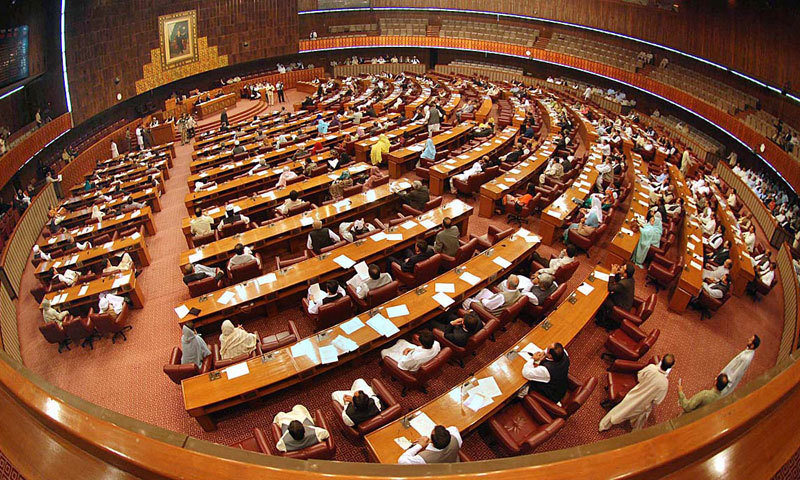
ISLAMABAD: The National Assembly on Wednesday approved a contentious amendment to the Anti-Terrorism Act of 1997, reinstating powers for law enforcement and armed forces to detain suspected individuals for up to three months without charge, a move hailed by the government as vital for national security but condemned by opposition as a threat to fundamental rights.
The legislation reinstates Section 11EEEE, focused on preventive detention for inquiry, a tool first added in 2014 to equip the government, armed forces and civil armed forces with powers to detain those suspected of terrorism links. That earlier version expired in 2016 under a two-year sunset clause, prompting the current push to revive it as security concerns persist.
The bill, quietly tabled in November 2024, sought to empower military and civil armed forces to detain those facing terrorism charges preventively for up to three months. Moved by Minister of State for Interior and Narcotics Control Tallal Chaudhry, it cleared the House via a clause-by-clause reading after lawmakers voted 125 in favour and 59 against on a motion to consider it.
The bill’s statement of objectives noted that the 2014 amendment aimed to let law enforcement preempt threats by holding suspects for no more than three months during inquiries. “However, this amendment was subject to a sunset clause, limiting its validity to a period of two years, which expired in 2016,” it read.
Law Minister Azam Nazeer Tarar assured the House the law targeted specific scenarios only. “A clause is being added to the bill stating that there are solid reasons for arrest,” Tarar said. “The arrested person will have to be presented before a magistrate within 24 hours [and] a clause has also been included to be enforceable for a specific period.”
Tarar further championed the bill, asserting the government’s right to legislate on public order and security, and stressed that arrests demand court presentation within 24 hours. He pointed out the Constitution’s allowance for 90-day preventive detention with judicial oversight in place, and mentioned that the government adopted amendments suggested by coalition partner Pakistan Peoples Party’s lawmaker Syed Naveed Qamar.
Qamar, addressing the session, said laws reflect national realities but urged caution against abuse. He warned that “no one should be detained merely because of personal dislike,” adding that some provisions were dropped and actions would hinge on terrorism evidence to steady troubled regions. The PPP endorsed the government’s ATA amendments, but opposition voices decried the bill vehemently.
Former prime minister Imran Khan’s Pakistan Tahreek-e-Insaf party’s chairman Gohar Ali Khan, reacting to the motion’s passage, recalled a prior similar law and labeled it a breach of “fundamental human rights.” “The Supreme Court said these laws were contrary to fundamental rights,” Gohar said. “You cannot touch a single person in the world without a solid reason.”
PTI senior figure and ex-speaker Asad Qaiser lambasted the bill in his speech. “A new legislation has been passed, where you can be kept in prison for months without permission,” he said. “These laws can be misused and will target political opponents.”
Jamiat Ulema-i-Islam-Fazl leader Maulana Fazlur Rehman decried Pakistan’s anti-terror laws as treating citizens like “inherently criminals” amid corruption and poor governance. “A person is first arrested and then later proven guilty. There is no room for such legislation in the world,” Rehman said.
“Terrorism has not stopped. I cannot even return to my village now,” he added. “A guest in our area was told that extremists are in control outside. Legislation has made no difference, as this parliament has no importance. They create laws based on signals.”
Copyright © 2021 Independent Pakistan | All rights reserved