By Staff Reporter
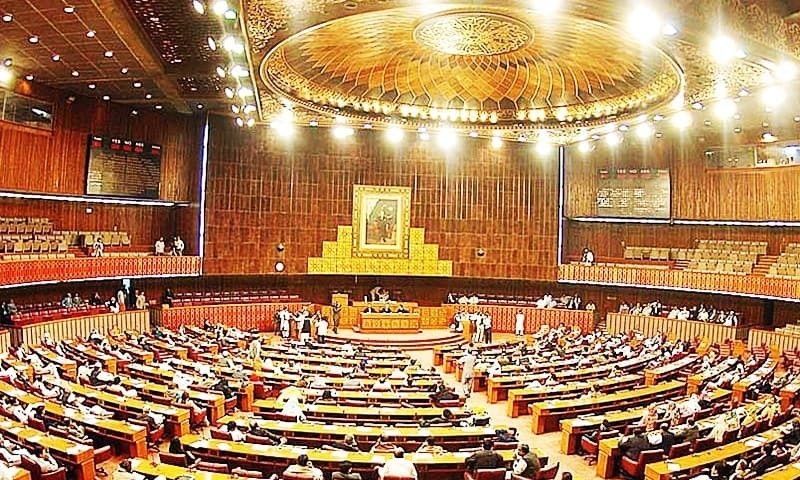
ISLAMABAD: Pakistan’s National Assembly recorded its highest legislative output of any recent assembly in its second year, passing 59 bills while relying less on presidential ordinances, but a detailed independent audit has exposed persistent weaknesses in attendance, agenda management and meaningful deliberation.
The findings, compiled by the Pakistan Institute of Legislative Development and Transparency (Pildat) paint a picture of a parliament that is working harder and longer on paper yet struggling with structural shortcomings that limit genuine oversight and cross-party engagement.
Defence minister Khawaja Muhammad Asif emerged as the most vocal legislator of the year, clocking up five hours and 59 minutes on the floor – the longest speaking time of any member in the 16th National Assembly’s second parliamentary session, which ran from 1 March 2025 to 28 February 2026. He was followed by opposition politician Omar Ayub Khan (five hours and six minutes), former foreign minister Bilawal Bhutto-Zardari (four hours and 52 minutes), Dr Tariq Fazal Chaudhry (four hours and 20 minutes) and Barrister Gohar Khan (three hours and 20 minutes).
Together, these five members accounted for a strikingly large share of total debate time, underscoring how parliamentary discussion has become concentrated among a small group of senior politicians rather than reflecting broader legislative participation. The lower house held 84 sittings – nine fewer than in its inaugural year – yet total working hours rose from 212 to 231, reflecting longer individual sessions. The assembly’s annual budget stood at Rs16.29bn, pushing the average cost per sitting to Rs193.93m, up from Rs136.96m the previous year.
Legislative productivity surged: 59 bills were enacted, a 25.5% increase on the first year and well above the average of 21.75 bills passed during the second years of the previous four assemblies. Reliance on ordinances – a hallmark of executive dominance in Pakistan’s history – fell sharply from 16 to eight.
Among the most significant pieces of legislation was the 27th constitutional amendment, which introduced far-reaching changes to judicial appointments and the balance of institutional power. The house also passed the Elections (Amendment) Bill 2026, which gives authorities discretionary power to withhold legislators’ asset declarations from public view on security grounds. Both measures were processed at speed, prompting Pildat to warn that compressed timetables had curtailed opportunities for detailed committee scrutiny and clause-by-clause debate.
Nearly half of the scheduled daily agenda items – 47.59% – were left unaddressed, only a marginal improvement on the 49.18% rollover rate of the first year. Average attendance of members of the National Assembly (MNAs) dropped to 58.8%, down from 66.29%. Quorum was challenged 19 times and eight sittings were adjourned for lack of a quorum. Prime Minister Shehbaz Sharif’s personal attendance was particularly low: he was present for just six of the 84 sittings, an attendance rate of roughly 7%.
The year was also marked by an extended institutional vacuum. Following the disqualification of opposition leader Omar Ayub Khan on 5 August 2025, the post remained vacant until 16 January 2026 – a five-month gap that, according to Pildat, further diminished structured government-opposition engagement at a time when consensus on major constitutional and electoral changes was most needed.
Yet the assembly was capable of unity when the moment demanded it. In May 2025, amid heightened border tensions with India, lawmakers adopted a unanimous resolution affirming Pakistan’s sovereignty and territorial integrity – a rare display of bipartisan consensus on national security.
Pildat’s assessment is sobering. While praising the assembly’s “heightened pace of legislation”, particularly on constitutionally weighty matters, the Islamabad-based watchdog highlighted the trade-off: “The speed with which several major laws were processed raised concerns about limited committee scrutiny and constrained clause-by-clause deliberation.” The report shows the country’s democratic institutions still navigating the political realignments that followed the 2024 general election, and the data suggest a parliament that is legislating more but deliberating less – producing volume at the potential expense of depth and accountability.
Copyright © 2021 Independent Pakistan | All rights reserved