By Staff Reporter
ISLAMABAD: The United States bombed Iran for a ninth consecutive night early on Monday, extending a war that began in February and has now claimed the lives of at least 17 American service members, as Iran answered with retaliatory strikes on Bahrain, Kuwait, and a U.S.-linked target in Syria.
The exchange came hours after the Pentagon disclosed the latest American death: a service member killed Saturday in northern Iraq during the disposal of an unexploded Iranian drone. That loss followed the deaths of two more troops in Jordan on Friday, one of whom remains listed as missing. US Central Command said Sunday it had recovered unidentified remains at the Jordan attack site and was working to confirm whose they were.
“We hit them very hard again tonight, and we did that in honor of the, probably three, it’s probably three great patriots,” President Trump told reporters as he returned to Washington following the World Cup final, where he presented the trophy to Spain after its 1-0 win over Argentina at MetLife Stadium in New Jersey — a ceremony where he was met with boos from the crowd.
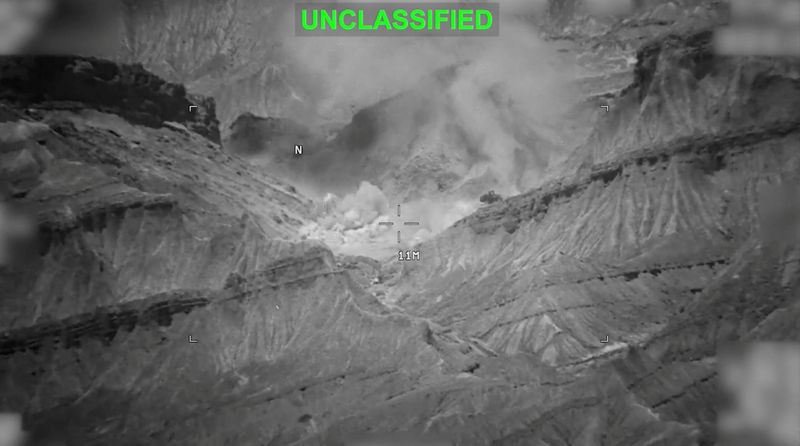
Central Command said the overnight raids, its ninth straight, targeted Iranian “military command centres, air defence and coastal surveillance sites, maritime capabilities, missile and drone launch sites and communications networks.” The command said the goal remains degrading Iran’s capacity to threaten shipping through the Strait of Hormuz, the narrow waterway at the mouth of the Persian Gulf through which roughly a fifth of the world’s oil once moved before the war choked it off.
Iran did not confirm casualties or damage from Monday’s strikes, though state media reported hearing explosions in the country’s south and northwest. Iranian officials said over the weekend that at least 50 people have been killed and more than 500 wounded in the fighting since it resumed this month.
The war, now in its fifth month, began Feb. 28 with a joint US-Israeli assault that killed Iran’s longtime supreme leader, Ayatollah Ali Khamenei, in the opening strikes. His son, Mojtaba Khamenei, was installed as his successor and has since become the voice of Iran’s continued resistance. In a statement broadcast on state television on Saturday, he warned that the United States has “unforgettable lessons in store” if it continues its campaign, and dismissed Trump’s signature on last month’s cease-fire framework as “utterly worthless and devoid of credibility.”
Trump, asked Sunday about Iran’s announcement that it was suspending its commitments under that agreement, brushed the matter aside. “I couldn’t care less,” he told a reporter.
Retaliation spreads across the Gulf
Iran answered the renewed American bombing with a wave of strikes on US allies across the region. Bahrain, which hosts the US Navy’s 5th Fleet, sounded missile alert sirens on Monday morning. Kuwait’s military said its air defences engaged incoming drones, adding in a statement that “any explosions heard are a result of air defence systems intercepting the hostile attacks.” A Kuwaiti desalination plant, critical to the country’s water supply, was hit for the second day in a row.
Iran’s Islamic Revolutionary Guard Corps claimed responsibility for a separate strike on what it described as an enemy command centre in Syria’s Al-Tanf region, calling it retaliation for Iranian soldiers killed in the southeastern city of Iranshahr. Jordan’s military said Sunday that three missiles launched from Iran were intercepted and a fourth landed in a remote area; the US Embassy in Amman separately issued a security alert saying Jordanian authorities had evacuated the airport and seaport in Aqaba over “a specific and credible threat.” A Jordanian government spokesman disputed that account, saying no threat had been recorded and that both facilities were “operating normally.”
A vessel caught fire early on Monday in the Strait of Hormuz near the Omani coast, according to the British military, which did not immediately identify a cause. Iran’s Revolutionary Guard later claimed it had struck two tankers attempting to pass through what it called an “unsafe” route through the strait, alleging the ships were sailing under American encouragement. The claim could not be independently verified.
Diplomacy stalled, oil climbing
The renewed fighting has all but unravelled the interim ceasefire framework signed by Washington and Tehran last month, which was intended to reopen the strait and lead to a permanent end to the war within 60 days — a deadline now roughly half elapsed. Iran’s deputy foreign minister, Kazem Gharibabadi, said Saturday that Tehran considers the agreement void, accusing the United States of having “violated and suspended all of its commitments” first.
Secretary of State Marco Rubio, speaking to reporters on Sunday before departing for a meeting of Southeast Asian foreign ministers in Manila, said it is “clear that Iran, at least some people in Iran, want to control the straits and hold that as leverage against the world,” and called on other nations to help protect global shipping, whether through military hardware or financing. Asked whether a diplomatic path remained open, Rubio said the US is “always open to diplomacy,” but that any deal “has to be real” — one Iran is actually willing to live by. “They can’t have an MOU that’s alive if they’re violating the terms of it,” he said.
Oil markets reflected the widening conflict. Brent crude rose above $90 a barrel on Monday, its highest level in more than a month, as tanker traffic through the strait slowed to a trickle. Energy Secretary Chris Wright disputed suggestions that the waterway had effectively closed, telling ABC News’s “This Week” on Sunday that a seven-day trailing average showed nearly 7 million barrels a day still moving through Hormuz, with a comparable volume flowing through overland bypass pipelines — together, he said, about two-thirds of pre-war traffic. “Almost all the public data I’ve seen is incorrect,” Wright said. A tracking firm, Kpler, had reported on Friday that vessel crossings through the strait fell to just eight on Thursday, the lowest level in three weeks.
American drivers are feeling the effects at the pump, though not quite as sharply as some recent accounts have suggested. AAA’s most recent weekly survey, released July 16, put the national average for a gallon of regular gasoline at $3.94, up 10 cents from the week before, as instability in the strait pushed crude prices toward $80 a barrel even before this weekend’s escalation.
Munitions concerns, warnings of wider war
Trump has threatened in recent days to expand the target list to include Iranian power stations and bridges if Tehran does not loosen its grip on the strait, and recent strikes suggest that threat is already being carried out. US forces on Saturday hit an electricity and desalination facility in Iran’s southern Hormozgan province; Iranian state television said the strike knocked out water service to roughly 10,000 residents and damaged a second desalination plant on Qeshm Island, inside the strait itself. Three bridges were also struck, including one along a route to Bandar Abbas, Iran’s principal port near the strait’s narrowest point.
The United States has separately reimposed a naval blockade on Iranian oil exports, redirecting six ships and disabling a seventh over the past week, Central Command said. Iran’s Revolutionary Guard said Sunday it had stopped two vessels attempting to breach the blockade and forced two others to abandon their approach.
The Washington Post has reported growing concern within the Pentagon over a depleting US munitions stockpile as the war extends into its fifth month, with Congress now weighing additional funding to replenish it.
The Atomic Energy Organization of Iran said American strikes also struck the unfinished Darkhovin nuclear power plant in the country’s southwest, calling it “an aggressive and brutal act contrary to international law.” The International Atomic Energy Agency said it was examining the claim but noted the site “contained no nuclear material when last visited” by its inspectors and was unlikely to pose a radiological risk. IAEA Director Rafael Grossi renewed his call for “military restraint in the vicinity of all nuclear-related sites.”
Trump, in a telephone interview with a NewsNation correspondent on Saturday, called the deaths of the two service members killed in Jordan “very sad, it’s a very sad thing.” “We hate to see it happen. It’s in service to our country,” he said, repeating his position that the United States will never allow Iran to acquire a nuclear weapon. Defense Secretary Pete Hegseth offered his own tribute on social media: “Godspeed, heroes. Their sacrifice only stiffens our resolve.”
Despite the mounting toll, Trump insisted Thursday that the war effort was going well. “We are likewise winning big in Iran,” he said in a primetime address, “and you will see the fruits of that labor very, very shortly.”
Copyright © 2021 Independent Pakistan | All rights reserved