By Staff Reporter
HYDERABAD: Leaders of Pakistan’s fractured opposition alliance gathered on Saturday to demand fresh elections, constitutional reforms and an end to what they described as systemic injustices, warning that the nation’s stability hinges on restoring parliamentary supremacy and equal rights for all provinces and ethnic groups.
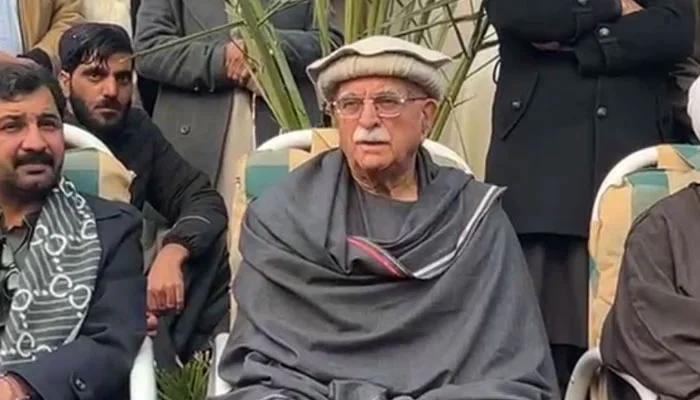
Mehmood Khan Achakzai, the chief of the Pashtunkhwa Milli Awami Party and head of the Tehreek Tahaffuz-e-Aiyeen Pakistan alliance, said the country could only progress if lawmakers reclaim their authority and provinces receive their fair share of power and resources.
Speaking after a meeting with Qaumi Awami Tehreek leader Ayaz Latif Palijo at his residence in Hyderabad, Achakzai invoked the words of Pakistan’s founder, Mohammad Ali Jinnah, who once lamented that his “pockets were full of counterfeit coins.”
Today, Achakzai said, a similar movement is needed to purge the system of such flaws. “Pakistan is a federation of nations and can only function smoothly if all nationalities are given equal rights and a fair share in power,” he told reporters.
The delegation, which included former National Assembly speaker Asad Qaiser and Majlis Wahdat-e-Muslimeen leader Allama Raja Nasir Abbas, also attended events marking the 122nd birth anniversary of Sindhi nationalist leader GM Syed in nearby Sann town. There, they urged participants to join a planned nationwide strike on Feb. 8 to protest alleged electoral fraud and curbs on democratic institutions.
Achakzai, recently named leader of the opposition in the National Assembly but still awaiting official notification, proposed that five major political parties form an interim national government for four months to oversee transparent elections, after which power would transfer to the victors.
He accused the current administration of lacking the ability to govern effectively and called for a three-day roundtable conference with all stakeholders to steer the country back on course. The TTAP alliance was created to defend the constitution against perceived assaults, Achakzai said, adding that the opposition’s warnings have since been validated.
He criticised recent constitutional changes, including the 26th and 27th amendments, which he said have led to a “constitutional demise.” Two judges resigned in protest, he noted, while the judiciary’s independence has been undermined, journalism stifled, and parliament reduced to something less than a debating forum. “Many believe there has been constitutional demise in their wake,” Achakzai said. “The judiciary’s wings are clipped, and journalism is banned. Now, parliament is no longer even a debating society. To date, nothing has been brought before parliament for debate.”
On the prospect of negotiations with the government to ease tensions, Achakzai was cautious, insisting that dialogue requires acknowledgement of wrongdoing. “If someone has the realisation that excesses have been committed, then there are recourse and treatment too. Let’s then talk.”
He was particularly outspoken about the treatment of Imran Khan, the jailed founder of the Pakistan Tehreek-e-Insaf party and a key opposition figure. Denying Khan’s family access to him violates fundamental rights, ethics and basic humanity, Achakzai argued.
Responding to claims by the special assistant to prime minister, Minister Rana Sanaullah, that PTI leaders seek talks but Khan does not, Achakzai countered with an analogy. “Talks on what issue? If someone robs the home of Saeen [Zain Shah] and loots everyone, then talks will be held [with the robbers] to recover the looted goods.” Everyone knows Khan won the elections decisively, Achakzai added, calling him the country’s most popular leader. “A car can be invented, not a political leader. A leader emerges from amongst the masses,” he said, dismissing past rivalries with Khan as irrelevant now that they’ve allied against shared threats.
Achakzai stressed the need for consensus on core principles, including Pakistan’s federal structure, parliamentary oversight of policies, provincial control over resources, and respect for diverse languages and cultures. Injustices breed hatred and conflict, he warned, noting that civilian rule has been thwarted since the nation’s founding. “The TTAP was formed because we had foreseen then that this parliament [after the Feb 8 polls] will come after the Constitution, because everything is being done through the assembly,” Achakzai said, recalling how a post-martial law parliament once absolved Gen. Ayub Khan of his actions with a brief resolution. No single person can resolve the impasse, he concluded; it demands “collective wisdom.”
Meanwhile, the speaker of Pakistan’s National Assembly said on Saturday that lawmakers would no longer be allowed to use the House floor to criticise the country, its judiciary or its armed forces, a move that reflects a tightening of parliamentary controls as political tensions continue to simmer.
Sardar Ayaz Sadiq, speaking to journalists during a visit to the National College of Arts in Lahore, said any negative or controversial remarks about the judiciary, judges or the armed forces were unacceptable. “Any kind of remarks against the armed forces was intolerable,” he said, according to a statement from the assembly secretariat and a post on its official X account.
Sadiq, who has held the speaker’s post since March, added that only discussions falling strictly within the bounds of the Constitution and the law would be allowed. “Those who speak against Pakistan will not be allowed to express their views on the floor of the National Assembly.”
He also addressed the right to protest, a flashpoint in recent months, noting that it was a fundamental democratic entitlement but must remain peaceful. “There is no room for arson, damage to life and property or vandalism,” he said, describing the use of sticks and weapons as a serious threat to the rule of law.
The tightening of parliamentary speech rules coincides with developments in opposition leadership roles, which have been vacant or delayed for months following legal actions against allies of Khan’s PTI party. On Friday Achakzai was appointed opposition leader in the National Assembly, filling a position empty for nearly five months since the disqualification of PTI’s Omar Ayub. The Election Commission of Pakistan had barred Ayub and Shibli Faraz, the former Senate opposition leader, in August after their convictions related to riots on May 9, 2023, which erupted after Khan’s brief arrest in corruption charges.
Khan, who remains incarcerated, had nominated Achakzai for the assembly role and Senator Allama Raja Nasir Abbas, chief of the Majlis Wahdat-i-Muslimeen, for the Senate equivalent last August. Senior PTI figures imprisoned in Lahore’s Kot Lakhpat jail — including Shah Mahmood Qureshi, Dr. Yasmin Rashid, Senator Ejaz Chaudhry, Mian Mehmoodur Rasheed and Umar Sarfraz Cheema — congratulated Achakzai in a letter shared with the media on Saturday. They expressed hope that he would, under Khan’s guidance, work to restore democracy, uphold the Constitution, ensure judicial supremacy and protect fundamental rights.
The leaders also called for Abbas’s immediate appointment as Senate opposition leader, noting the government’s delay in naming his counterpart in the lower house. They urged consultations to address the economic crisis gripping the country for the past four years. Law Minister Azam Nazeer Tarar, speaking to reporters in Lahore on Saturday, said the Senate appointment would proceed soon. “That will also happen,” he said, explaining that the Senate chairman, currently serving as acting president, would handle it upon his return.
Copyright © 2021 Independent Pakistan | All rights reserved