By Staff Reporter
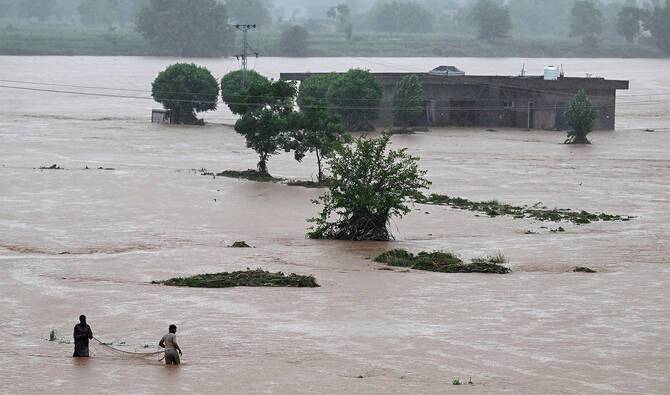
ISLAMABAD: Pakistan is gearing up for another spell of monsoon rains from August 8 to 13, as the country struggles to recover from weeks of heavy showers and floods that have killed at least 303 people and injured more than 700.
The relentless downpours, which began on June 26, have sparked fears of a repeat of the devastating 2022 floods that submerged a third of the nation and claimed over 1,700 lives.
“Under the influence of low-pressure systems developing in the surrounding regions, along with a western disturbance, isolated rainfall is expected across most parts of the country from August 8th to 13th,” Pakistan’s National Disaster Management Authority (NDMA) said on Thursday.
The forecast has heightened concerns in a nation already battered by extreme weather this season. The warning follows a glacial lake outburst flood (GLOF) from the Shisper Glacier, which swelled the Hassanabad Nullah in Hunza, a remote area of Gilgit-Baltistan.
Local media, citing officials, reported that the flood damaged infrastructure and put dozens of mountainside homes at risk. The surging waters eroded the protective walls of the Karakoram Highway, a critical artery linking Pakistan with China, and washed away swathes of farmland.
The Gilgit-Baltistan Disaster Management Authority (GBDMA) detailed the toll of the disaster. The flood damaged a newly constructed retaining wall and a section of the Karakoram Highway. While the highway remains open to traffic, the affected portion has been cordoned off for safety.
The deluge also wiped out significant areas of cultivable land, standing crops, and trees, and cut off electricity to Hassanabad. A property owned by the Forest Department and a portion of land belonging to the Frontier Works Organisation near a bridge were also hit.
More showers are expected across Gilgit-Baltistan, including in Astore, Skardu, Hunza, and Shighar, as well as in Azad Kashmir’s Bagh, Neelum Valley, and Muzaffarabad, according to the NDMA. In Punjab, rains are forecast for cities including Islamabad, Rawalpindi, Murree, Galliyat, Attock, Chakwal, Jhelum, Mianwali, Hafizabad, Sargodha, Faisalabad, Sialkot, Narowal, Okara, Lahore, and Gujranwala, with occasional breaks during the period.
“We request citizens to take precautionary measures during the monsoon season,” said Irfan Ali Kathia, Director General of Punjab’s Provincial Disaster Management Authority (PDMA). “Keep children away from streams, low-lying areas, rivers and canals and strictly avoid swimming during rainfall.”
The situation in Gilgit-Baltistan remains precarious. Officials noted that land erosion caused by the swollen nullah threatens dozens of homes in the event of future floods. Locals said four houses downstream were dismantled just in time to save them from the latest deluge. Last month, a similar GLOF event damaged four homes, agricultural land, trees, and both public and private properties in the region.
The GBDMA has called on the National Highway Authority to urgently assess the damaged section of the Karakoram Highway and inspect other vulnerable stretches. Community Based Disaster Risk Management Committee members, GBDMA staff, and volunteers are on the ground, monitoring developments and assisting with preparedness and response efforts.
Elsewhere, the Gilgit-Shandur Road in Khotom village of the Phander valley has been closed for a seventh consecutive day due to flooding, stranding thousands of residents. Adding to the mounting challenges, the Pakistan Meteorological Department issued a warning for heavy rain across Azad Kashmir and Khyber Pakhtunkhwa, urging citizens to stay vigilant.
Copyright © 2021 Independent Pakistan | All rights reserved