By Staff Reporter
ISLAMABAD: Pakistan’s monsoon death toll has climbed to 97 after 11 more people died in rain-related incidents over the past 24 hours, disaster management officials said on Saturday, as forecasters warned that widespread rain and pockets of heavy downpours would persist across much of the country for at least another two days.
The latest deaths came after a fresh spell of monsoon rain swept across Punjab on Friday, making it the worst-hit province during the latest reporting period with seven fatalities. The Pakistan Meteorological Department (PMD) said further heavy rainfall was likely to add to flooding risks already facing several areas of the province.
According to the National Disaster Management Authority’s (NDMA) latest situation report, the death toll since the monsoon season began on 26 June has reached 97, with 297 people injured nationwide.
Most of the latest Punjab deaths were caused by collapsing houses, with fatalities reported in Lahore, Kasur and Chiniot. One person drowned in Gujranwala. Across the season as a whole, house collapses remain the single biggest killer, accounting for more than half of all deaths, ahead of flash floods, lightning strikes and drowning.
Rivers rising toward danger levels
The Chenab River was flowing at medium flood level at Khanki and Qadirabad on Saturday, the PMD’s Flood Forecasting Division said, while all other major rivers across the country remained at low or below-low levels for now. But that picture is expected to worsen: water flows in the Chenab are forecast to increase further over the next 24 hours at Marala, Khanki, Qadirabad and Chiniot Bridge, with Trimmu Barrage also likely to climb to medium flood level in the same period.
The Ravi River, currently at a lower flood level than the Chenab, is expected to rise to medium or high flood levels at Balloki, in Kasur district, and at Sidhnai, in Khanewal, within 24 hours.
The NDMA separately confirmed medium-level flooding at Khanki, Qadirabad and Chiniot Bridge on the Chenab, and at Palkhu Nala near Wazirabad. Low-level flooding continues at Kalabagh, Chashma and Taunsa on the Indus; at Marala and Trimmu on the Chenab; at Balloki and Sidhnai on the Ravi; and at Nowshera on the Kabul River, along with Nala Aik and Palkhu Nala Cantonment Bridge.
Forecasters attributed the pattern to a westerly wave moving over north-western Pakistan, a seasonal low-pressure system over north-west Balochistan, and moisture streaming in from both the Arabian Sea and the Bay of Bengal. The PMD has forecast continued rain, thunderstorms and isolated heavy falls until 28 July, and separately warned of flash flooding in the hill torrents of Dera Ghazi Khan and pluvial flooding in south-eastern Sindh within the next 24 to 36 hours. The NDMA echoed the warning on flash flood risk in Dera Ghazi Khan’s hill torrents, extending it to seasonal streams in Khyber Pakhtunkhwa and parts of northern Balochistan.
Urban flooding has also been forecast for Gujranwala, Mandi Bahauddin, Sialkot, Narowal, Faisalabad, Sargodha, Jhang, Multan, Hafizabad and Lahore.
The NDMA has placed all provincial and district authorities on alert, urged the public to avoid unnecessary travel into flood-affected areas, and warned motorists to check road conditions before setting out. Officials repeated longstanding safety guidance to stay away from riverbanks, steep slopes and narrow mountain passages prone to rockfalls and landslides, and warned against attempting to cross flooded roads or fast-moving water on foot or by vehicle, noting that even shallow floodwater can sweep people and cars away. Citizens have been advised to follow alerts through the Pak NDMA Disaster Alert mobile app.
“Like an inland sea” — 400 square kilometres of Punjab under water
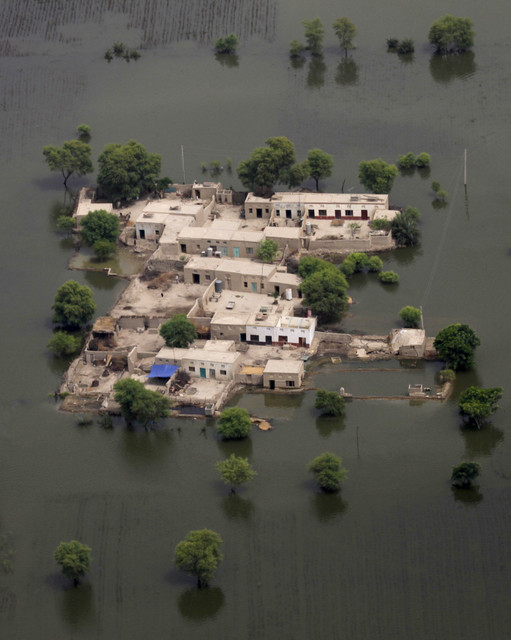
The scale of the flooding in central Punjab has alarmed officials on the ground. A senior Punjab irrigation department official told Dawn that roughly 400 square kilometres of land had been submerged across Sheikhupura, Muridke, Gujranwala, Narowal, Sambrial and Pasrur — districts spanning the Lahore and Gujranwala divisions — after torrential rain overwhelmed drainage channels built to carry far smaller volumes of water.
“The current situation resembles an inland sea because of the vast expanse of floodwater,” the official said, speaking on condition of anonymity, and describing the scale of the flooding as both unprecedented and severely testing for the province’s response capacity.
The official pointed to a sharp and unexplained surge in the Ravi’s flow as it passes through Lahore: readings at Shahdara showed 22,000 cusecs, while downstream at Balloki the flow had jumped to 87,000 cusecs. “The question is: where did the additional 65,000 cusecs come from? It is water flowing into the river through drains and rainfall,” he said, adding that the river’s flow would normally be expected to fall, not rise, over that stretch. He estimated it could take another three to four days for conditions to return to normal, provided no further rain falls.
With more showers forecast for Sunday, deputy commissioners in Lahore, Gujranwala, Sheikhupura, Sialkot, Narowal and Khanewal, among other districts, have been placed on high alert for flood monitoring and emergency preparedness.
Officials have already begun inspecting the worst-affected sites. The Lahore deputy commissioner and his team visited Tiba Khudpur Road and the Hadyara Drain in Mohlanwal, in the catchment area of the Hudiara drain, to assess drainage operations and monitor rainwater flow. The Lahore commissioner travelled to Nankana Sahib to review the flood situation and emergency response there, and inspected river erosion beyond the village of Halla Waraich, where he was briefed on evacuation, rescue and relief arrangements and ordered the desilting of blocked points along Nullah Dek. In Khanewal, deputy commissioner Hena Arshad visited Sidhnai headworks, the Mai Safura Bund breaching section, Kund Sargana and Fazil Shah Bund to inspect flood defences and preparedness measures.
Flooding has also caused widespread damage to standing crops, livestock and infrastructure, prompting district administrations across the affected divisions to accelerate their response, including the setting up of relief camps.
Gilgit-Baltistan cut off for a fourth day
Further north, road access to several parts of Gilgit-Baltistan remained severed for a fourth consecutive day on Saturday, as flash floods and glacial lake outburst floods (GLOFs) — triggered by rapid glacier melt amid unusually high temperatures — continued to damage highways and hinder repair work.
Ataur Rehman Kakar, director general of the Gilgit-Baltistan Disaster Management Authority (GBDMA), told Dawn that heavy machinery had been deployed and restoration work was continuing around the clock. The Karakoram Highway and the Gilgit-Shandur Road have reopened to traffic, he said, while crews work to restore the Baltistan Road, Astore Valley Road, Naltar Highway and other routes linking remote communities across the region.
Despite that progress, thousands of residents and tourists remain stranded, with several valleys still cut off. Affected communities continue to face shortages of drinking water, electricity and communication services.
Kakar said the frequency of GLOF events and the pace of glacier melt had both worsened this year. “Between July 18 and July 21, GB recorded unprecedented temperatures, resulting in rapid glacier melting and Glof incidents in several areas,” he said, adding that food, tents, medicines and other relief supplies had since been distributed to affected families.
He said the Baltistan Road remained blocked at three points, including a major obstruction near Ansar Bridge, while rising water levels in a nullah had disrupted traffic in the Haramosh area. “High water levels and mudflows in rivers and nullahs have created serious challenges for road restoration activities,” he said.
In Astore, residents voiced frustration at what they described as the slow pace of efforts to reopen the Valley Road, with the valley cut off for three days. People in Diamer, Astore, Ghizer and other affected districts reported prolonged disruption to electricity, water supply and access to essential goods.
The situation is more severe still in Hisper Valley, in Nagar district, which has been disconnected for nearly two months after repeated GLOF events washed away large sections of its only access road. Residents said patients and students were facing serious hardship amid worsening shortages of food, medicines and other essentials.
A GBDMA report said a further GLOF on 22 July caused fresh damage to Hisper Road at two additional locations, washing away roughly 300 feet of road at Apiharai and around 800 feet at Bayo Khai, and suspending vehicle traffic entirely. The authority said rock blasting had been completed and boulders were being stockpiled so that restoration could begin as soon as water levels fall, and that a temporary pedestrian track had been built along the river to allow local residents to move on foot. Road repairs proper, the GBDMA said, would resume once conditions there become more favourable.
Elsewhere in the region, the GBDMA’s latest situation report said conditions were gradually returning to normal in most districts following the recent bout of heavy rain. Most roads have reopened, though Haramosh Road, Naltar Road, Hisper Road, the Astore Valley Road at Khachak, and the Hushe Valley Road at Rout Longba, in Ghanche district, remain closed. Heavy machinery has been deployed to clear the remaining blockages, the authority said, while relief supplies continue to reach affected families.
Internet and mobile phone services remain suspended in several areas after floods and landslides damaged optical fibre infrastructure.
Chairing a high-level meeting on relief and rehabilitation, Gilgit-Baltistan Chief Minister Amjad Hussain ordered authorities to launch helicopter operations to reach remote areas where road links have been cut. He directed officials to use all available resources to partially restore the Baltistan Road and to prepare an alternative route for light vehicles within two days, and instructed them to ensure an uninterrupted supply of food and other essential goods to affected communities.
Copyright © 2021 Independent Pakistan | All rights reserved