By Staff Reporter
KARACHI: Pakistan’s central bank left its benchmark interest rate unchanged for a third consecutive policy meeting, judging that the risk of a fresh Middle East oil shock outweighed pressure at home to ease monetary policy and revive economic growth.
The State Bank of Pakistan’s Monetary Policy Committee held the policy rate at 11.5% on Monday, matching the median estimate of economists and extending a pause that has now stretched since April. The vote capped the panel’s first review of the fiscal year that began July 1.
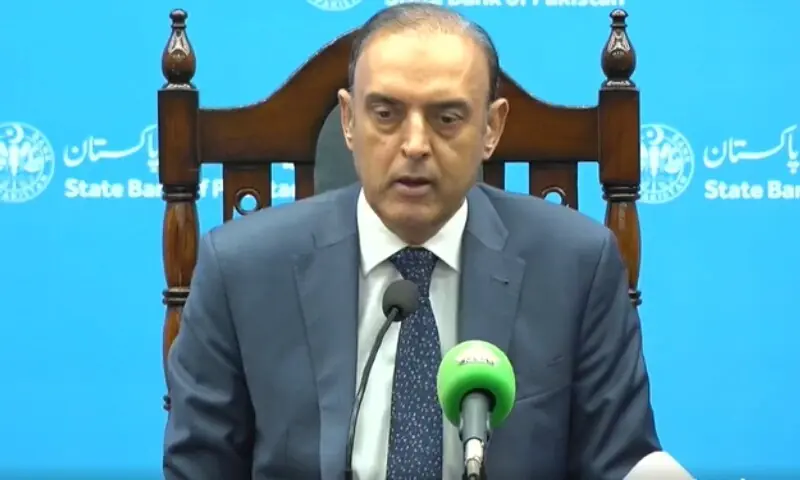
Governor Jameel Ahmad told reporters in Karachi that the decision reflected a fragile but improving economic backdrop, clouded by the collapse of a ceasefire between the US and Iran earlier this month. The two countries traded strikes for roughly two weeks over control of the Strait of Hormuz — a vital artery for global oil shipments — before both sides stood down late last week.
“There were several reasons for this,” Ahmad said of the rate decision, noting that inflation had accelerated sharply as the conflict disrupted energy markets. Consumer prices climbed to 11.7% in May and 11.1% in June, he said, up from an average of 5.5% between July and February — a stretch that had fallen comfortably within the central bank’s 5-7% target band.
Ahmad said he expects inflation to ease starting next month provided hostilities do not resume, with price growth settling near the upper end of the target range by June 2027. He cautioned that the outlook remains hostage to developments in the Gulf.
Oil Swings Drive Policy Calculus
Brent crude touched roughly $100 a barrel at the height of the standoff before retreating to about $91 in recent days, according to the SBP, as the ceasefire held and shipping risk premiums unwound. Pakistan imports the bulk of its energy needs, leaving inflation and the current account acutely sensitive to swings in global crude prices.
Mediators have made headway in efforts to bring Washington and Tehran back to the negotiating table, two regional officials told the Associated Press on Monday, after both sides went three straight days without reporting new attacks.
The MPC’s statement described the macroeconomic backdrop as improved since its June meeting but still exposed to the Middle East’s volatility. An earlier de-escalation had already eased global oil prices and supply-chain strains, the committee said, helping cool headline and core inflation in June even as both measures stayed elevated. High-frequency data pointed to a pickup in economic activity, the panel added, while external-account pressures stayed contained.
Reserves Beat Target
The central bank highlighted foreign-exchange reserves that climbed to $18.4 billion at the end of June, surpassing its $18 billion target by $400 million on the back of sustained SBP purchases and official inflows. Ahmad said the SBP is now aiming for reserves of $20.2 billion by December.
Remittances are expected to rise to $44 billion this fiscal year from $41.6 billion previously, Ahmad said, while inflows through the Roshan Digital Account have averaged $300 million a month over the past four to five months. Exports faced pressure over the past year but should improve given government support measures, he said.
Standard & Poor’s upgraded Pakistan’s long-term sovereign credit rating to B during the period under review, the SBP noted, while the Federal Board of Revenue met its tax-collection target for the fiscal year that ended in June.
On external debt, Ahmad said the country faces $21.5 billion in servicing costs this year, comprising $3.5 billion in interest and $17 billion in principal — of which a large share is expected to be rolled over, leaving roughly $7 billion in actual principal payments. He said Pakistan had shifted a portion of its commercial borrowing into longer-term multilateral debt, trimming total obligations by about $4 billion, while the SBP’s forward liabilities fell to $900 million from $5 billion.
Growth Seen in 3.5%-4.5% Range
The Pakistan Bureau of Statistics estimated 3.7% growth for the last fiscal year, though Ahmad said he expects that figure to be revised higher. Growth averaged 4% in the first three quarters through March, he said, with momentum cut short by the Middle East conflict after the central bank had projected a fourth-quarter reading closer to 4.2%.
The MPC forecast growth of 3.5% to 4.5% for the current fiscal year, while flagging risks from volatile commodity prices and unpredictable weather, including effects tied to El Niño. The current account deficit is projected to widen to between zero and 1% of gross domestic product as activity picks up, with remittances helping offset a larger trade gap.
The committee reiterated its commitment to price stability and pointed to the need for continued fiscal consolidation and structural changes. “These are necessary to strengthen resilience to recurring shocks, enhance productivity and support higher and sustainable economic growth,” the MPC said in its statement.
Investors, Businesses Split on Outlook
The rate decision followed a poll by Topline Securities showing 97% of respondents expected no change, with the remainder anticipating a 100-basis-point cut. AKD Securities had said in a note that a resilient external position argued for steady policy even as weakening leading indicators and a contraction in money supply built a case for easing.
Topline said that market participants had begun pricing in 100 to 150 basis points of cuts over the next two to three meetings following a US-Iran memorandum of understanding signed June 18, before renewed hostilities reversed that shift. JS Global cited disruptions to energy trade routes in forecasting a cautious central bank stance.
Pakistani equities rallied Monday as the ceasefire held, with the benchmark KSE-100 Index surging 7,241.13 points, or 4.23%, to 178,262.33. Ahsan Mehanti, chief executive officer at Arif Habib Commodities, attributed the gain to a recovery in global equities and speculation over the SBP’s policy move alongside falling oil prices.
Not everyone welcomed the central bank’s caution. The Federation of Pakistan Chambers of Commerce and Industry called the decision contractionary, warning that holding rates at current levels would continue to restrict access to financing and hamper industrial recovery. Saquib Fayyaz Magoon, the group’s acting president, said businesses had hoped for a rate cut to ease the cost of doing business. The SBP cut its policy rate by 50 basis points to 10.5% in December before raising it by 100 basis points in April, where it has remained since.
Copyright © 2021 Independent Pakistan | All rights reserved