By Staff Reporter
ISLAMABAD: Pakistan is hosting a two-day meeting of the Makkah Defence Alliance in Islamabad from today, where Saudi Arabia, Turkey and Pakistan will try to turn a defence pact less than four months old into a working military framework, with the Houthi war in Yemen on the agenda.
Defence Minister Khawaja Asif said on Thursday that the “continuous turmoil south of Saudi Arabia will obviously be one agenda point in the meeting and it is very important”. He confirmed that the foreign and defence ministers of all three countries would attend the third session of the alliance’s Strategic Political and Defence Committee (SPDC).
Saudi Arabia has come under repeated attack from the Iran-backed Houthi movement, which has targeted cities, oil facilities and shipping since Yemen’s civil war intensified in July. The Houthis hold swathes of territory, including the capital, Sanaa. A Saudi-led coalition government launched a major campaign to recapture Houthi-held ground just before the alliance’s emergency meeting in Riyadh on 5 October.
“Any threat to Saudi Arabia is a threat to Pakistan and Turkiye according to the pact, which is absolutely clear,” Asif said on Wednesday, praising Riyadh’s handling of the conflict.
A Pakistani official said the Islamabad talks were expected to finalise standard operating procedures, set up a mechanism for implementing the pact and define how the three countries’ political, defence and military institutions will coordinate. Senior defence and military officials held preparatory talks on Thursday to settle the agenda and documents, and Ishaq Dar, the deputy prime minister and foreign minister, is due to chair the meeting. The Saudi and Turkish foreign ministers were reported on Thursday to be arriving in Pakistan, with sessions today and on Saturday. The alliance’s secretary general, Lt Gen Nauman Mahmood, has already reached the country.
The committee, which also includes the three countries’ chiefs of defence staff, is the alliance’s principal decision-making body. It last met in Riyadh on 5 October for an emergency session. That meeting called for practical implementation of collective defence commitments, including arrangements for rapidly deploying agreed forces and capabilities, subject to national laws. It also condemned attempted attacks on Makkah and Madina and the continuing strikes on Saudi cities and economic facilities.
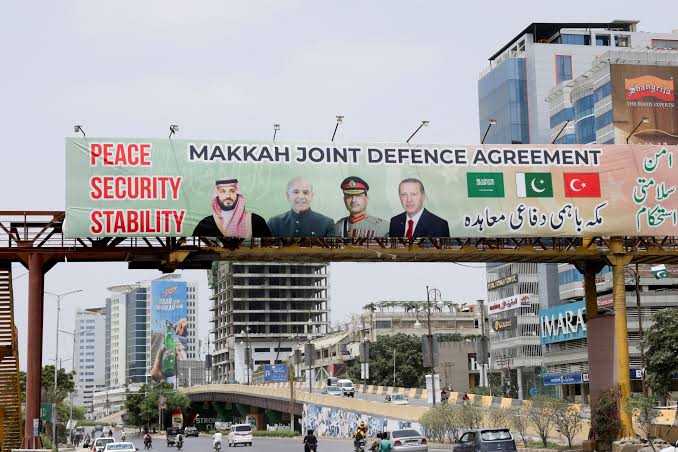
The three countries signed the Makkah Joint Defence Agreement on 7 August. Shehbaz Sharif, the Pakistani prime minister, Saudi Crown Prince Mohammed bin Salman and Turkey’s president, Recep Tayyip Erdogan, signed it at a summit at Al-Safa Palace. An armed attack on any one member is to be treated as an attack on all, obliging the other two to help by any available means, including military support. The pact was formed as the war in the Middle East widened after US-Israeli strikes on Iran in February. Pakistan is the only nuclear-armed Muslim country.
Yet Asif conceded that the machinery behind that pledge remains thin. He described the alliance as being at a “nascent stage”.
“Initially, we need to have frequent meetings to steer what is being formulated, in a way that in the next couple of months we have everything in place so that we can move forward.”
The alliance has yet to publicly define its doctrine, the make-up of its forces, its command arrangements or the procedures that would govern a collective military response. However, some structure is in place. The first committee meeting, in Istanbul on 31 August, gave the grouping its name. A permanent secretariat has been established in Riyadh, with Lt Gen Mahmood, a retired Pakistani officer, appointed its first secretary general for three years. A working committee of officials from the member states is also functioning. Turkey’s ratification has completed the accession process for all three countries.
Questions about Iran and Israel are likely to prove harder. Asif declined to say how the alliance would respond to a direct Iranian attack on Saudi Arabia, but pointed to Israel as a possible threat to the region.
“The possibility of some conflict, or aggression from the Israeli side exists, so we need to close our ranks, the countries of this region,” he said.
Islamabad’s position is delicate as Pakistan has tried to keep diplomatic channels open with Tehran while deepening its defence ties with Riyadh and Ankara, and a meeting in Tehran involving representatives of the three countries and Iranian officials was held on its initiative. Pakistan also brokered a June accord that briefly halted fighting between the US and Iran and set out a roadmap for reopening the Strait of Hormuz and for negotiations on Iran’s nuclear programme. The truce collapsed, with Washington and Tehran accusing each other of violations, and months of shuttle diplomacy followed, led mainly by Qatar and Pakistan.
Asif said Pakistan had played “a very, very constructive role” between the two sides, but that the outcome of the mediation was “still fragile” and peace was “not yet embedded in a way people were expecting”.
Recent Pakistani deployments to Saudi Arabia, including JF-17 aircraft, drones and HQ-9 air defence systems, were made under bilateral cooperation that predates the alliance. Those arrangements will now come under the trilateral framework, security officials said. Turkey, for its part, has stressed the defensive character of the agreement and remained cautious about involvement in combat operations in Yemen.
The three members share an interest in strengthening regional deterrence, but their strategic priorities differ. The pact also reflects a wider effort by Gulf states to diversify their security arrangements amid doubts over the traditional US security umbrella. It is not meant to replace existing ties with Washington, but to add a framework for collective deterrence.
The meeting has brought parts of the Pakistani capital to a standstill. The Islamabad administration declared today a local holiday, suspending routine government work, and Rawalpindi has one too. Police, hospitals, the Capital Development Authority, the city’s Metropolitan Corporation, IESCO and SNGPL are exempt and working as normal.
Heavy vehicles have been barred from entering Islamabad and Rawalpindi by the motorway and Grand Trunk Road since 6pm on Thursday, and the restriction runs until 12:30am on Saturday. Faizabad Bus Terminal is shut. Metrobus and electric bus services between 7th Avenue and the Pak Secretariat have been suspended since 10pm on Thursday. Margalla Hills hiking trails 3 and 5 are closed from 6am to 11pm today. Police have urged residents to avoid unnecessary travel between the twin cities.
Copyright © 2021 Independent Pakistan | All rights reserved