By Staff Reporter
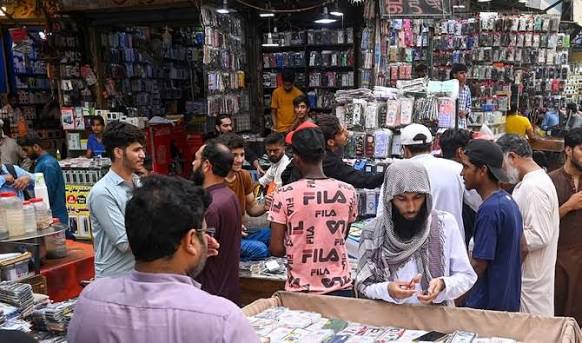
ISLAMABAD: Pakistan rolled out a mobile application on Wednesday to formalize its Fixed Tax Asaan Scheme, a bid to draw millions of small traders into the tax system through a simplified, app-based filing process that officials say removes the friction that doomed past efforts.
The scheme, unveiled ahead of the federal budget and now live through the app, applies to shopkeepers and traders with annual turnover of up to Rs200 million ($720,585). It sets a fixed levy of 1% of declared sales, inclusive of withholding tax, with a minimum payment of Rs25,000 regardless of income level.
State Minister for Finance Bilal Azhar Kayani, addressing a press conference alongside Finance Minister Muhammad Aurangzeb, Federal Board of Revenue Chairman Rashid Mahmood Langrial and trader representatives, called the launch the “practical start” of a project developed over several months in consultation with the trading community.
“This app is available for those traders who are not yet on the tax net, and it’s also available for those already in the tax net,” Kayani said. “The only condition is that you are a trader whose annual sales are less than 20 crores.”
Filing Made Simple
The app — branded “Asaan Tajir” and available now on the Google Play Store, with an Apple Store version to follow — offers a form in Urdu, with Pashto, Balochi and Sindhi versions expected by the first week of September, according to Kayani.
Registration generates a payment slip ID, allowing traders to settle their tax bill directly through the app. Once payment clears, users are notified of their inclusion in the scheme and updated filer status, along with details of the benefits available to them.
Enrolled traders receive a digital version of a compliance plate for display at their premises — a marker Kayani said would shield them from unsolicited scrutiny. “No FBR official can enter the premises of a shop displaying the plate to question the trader on tax matters,” he said. Physical plates, which Kayani said carry security features and will be distributed free to traders who register by the filing deadline, will be available from regional offices within two weeks and are expected to cost no more than Rs1,500 for those who register later.
Traders who opt into the scheme are exempt from installing point-of-sale machines and from acting as withholding agents, according to Kayani.
Existing filers may also join, provided their turnover has stayed under Rs200 million in each of the past three years — though their minimum liability will match whatever they paid in the prior year rather than the flat Rs25,000 floor.
A Second Attempt at an Old Problem
The launch is Islamabad’s latest attempt to widen a tax base that has long lagged regional peers. Pakistan’s tax-to-GDP ratio sits at roughly 10%, among the lowest globally, a gap that has shaped years of engagement with the International Monetary Fund over fiscal reform.
The FBR collected a record Rs11.7 trillion ($42.2 billion) in the fiscal year ended June 30, a 26% increase from the prior year, though it fell just short of a revised Rs11.9 trillion target. The government has set a Rs15 trillion ($53.96 billion) collection target for the current fiscal year, and authorities are separately developing an artificial-intelligence-based “faceless” system for inland revenue operations intended to limit direct contact between taxpayers and officials.
Kayani said the government examined why earlier trader tax schemes had failed before designing this one. “That is why an out-of-the-box approach has been thought for small shopkeepers,” he said, adding that the scheme relies on buy-in from shopkeepers themselves and was shaped in consultation with trader representatives Ajmal Baloch and Kashif Chaudhry.
Participation is optional. Traders may instead remain in the regular tax regime, Aurangzeb said. “It has been made optional,” he said. “In the sense that if you want to go in the regular scheme, you can go in the regular scheme.”
Officials Voice Confidence
Aurangzeb told reporters that small businesses have long sought a simpler compliance framework, and said the FBR had “gone out of its way” to make the new scheme workable. He argued that broad participation across income groups is a precondition for a functioning tax system.
“The reason is that if any section of Pakistan does not come into the mainstream, then the tax system cannot run,” he said. “Sometimes it is about the salary class, sometimes it is about corporate, sometimes it is about our multinationals. When you are a country of 25 to 26 crore people, you have to deal with the FBR.”
Langrial, the FBR chairman, expressed confidence in the scheme’s design. “I think there is no flaw in it,” he said. “I am sure it will be a roaring success.”
Chaudhry, president of the Central Association of Traders, urged members to comply. “You have the option to pay tax on less income, at least Rs25,000, and you have to pay 1% tax on turnover,” he said, adding that failing to file returns “is a crime.”
Aurangzeb said the government intends to keep working with chambers of commerce, which he described as central to extending the scheme’s reach, as implementation continues.
Copyright © 2021 Independent Pakistan | All rights reserved