By Staff Reporter
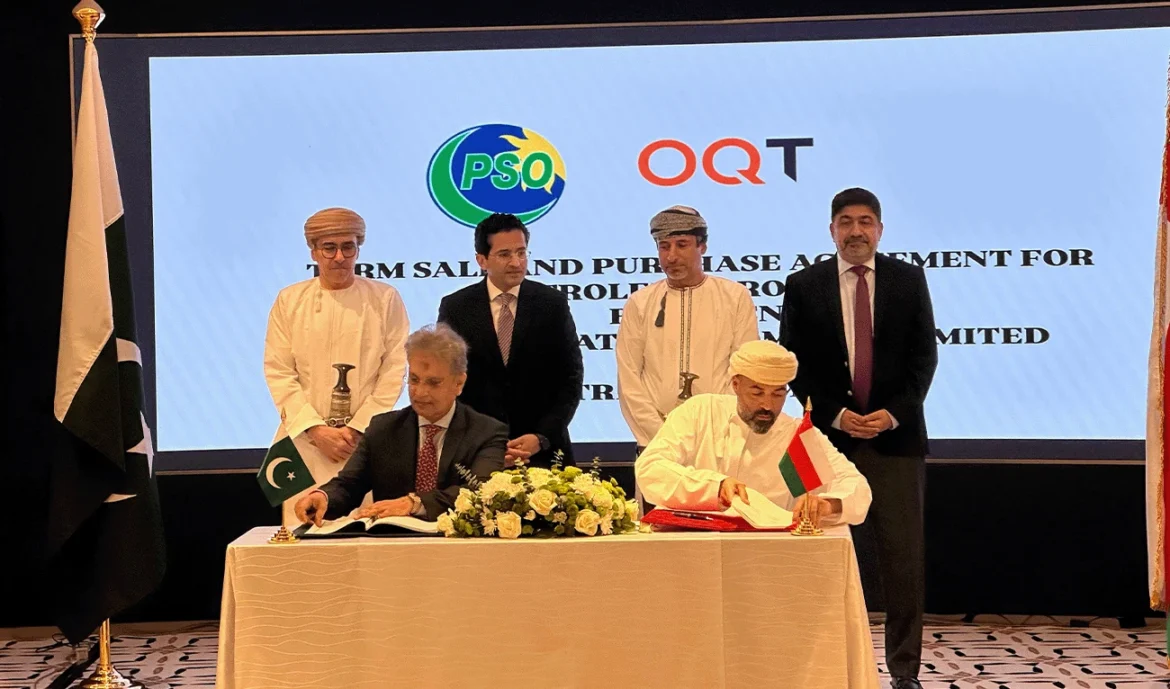
ISLAMABAD: Pakistan State Oil Co. signed a petroleum supply agreement with Oman’s OQ Trading that comes with a $200 million credit facility, giving the import-dependent country another fuel source while the Iran war keeps shipments through the Strait of Hormuz in doubt.
The agreement was signed in Muscat in the presence of Pakistan’s Petroleum Minister Ali Pervaiz Malik and Oman’s Minister of Energy and Minerals Salim Al Aufi, according to state-run Radio Pakistan. It establishes a regular commercial framework for supplying petroleum products to PSO, the country’s largest fuel supplier. OQ Trading is the Omani government’s international energy and commodity trading arm.
Pakistani officials described the pact as a step toward strengthening energy security and widening the range of countries from which Pakistan buys fuel. The terms of the credit line, including pricing, tenor and repayment, weren’t disclosed.
“Welcoming the agreement, both Ministers expressed confidence that its implementation would further strengthen Pakistan-Oman energy ties and support Pakistan’s efforts to enhance energy security through diversification of energy imports,” Pakistan’s Petroleum Division said in a statement. “The agreement marks an important milestone in the commercial relationship between the two companies and provides a structured arrangement for petroleum product supplies from OQT to PSO, supporting supply reliability amid continued volatility in regional energy markets.”
The credit facility gives PSO financing for fuel purchases from Oman, a Gulf producer whose export terminals on the Gulf of Oman and Arabian Sea lie outside the strait. Pakistan relies on imports for roughly 70% of its petrol consumption.
OQ Trading has already become a meaningful supplier. It delivered more than 1 million metric tons of petrol to PSO in 2026, and its LPG shipments to Pakistan are expected to top 120,000 tons by the end of the year. Pakistan took three petrol cargoes and one diesel cargo from Omani ports in March alone.
The LPG volume is small against demand. Pakistan consumes about 2.4 million tons of the fuel a year and produces only a fraction domestically, so the expected Omani deliveries equal roughly 5% of annual use. Islamabad has been looking at Saudi Arabia and Oman for additional LPG imports, Arab News reported.
The commercial agreement rests on an inter-governmental accord. Pakistan and Oman signed it on May 14, 2018, naming PSO and OQ Trading, then known as Oman Trading International, as their respective counterparties. The Economic Coordination Committee, chaired by Finance Minister Muhammad Aurangzeb, approved the sale and purchase agreement in August. PSO later disclosed that it had signed the contract on Oct. 8, after approval from its board and the federal cabinet. The report from Muscat didn’t say whether the credit facility was part of that earlier contract or was agreed separately.
The deal comes after months of disruption to Gulf energy flows. Pakistan raised petrol and diesel prices by 55 rupees a liter in March and introduced austerity measures to curb consumption. Qatar, Pakistan’s long-term LNG supplier, has declared force majeure, and K-Electric has warned of possible power load management because of a nationwide shortage of regasified LNG.
Diesel is a particular exposure. Pakistan relies on long-term supplies from Kuwait for PSO, and those cargoes must pass through the strait, Dawn reported. PSO said last month it kept fuel supplies uninterrupted since the crisis began.
Muhammad Saad Ali, head of research at Lucky Investments Ltd., said the Oman agreement works mainly as a backup in case the conflict escalates. Its commercial value, he said, will depend on whether Oman offers discounts comparable to those PSO gets from Kuwait Petroleum.
During the meeting in Muscat, the two ministers agreed to expand cooperation in oil, gas and minerals. They welcomed the creation of a joint working group on oil and gas and said they would use it to advance work in energy and minerals. Both sides also reaffirmed their commitment to exploring new trade and investment opportunities in the energy sector.
How long the disruption lasts remains the main uncertainty for Pakistan’s fuel planning. Pakistan’s foreign minister has said he is hopeful of a US-Iran deal and has warned against a prolonged war.
Copyright © 2021 Independent Pakistan | All rights reserved