By Staff Reporter
ISLAMABAD: The death toll from Pakistan’s monsoon rains has climbed past 100, with the country’s disaster management authority confirming ten further fatalities in the 24 hours to Sunday afternoon, as officials warned that another spell of heavy rain is expected to sweep the north of the country within days.
The National Disaster Management Authority (NDMA) said seven people had died in Punjab and three in Khyber Pakhtunkhwa, bringing the nationwide death toll since the rains began on 26 June to 107. A separate update issued later on Sunday put the figure at 108, with the number of injured nationwide reaching 344.
Khyber Pakhtunkhwa remains the worst-affected province, recording 55 deaths, followed by Punjab with 36. Azad Jammu and Kashmir has recorded seven deaths, Balochistan six, Sindh two and Gilgit-Baltistan one.
The NDMA’s latest situation report, covering the 24 hours to 1pm on Sunday, recorded two deaths each in Punjab’s Gujrat and Okara districts, with one fatality apiece in Sargodha, Narowal and Sialkot. In Khyber Pakhtunkhwa, two people died in Hangu and one in Shangla. The authority said the deaths were caused by house collapses, electrocution and drowning — a pattern that has defined much of this year’s monsoon season, as ageing infrastructure and mud-brick housing in flood-prone districts buckle under sustained rainfall.
At least 47 people were injured across Punjab during the same period, with three more hurt in Hangu.
Rivers “within safe limits” but under close watch
A high-level government committee overseeing the national response met in Islamabad on Sunday and concluded that water levels in Pakistan’s major rivers remain within safe limits, even as the death toll continued to rise.
The Emergency Response Committee, established by Prime Minister Shehbaz Sharif to coordinate monsoon preparedness across the country, was told that the broader riverine flood picture remained stable. The committee convened at the National Emergencies Operation Centre in Islamabad.
“The Committee was informed that the overall riverine flood situation remains normal, with water flows in the major rivers currently within safe limits,” the NDMA said in a statement, adding that monitoring of weather systems and vulnerable areas was continuing “to ensure timely dissemination of early warnings and prompt response to any emerging situation.”
The committee, which includes representatives from provincial disaster authorities, reviewed relief supplies, emergency communications, evacuation planning and inter-agency coordination across the country.
Climate Change Minister Dr Musadik Malik told the meeting that early warnings needed to reach at-risk communities using every available channel, while Planning Minister Ahsan Iqbal called for closer coordination between federal, provincial and district institutions to speed up decision-making and the mobilisation of resources. He directed departments to maintain a high state of readiness for the remainder of the season, according to the NDMA statement.
The rains follow a pattern that has become familiar in recent monsoon seasons. Pakistan’s four major rivers — the Ravi, Chenab, Jhelum and Sutlej — swelled sharply during last year’s monsoon, triggering floods across Punjab that forced the government to relocate millions of people to safer ground.
Ravi and Chenab flagged as high risk
Despite the committee’s assessment that river levels remain broadly under control, the Meteorological Department’s Flood Forecasting Division placed both the Ravi and Chenab on a high-risk category on its flood severity scale on Sunday.
According to the division’s 6pm update, most major rivers were flowing at normal or low flood levels. The Ravi, however, was registering a medium-level flood with rising flows at the Sidhnai headworks, though levels at Jassar and Shahdara remained normal and Balloki was in low flood. The Indus was normal at three barrages and in low flood at four others, while the Jhelum and Sutlej held at normal levels. Flows in the Chenab had eased to low-level flood at the Marala, Khanki, Qadirabad and Trimmu barrages.
An earlier update at 11.30am had forecast that the Indus at Kalabagh, Chashma, Taunsa and Guddu would remain in low flood for the following 48 hours.
Punjab’s Provincial Disaster Management Authority said on Sunday morning that although rivers in the province continued to rise, flows across the waterway network had stayed stable over the previous day. The authority reported a medium-level flood in Narowal’s Basantar Nullah and a high-level flood in Wazirabad’s Phalko Nullah, where the flow reached 5,000 cusecs.
The PDMA’s director general repeated an appeal for residents living on floodplains to move to safer ground immediately, saying the provincial government had put the necessary arrangements in place for those displaced. “All basic facilities and medicines will be provided in the flood relief camps,” the director general said.
Lahore records 450mm of rain in five days
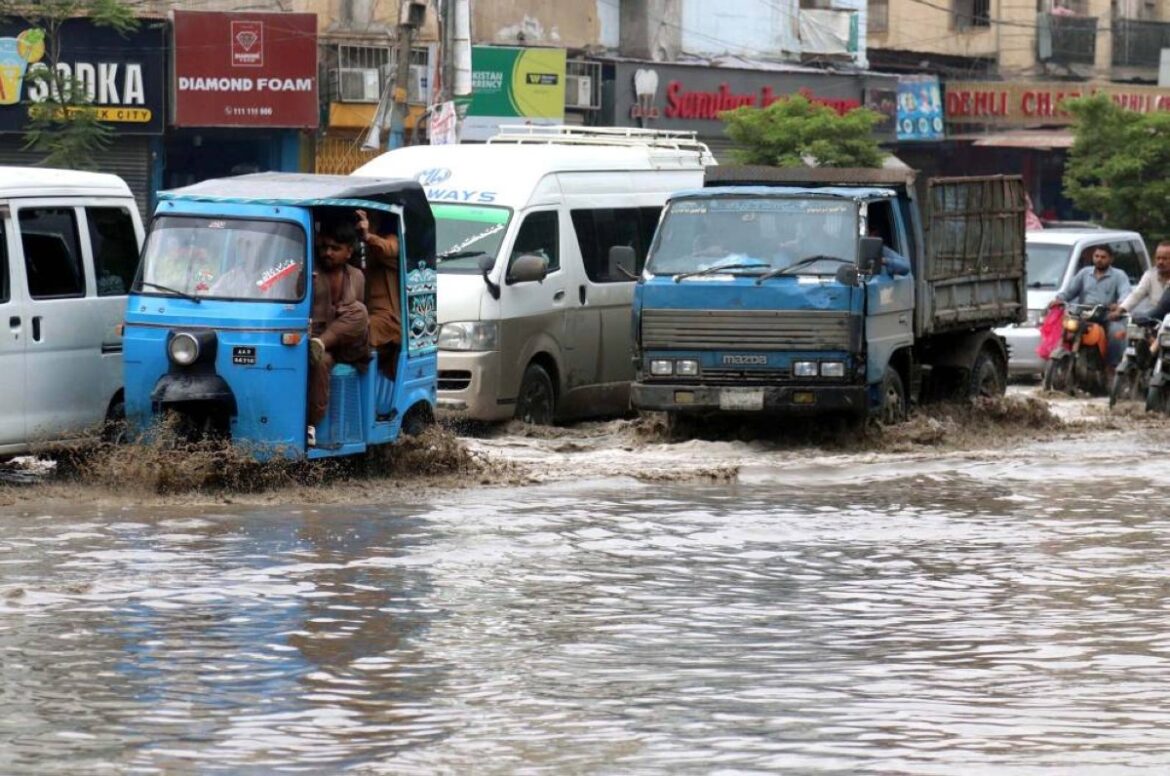
Rainfall data released separately by the PDMA showed the scale of the downpours across northern and central Punjab over the past day. Noorpur Thal recorded 115mm, Gujranwala 107mm, Gujrat 94mm, Narowal 68mm, Mandi Bahauddin 65mm, Sialkot Airport 52mm, Okara 46mm, Jauharabad 40mm and Sargodha 38mm.
Lahore received 37mm in the same period, matched by Mangla, while Jhelum recorded 32mm, Sheikhupura 28mm, Hafizabad and Kasur 27mm each, Chakwal 20mm, Bahawalnagar 18mm and Khanewal 16mm. A PDMA spokesperson said Lahore had recorded 450mm of rain over the preceding five days alone, with Rawalpindi, Faisalabad, Multan, Attock, Murree and Bahawalpur also affected.
The authority warned of a continued risk of flooding in rivers, canals and low-lying areas, along with landslides in hill stations such as Murree, and cautioned that sustained heavy rain could damage mud-brick housing — one of the leading causes of death recorded so far this season.
Fresh spell of rain forecast from Tuesday
The Meteorological Department said a new wet spell was expected to develop from 29 July across the upper catchments of all major rivers, as well as Islamabad, upper Punjab, Azad Kashmir, Khyber Pakhtunkhwa and Gilgit-Baltistan. Officials said there was no indication of flood-generating rainfall before 28 July.
In the shorter term, the department forecast scattered rain, winds and thunderstorms over the upper river catchments, Islamabad, Azad Kashmir and Gilgit-Baltistan up to Monday afternoon.
For Khyber Pakhtunkhwa, rain is expected in Abbottabad, Battagram, Buner, Chitral, Haripur, Kohat, Kohistan, Mansehra, Mardan, Nowshera, Shangla, Swabi, Swat, Tor Ghar and Dir.
In Punjab, the forecast covers Attock, Bahawalnagar, Bahawalpur, Chakwal, Chiniot, Dera Ghazi Khan, Faisalabad, Gujranwala, Gujrat, Hafizabad, Jhang, Jhelum, Kasur, Khanewal, Khushab, Lahore, Lodhran, Mandi Bahauddin, Multan, Muzaffargarh, Nankana Sahib, Narowal, Okara, Pakpattan, Rawalpindi, Sahiwal, Sargodha, Sheikhupura, Sialkot, Toba Tek Singh and Vehari.
In Sindh, rain is forecast for Badin, Hyderabad, Matiari, Mirpurkhas, Sanghar, Tando Allahyar, Tando Muhammad Khan, Tharparkar and Umerkot, while in Balochistan, Barkhan, Duki, Kalat, Khuzdar, Kohlu, Loralai and Musakhel are expected to see rainfall.
Karachi is forecast to remain cloudy and humid, with light rain or drizzle and the possibility of thunderstorms on the city’s outskirts on Sunday. The Meteorological Department said the cloudy conditions would persist into Monday and Tuesday, with isolated drizzle likely across the metropolis.
Copyright © 2021 Independent Pakistan | All rights reserved