By Staff Reporter
ISLAMABAD: Pakistan on Thursday firmly rejected any involvement in the US-brokered Abraham Accords, insisting that its recent decision to join a Gaza-focused peace initiative did not signal a shift in its longstanding support for Palestinian self-determination or recognition of Israel.
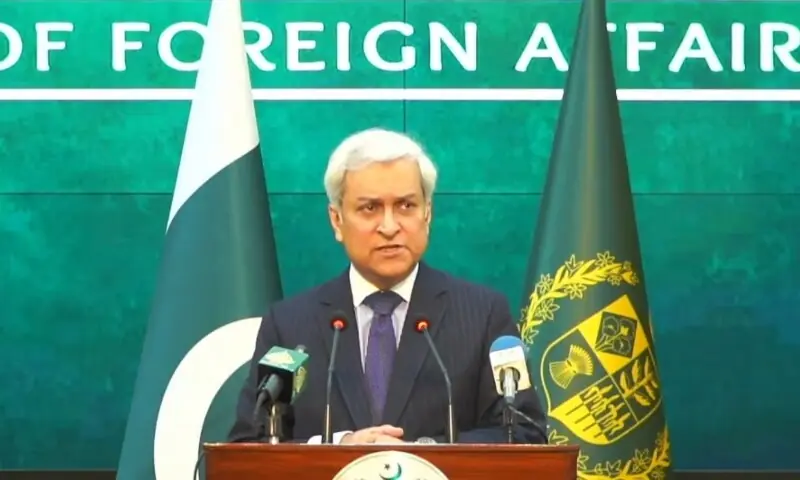
Foreign Office spokesperson Tahir Andrabi, addressing reporters at a weekly briefing, dismissed speculation linking Islamabad’s participation in the Board of Peace to the normalization pacts between Israel and several Arab states, describing such reports as a “misconception.” “Joining the Board of Peace has no connection with the Abraham Accords and does not represent any deviation from Pakistan’s principled position on Palestine,” Andrabi said.
The Abraham Accords, signed in 2020 under then-U.S. President Donald Trump, formalised diplomatic, economic and security relations between Israel and countries including the United Arab Emirates, Bahrain, Sudan and Morocco. Pakistan has consistently refused to recognize Israel, conditioning any normalization on a resolution to the Palestinian issue that ensures an independent state.
Prime Minister Shehbaz Sharif signed the Board of Peace charter earlier this month in Davos alongside other leaders, as part of an effort authorized by U.N. Security Council Resolution 2803 in November 2025. The board aims to oversee ceasefire implementation, humanitarian aid and reconstruction in Gaza, with a broader mandate for peace-building in conflict-affected areas.
Andrabi said Pakistan’s involvement was driven by three core objectives: consolidating and sustaining the ceasefire in Gaza, supporting post-conflict reconstruction, and advancing a just and lasting peace grounded in the Palestinian people’s right to self-determination. “Our basic objectives of joining the Board of Peace are three: one is to consolidate and sustain ceasefire, second is to support reconstruction, and third is to advance … a lasting peace based on the Palestinian right to self-determination.”
He noted that Pakistan was not acting unilaterally, pointing out that seven other Muslim-majority nations – Saudi Arabia, Turkiye, Egypt, Jordan, the United Arab Emirates, Indonesia and Qatar – had also joined the initiative. “Pakistan, joining the Board of Peace should be seen in the continuum of the initiative by eight Muslim countries to promote peace in Gaza, leading toward a lasting solution to the Palestinian question,” Andrabi added. “All eight countries have joined the Board of Peace with a single collective voice. The Board of Peace offers a viable glimmer of hope for Gaza and for wider Palestinian questions.”
The spokesperson clarified that the board did not supplant the United Nations, but complemented it under the U.N. resolution. He said Pakistan had not committed to deploying troops to the International Stabilization Force (ISF) for Gaza, and membership in the board carried no such obligation. “We hope that the framework established by the Board of Peace will lead to concrete steps toward permanent ceasefire, expanded humanitarian assistance, and the reconstruction of Gaza, and in advance Palestinian people’s right to self-determination,” Andrabi said.
He reiterated Pakistan’s vision for a resolution, saying the process should culminate in “an independent, sovereign, contiguous state of Palestine, based on the pre-1967 borders, with Al-Quds Al-Sharif as its capital.” “Pakistan looks forward to continuing to play a constructive role as part of the Board of Peace in achieving these goals and ending the suffering of our Palestinian brothers and sisters,” he added. The decision to join followed consultations within the Foreign Ministry and with all relevant stakeholders, Andrabi said, in line with federal government procedures. Representation on the board would vary by meeting level, such as summit or ministerial, with membership terms set at three years initially, without categories tied to financial contributions.
Andrabi also addressed a recent U.S. travel advisory for Pakistan, calling it an “update” rather than a downgrade. He said it had removed some prior security restrictions, easing travel for American citizens. “Pakistan is a safe and open country for international travellers, and the government is working to ensure the convenience and safety of tourists,” he said, adding that Islamabad and Washington were in contact through diplomatic channels to facilitate bilateral travel.
Turning to regional tensions, Andrabi expressed Pakistan’s opposition to any use of force against Iran amid reports of potential U.S. military action and escalating U.S.-Iran frictions. “Pakistan remains firmly opposed to interference in internal affairs of our brotherly country, Iran. We have opposed the use of force. We have opposed the imposition of sanctions and this position continues,” he said.
The comments come against a backdrop of widespread protests in Iran over economic woes, inflation and government policies, with human rights groups reporting hundreds killed and thousands arrested in crackdowns. U.S. deployments in the region, including an aircraft carrier group, have heightened fears of conflict, with Washington pressing Tehran on its nuclear program and other issues.
Andrabi noted that Deputy Prime Minister and Foreign Minister Ishaq Dar had spoken twice by phone with his Iranian counterpart recently and engaged U.S. officials at the World Economic Forum in Davos. “So, our advocacy for peace, diplomacy continues and this remains our stated position,” he said. “This region cannot afford war, turmoil, and because this, in essence, stops the economic development, peace, and prosperity. So, we hope that peace and diplomacy will prevail.”
In response to a court judgment convicting lawyer Imaan Mazari-Hazir and her husband Hadi Ali Chattha, Andrabi distanced the government from the judge’s reference to “terrorist states,” including Iran. “This judgment […] is the view of the learned judge. Pakistan, of course, does not subscribe to this opinion,” he said. “And frankly, this kind of designation does not exist either under the United Nations (UN) or under international law.”
The couple was sentenced on Jan. 24 to a total of 17 years in prison under Pakistan’s electronic crimes law for social media posts, with fines totaling 36 million rupees each. The judge had noted Pakistan was not on any such list, while mentioning Cuba, North Korea, Iran and Syria.
Andrabi also addressed European Union concerns over the convictions, voiced by EU spokesperson Anouar El Anouni, who said they undermined freedom of expression and lawyers’ independence. “This is a domestic affair of Pakistan, the trial and conviction took place under our local laws through a judicial process,” Andrabi said. “The relevant individuals have a right to appeal and have a right to a judicial recourse. As such, there is domestic remedy available to these individuals. Whilst we remain engaged with the EU on all issues, we do make a distinction about our domestic affairs.”
Finally, on U.S. restrictions on immigrant visas for certain countries including Pakistan, Andrabi said discussions were ongoing in both capitals. “This matter has been under discussion in Islamabad as well as in Washington through our diplomatic channels. This is an ongoing review,” he said. “Our understanding is that eventually Pakistan will be excluded from this list. Our talks with the US, our diplomatic exchanges with the US are geared towards this objective.”
Copyright © 2021 Independent Pakistan | All rights reserved